Classificação / Names
Nomes comuns | Sinónimos | Catalog of Fishes(Género, Espécies) | ITIS | CoL | WoRMS | Cloffa
>
Gobiiformes (Gobies) >
Gobiidae (Gobies) > Gobionellinae
Etymology: Nesogobius: Greek,nessa = island + Latin, gobius = gudgeon (Ref. 45335); greeni: Named after R.H. Green, formerly of the Queen Victoria Museum, Launceston, Tasmania, who collected much of the type material used.
Eponymy: Dr Robert ‘Bob’ Geoffrey Hewett Green (1925–2013) was a Tasmanian farmer. [...] (Ref. 128868), visit book page.
More on authors: Hoese & Larson.
Environment: milieu / climate zone / intervalo de profundidade / distribution range
Ecologia
marinhas demersal; intervalo de profundidade 0 - 8 m (Ref. 76773). Subtropical
Indo-Pacific: known from Merimbula, New South Wales, throughout Tasmania, Victoria, and west to Kangaroo I., South Australia.
Tamanho / Peso / Idade
Maturidade: Lm ? range ? - ? cm
Max length : 3.1 cm SL macho/indeterminado; (Ref. 76773); 3.0 cm SL (female)
Descrição breve
Chaves de identificação | Morfologia | Morfometria
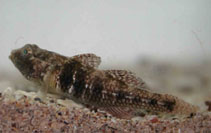
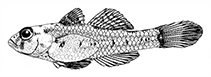
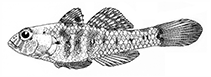
Espinhos dorsais (total) : 7; Raios dorsais moles (total) : 6 - 7; Espinhos anais: 0; Raios anais moles: 8 - 10. This species differs by the following characters: 1st D VII; 2nd D 8-11, rarely 8 or 11; A 8-10; no spine in 2nd dorsal or anal fin; branched caudal-fin rays 11-12; pectoral-fin rays 16-20; no head pores; wide gill opening reaching forward to below or slightly before posterior preopercular margin; scales reaching to above preoperculum in the head, sometimes almost to eye; dorsal mid-line of nape naked or rarely with a single scale just before 1st dorsal fin, but scales often present just to side of midline; body scales ctenoid, in 25-30 rows; midline of belly without scales or with a few scales posteriorly; pectoral base usually without scales or with 1 or 2 cycloid scales ventrally; area before pelvic fin n with cycloid scales; body deep, depth at anal origin subequal to or greater than caudal fin length; 1st dorsal fin low, with rounded or triangular shaped margin (Ref. 76773).
Inhabits sand around sea grass beds and around rocky reefs (Ref. 76773).
Life cycle and mating behavior
Maturidade | Reprodução | Desova | Ovos | Fecundidade | Larvas
Hoese, D.F. and H.K. Larson, 2006. Description of two new species of Nesogobius (Pisces: Gobioidei: Gobiidae) from Southern Australia. Mem. Mus. Victoria 63(1):7-13. (Ref. 76773)
Categoria na Lista Vermelha da IUCN (Ref. 130435: Version 2025-1)
Utilização humana
Ferramentas
Relatórios especiais
Descarregue XML
Fontes da internet
Estimates based on models
Preferred temperature (Ref.
123201): 13.2 - 18.5, mean 16.8 °C (based on 318 cells).
Phylogenetic diversity index (Ref.
82804): PD
50 = 0.5312 [Uniqueness, from 0.5 = low to 2.0 = high].
Bayesian length-weight: a=0.00724 (0.00338 - 0.01553), b=3.05 (2.87 - 3.23), in cm total length, based on LWR estimates for this (Sub)family-body shape (Ref.
93245).
Nível Trófico (Ref.
69278): 3.2 ±0.5 se; based on size and trophs of closest relatives
Resiliência (Ref.
120179): Elevada, tempo mínimo de duplicação da população menor que 15 meses (Preliminary K or Fecundity.).
Fishing Vulnerability (Ref.
59153): Low vulnerability (10 of 100).
🛈