



Cephalopholis sexmaculata (Rüppell, 1830)
Sixblotch hind
Adicionar sua observação em Fish Watcher
| Native range | All suitable habitat | Point map | Year 2050 |

|
| This map was computer-generated and has not yet been reviewed. |
| Cephalopholis sexmaculata AquaMaps Data sources: GBIF OBIS |
Carregue seu(sua) Fotos e vídeos
Fotos | vídeos | Selos, moedas, diversos. | Imagem do Google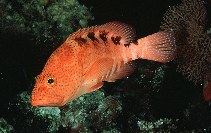 Cephalopholis sexmaculata
Foto de Randall, J.E.
Fotos | vídeos | Selos, moedas, diversos. | Imagem do Google
Foto de Randall, J.E.
Classificação / Nomes Nomes comuns | Sinônimos | Catalog of Fishes(Gênero, Espécies) | ITIS | CoL | WoRMS | Cloffa
> Perciformes/Serranoidei (Groupers) > Epinephelidae (Groupers)
Etymology: Cephalopholis: Greek, kephale = head + Greek, pholis = scale (Ref. 45335).
More on author: Rüppell.
Etymology: Cephalopholis: Greek, kephale = head + Greek, pholis = scale (Ref. 45335).
More on author: Rüppell.
Meio ambiente: milieu / Zona climática / intervalo de profundidade / faixa de distribuição Ecologia
marinhas associadas(os) a recifes; não migratória; intervalo de profundidade 0 - 150 m (Ref. 9710). Tropical; 34°N - 23°S, 31°E - 138°W (Ref. 5222)
Distribuição Territórios | Áreas da FAO | Ecossistemas | Ocorrências | Mapa de pontos | Introduções | Faunafri
Indo-Pacific: Red Sea to South Africa and eastward to French Polynesia. Reported from the Arafura Sea (Ref. 9819). Reports by Heemstra & Randall (1984, Ref. 3153) from the Gulf of Oman, Pakistan, India, and Sri Lanka are unsubstantiated. Absent from the Persian Gulf and is not yet known from Lakshadweep Islands.
Tamanho / Peso / Idade
Maturidade: Lm ? range ? - ? cm
Max length : 50.0 cm TL macho/indeterminado; (Ref. 11441); peso máx. publicado: 7.0 kg (Ref. 30874)
Max length : 50.0 cm TL macho/indeterminado; (Ref. 11441); peso máx. publicado: 7.0 kg (Ref. 30874)
Descrição suscinta Chaves de identificação | Morfologia | Morfometria
Espinhos dorsais (total) : 9; Raios dorsais (total) : 14 - 16; Espinhos anais: 3; Raios anais : 9. This species is distinguished by the following characters: greatest body depth 2.5-3.0 times in standard length (for specimens 13-39 cm SL); head length 2.3-2.5 times in SL; longitudinal scale series 95-108; ctenoid scales on body, including abdomen; caudal fin rounded; pelvic fins not reaching or just about the anus, 1.9-2.3 in HL. Colour of body orange-red, with small blue spots sparsely scattered but more densely on head and median fins; head also with elongated blue spots and lines; body with 4 dark bars (sometimes very faint) merging dorsally with blackish blotches at base of dorsal fin and extending onto the fin; 2 similar but smaller dark bar/blotches on caudal peduncle (Ref. 39231, 90102).
Body shape (shape guide): fusiform / normal; Cross section: oval.
Body shape (shape guide): fusiform / normal; Cross section: oval.
Adults are found in rich coastal to outer reefs, usually along deep walls with caves, rich with invertebrate growth such as large sponges or soft corals (Ref. 48635). They occur singly or in small groups (Ref. 90102). A secretive species which are active nocturnally in shallow water and diurnally in deeper water (Ref. 5222). They are often seen with the cleaner shrimp Periclimenes elegans (Ref. 37816). Adults feed mainly on fishes (Ref. 5222) and reach sexual maturity at 25 cm SL (Ref. 89707). Probably of commercial interest to certain local fisheries. Are caught with hook-and-line, traps, and spear (Ref. 39231). Minimum depth reported taken from Ref. 128797.
Ciclo de vida ou comportamento de acasalamento Maturidade | Reprodução | Desova | Ovos | Fecundidade | Larvas
Referência principal
Carregar suas referências | Referências | Coordenador | Colaboradores
Heemstra, P.C. and J.E. Randall, 1993. FAO Species Catalogue. Vol. 16. Groupers of the world (family Serranidae, subfamily Epinephelinae). An annotated and illustrated catalogue of the grouper, rockcod, hind, coral grouper and lyretail species known to date. Rome: FAO. FAO Fish. Synop. 125(16):382 p. (Ref. 5222)
Status na Lista Vermelha da UICN (Ref. 130435: Version 2025-2 (Global))
Segura ou pouco preocupante (LC) ; Date assessed: 16 October 2017
CITES
Not Evaluated
Ameaça para os humanos
Harmless
Uso pelos humanos
Pescarias: pesca de subsistência; peixe esportivo: sim
FAO - Publication: search | FishSource | Sea Around Us
Mais informação
Ecologia Trófica
Itens alimentares (presas)
Composição da dieta
Consumo alimentar
Rações alimentares
Predadores
Itens alimentares (presas)
Composição da dieta
Consumo alimentar
Rações alimentares
Predadores
Dinâmica populacional
Parâmetros de crescimento
Idade máxima / tamanhos
Relação comprimento-peso.
Relação comprimento-comprimento.
Frequências de comprimento
Conversão de massa
Recrutamento
Abundância
Parâmetros de crescimento
Idade máxima / tamanhos
Relação comprimento-peso.
Relação comprimento-comprimento.
Frequências de comprimento
Conversão de massa
Recrutamento
Abundância
Ciclo de vida
Reprodução
Maturidade
Maturidade/Rel. das guelras
Fecundidade
Desova
Agregações de desova
Ovos
Desenvolvimento dos ovos
Larvas
Dinâmica larval
Reprodução
Maturidade
Maturidade/Rel. das guelras
Fecundidade
Desova
Agregações de desova
Ovos
Desenvolvimento dos ovos
Larvas
Dinâmica larval
Anatomia
Área branquial
Cérebro
Otólito
Área branquial
Cérebro
Otólito
Fisiologia
Composição corporal
Nutrientes
Consumo de oxigênio
Tipo de natação
Velocidade de natação
Pigmentos visuais
Som de peixe
Doenças e Parasitas
Toxicidade (LC50s)
Composição corporal
Nutrientes
Consumo de oxigênio
Tipo de natação
Velocidade de natação
Pigmentos visuais
Som de peixe
Doenças e Parasitas
Toxicidade (LC50s)
Genética
genoma
Genética
Heterozigosidade
Hereditariedade
Diversidade genética
genoma
Genética
Heterozigosidade
Hereditariedade
Diversidade genética
Relacionado a humanos
Sistemas de aquicultura
Perfis para aquacultura
Estirpes
Casos de Ciguatera
Selos, moedas, diversos.
Sistemas de aquicultura
Perfis para aquacultura
Estirpes
Casos de Ciguatera
Selos, moedas, diversos.
Ferramentas
Questionário orgânico | Livro eletrônico | Guia de campo | Chaves de identificação | Ferramenta auxiliar de frequências de comprimento | Ferramenta sobre a história de vida | Mapa de pontos |
Catch-MSY |
Relatórios especiais
Checar Manutenção em Aquário | Checar Planilhas de Fatos sobre as Espécies | Checar Planilhas de Fatos sobre Aquicultura
Baixar XML
Fontes da internet
AFORO (otoliths) | Aquatic Commons | BHL | Cloffa | Websites from users | Checar Observador de Peixes (FishWatcher) | CISTI | Catalog of Fishes: Gênero, Espécies | DiscoverLife | ECOTOX | FAO - Publication: search | Faunafri | Fishipedia | Fishtrace | GloBI | Google Books | Google Scholar | Google | IGFA World Record | Bases de dados nacionais | OneZoom | Open Tree of Life | Otolith Atlas of Taiwan Fishes | PubMed | Reef Life Survey | Socotra Atlas | TreeBase | Árvore da vida | Wikipedia: Ir para, procura | World Records Freshwater Fishing | Registro zoológico
Estimativas baseadas em modelos
Temperatura preferida (Ref. 123201): 23.7 - 28.5, mean 27.2 °C (based on 881 cells).
Índice de diversidade filogenética (Ref. 82804): PD50 = 0.5000 [Uniqueness, from 0.5 = low to 2.0 = high].
Bayesian length-weight: a=0.01230 (0.00576 - 0.02626), b=3.04 (2.87 - 3.21), in cm total length, based on LWR estimates for this Genus-body shape (Ref. 93245).
Nível Trófico (Ref. 69278): 4.0 ±0.66 se; based on food items.
Resiliência (Ref. 120179): médio(a), tempo mínimo de duplicação da população 1,4 - 4,4 anos (Preliminary K or Fecundity.).
Nutrientes (Ref. 124155): Calcium = 42.7 [25.3, 74.7] mg/100g; Iron = 0.56 [0.32, 1.08] mg/100g; Protein = 18.5 [16.7, 20.1] %; Omega3 = 0.175 [0.110, 0.278] g/100g; Selenium = 48 [26, 84] μg/100g; VitaminA = 116 [44, 354] μg/100g; Zinc = 0.721 [0.509, 1.162] mg/100g (wet weight);