>
Ophidiiformes (Cusk eels) >
Dinematichthyidae (Viviparous brotula)
Etymology: Ungusurculus: Name from Latin words 'ungulus' (= claw) and 'surculus' (= grapevine tendril), refers to the functional analogy with the pseudoclaspers and the specific shape of the inner pseudoclasper; sundaensis: Named for the Sunda Archipelago of Indonesia,.
More on authors: Schwarzhans & Møller.
Environment: milieu / climate zone / kisaran kedalaman / distribution range
Ekologi
laut berasosiasi dengan karang; kisaran kedalaman 0 - 8 m (Ref. 90102). Tropical
Western Pacific: Indonesia.
Size / Weight / umur
Kematangan: Lm ? range ? - ? cm
Max length : 5.4 cm SL jantan/; (Ref. 76869)
deskripsi pendek
Kunci identifiaksi (pengenalan) | Morfologi | Morfometrik
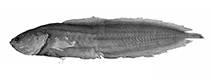
duri punggung lunak (Keseluruhan (total)) : 79 - 86; Sirip dubur lunak: 60 - 64; vertebrata, bertulang belakang: 42 - 43. This species is distinguished by the following characters: D 79-86, A 60-64, D/A 26, V in D 2.2-2.3; vertebrae 12+30-31=42-43; anterior nostril located 1/4 distance from upper lip to aggregate distance to anterior margin of eye; free pseudoclaspers 2 pairs, the outer pseudoclasper is wing-shaped with broad base and distally widened supporter with anterior hook, prominent knob on inner face of outer pseudoclasper fitting into opening of inner pseudoclasper, the inner one is long, very massive, stalked with narrow base, distally with claw-like, outwardly directed strong spines, inner and outer pseudoclasper matching together in lock/key mode; cheeks with 6 scale rows on upper part and 4 rows on lower part; no upper preopercular pore; otolith elongate, its length to height is 2.3-2.4, with pointed anterior and posterior tips, symmetrical pre- and postdorsal angles, the section in between straight, short sulcus with fused colliculi, its centre anterior of centre of otolith, inclined about 5°, otolith length to sulcus length is 2.4-2.5 (Ref. 76869).
Body shape (shape guide): elongated; Cross section: compressed.
Cryptic and solitary, inhabits reef crevices in about 0-8 m (Ref 90102).
Life cycle and mating behavior
Kematangan | Reproduksi, perkembang biakan | Pemijahan | telur-telur | Fecundity | Larva
Schwarzhans, W. and P.R. Møller, 2007. Review of the Dinematichthyini (Teleostei: Bythitidae) of the Indo-west Pacific. Part III. Beaglichthys, Brosmolus, Monothrix and eight new genera with description of 20 new species. The Beagle, Records of the Museums and Art Galleries of the Northern Territory 23:29-110. (Ref. 76869)
Status IUCN Red List (Ref. 130435: Version 2025-1)
penggunaan manusia
Perikanan: tidak ada kepentingan
Alat, peralatan
laporan khas
muat turun XML
Sumber internet
Estimates based on models
Preferred temperature (Acuan
123201): 28.8 - 29.2, mean 29 °C (based on 265 cells).
Phylogenetic diversity index (Acuan
82804): PD
50 = 0.5156 [Uniqueness, from 0.5 = low to 2.0 = high].
Bayesian length-weight: a=0.00389 (0.00180 - 0.00842), b=3.12 (2.94 - 3.30), in cm total length, based on all LWR estimates for this body shape (Ref.
93245).
Trophic level (Acuan
69278): 3.2 ±0.5 se; based on size and trophs of closest relatives
Fishing Vulnerability (Ref.
59153): Low vulnerability (10 of 100).
🛈