>
Eupercaria/misc (Various families in series Eupercaria) >
Scaridae (Parrotfishes) > Scarinae
Etymology: Scarus: Greek, skaros = a fish described by anciente writers as a parrot fish; 1601 (Ref. 45335).
More on author: Bleeker.
Environment: milieu / climate zone / profondeur / distribution range
Écologie
marin récifal; profondeur 2 - 25 m (Ref. 37816). Tropical
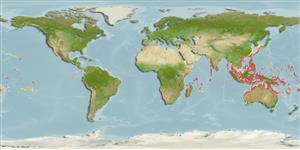
Indo-Pacific: widespread in the Indian Ocean (Ref. 9793), ranging from East Africa south to Natal, South Africa (Ref. 5490) and east to Madagascar, Seychelles, Mauritius, Chagos Archipelago, and Maldives through the eastern Indian Ocean to French Polynesia and Pitcairn. Replaced by Scarus forsteni in most of the Pacific, with overlapping distributions in the Philippines, eastern Indonesia and Palau (Ref. 37816). Recently reported from Tonga (Ref. 53797).
Taille / Poids / Âge
Maturité: Lm ? range ? - ? cm
Max length : 52.7 cm TL mâle / non sexé; (Ref. 125599); common length : 17.5 cm SL mâle / non sexé; (Ref. 9793); poids max. publié: 2.9 kg (Ref. 125599)
Description synthétique
Clés d'identification | Morphologie | Morphométrie
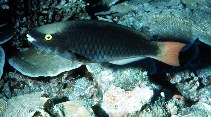
Épines dorsales (Total) : 9; Rayons mous dorsaux (Total) : 10; Épines anales: 3; Rayons mous anaux: 9. Males differ slightly in head pattern and differences most obvious in females with yellow or red anal fins (Ref. 48636). Terminal phase similar to S. forsteni, differing primarily by having a yellow inner pectoral axil (Ref. 37816).
Body shape (shape guide): fusiform / normal.
Inhabits lagoon and seaward reefs, in areas with dense coral growth (Ref. 9710) up to at least 30 m. Usually solitary, sometimes in groups (Ref. 9710). Feeds on benthic algae (Ref. 3488).
Life cycle and mating behavior
Maturité | Reproduction | Frai | Œufs | Fécondité | Larves
Oviparous, distinct pairing during breeding (Ref. 205).
Randall, J.E. and J.H. Choat, 1980. Two new parrotfishes of the genus Scarus from the Central and South Pacific, with further examples of sexual dichromatism. Zool. J. Linn. Soc. 70:383-419. (Ref. 2689)
Statut dans la liste rouge de l'IUCN (Ref. 130435: Version 2025-1)
Menace pour l'homme
Harmless
Utilisations par l'homme
Pêcheries: commercial; Aquarium: Commercial
Outils
Articles particuliers
Télécharger en XML
Sources Internet
Estimates based on models
Preferred temperature (Réf.
123201): 24.9 - 29.3, mean 28.4 °C (based on 3096 cells).
Phylogenetic diversity index (Réf.
82804): PD
50 = 0.5000 [Uniqueness, from 0.5 = low to 2.0 = high].
Bayesian length-weight: a=0.01778 (0.01087 - 0.02908), b=3.06 (2.93 - 3.19), in cm total length, based on LWR estimates for this species & Genus-body shape (Ref.
93245).
Niveau trophique (Réf.
69278): 2.0 ±0.0 se; based on diet studies.
Résilience (Réf.
120179): Milieu, temps minimum de doublement de population : 1,4 à 4,4 années (Preliminary K or Fecundity.).
Fishing Vulnerability (Ref.
59153): Moderate vulnerability (41 of 100).
🛈
Nutrients (Ref.
124155): Calcium = 51.9 [33.6, 86.3] mg/100g; Iron = 0.833 [0.578, 1.274] mg/100g; Protein = 18.5 [16.5, 20.3] %; Omega3 = 0.094 [0.064, 0.138] g/100g; Selenium = 16.9 [10.4, 26.6] μg/100g; VitaminA = 59.4 [18.4, 194.3] μg/100g; Zinc = 2.51 [1.91, 3.27] mg/100g (wet weight); based on
nutrient studies.