This website uses cookies to enhance your browsing experience and ensure the functionality of our site. For more detailed information about the types of cookies we use and how we protect your privacy, please visit our Privacy Information page.
×
Cookie Settings
This website uses different types of cookies to enhance your experience. Please select your preferences below:
> Carangaria/misc (Various families in series Carangaria) > Polynemidae (Threadfins)
Etymology: Polydactylus:Greek, poly = a lot of + greek, daktylos = finger (Ref. 45335). More on author: Valenciennes.
Indo-Pacific: mainly around oceanic islands. Known from Mauritius, Seychelles, Kenya and many islands of the northern Indian Ocean; then from Indonesia north to the Ryukyu, Ogasawara and Yaeyama islands and east to the Hawaiian Islands, French Polynesia and Pitcairn. Has not been collected in Australia (Ref. 57343).
ขนาด / น้ำหนัก / อายุ
วัยเจริญพันธุ์: Lm? range ? - ? cm Max length : 61.0 cm TL เพศผู้/กระเทย; (Ref. 4887); น้ำหนักสูงสุดที่มีการรายงาน: 3.2 kg (Ref. 4699)
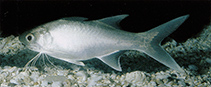
เงี่ยงครีบหลัง (รวม) : 9; ก้านครีบอ่อนที่หาง (รวม) : 13; เงี่ยงครีบก้น: 3; ก้านครีบอ่อนที่ก้น: 11. Body uniformly golden silver; occasionally with several faint dark stripes along longitudinal scale rows above and below lateral line. Pectoral filaments 6 with tip of uppermost filament reaching to or slightly beyond level of posterior tip of upper part of pectoral fin (Ref. 41110). Body shape (shape guide): short and / or deep; Cross section: compressed.
This schooling species occurs along sandy and rocky shorelines and over sandy lagoon bottoms, often in zones of turbulence (Ref. 9685). Benthopelagic (Ref. 58302). Often encountered in river mouths or brackish mangrove estuaries. Feeds mainly on crustaceans (shrimps and crabs), polychaete worms, other benthic invertebrates; also on teleosts (Ref. 9685). A lunar spawning rhythm occurs close to shore (Ref. 9685). Sexual maturity in males occurs at 12 to 15 cm (Ref. 9685). Subsequently undergoes sex reversal passing through a hermaphroditic stage, and become female between 18 and 24 cm (Ref. 9685). The potential of this species for aquaculture has been studied (Ref. 9685).
Motomura, H., 2004. Threadfins of the world (Family Polynemidae). An annotated and illustrated catalogue of polynemid species known to date. FAO Spec. Cat. Fish. Purp. Rome: FAO. 3:117 p. (Ref. 57343)
สถานะบัญชีแดงของ IUCN (Ref. 130435: Version 2025-2 (Global))
อุณหภูมิที่ต้องการ (อ้างอิง 123201): 24.1 - 29, mean 27.9 °C (based on 1038 cells).
ดัชนีความหลากหลายทางวิวัฒนาการ (อ้างอิง 82804): PD50 = 0.5000 [Uniqueness, from 0.5 = low to 2.0 = high].
Bayesian length-weight: a=0.01820 (0.01035 - 0.03199), b=3.11 (2.96 - 3.26), in cm total length, based on LWR estimates for this species & (Sub)family-body (Ref. 93245).
ระดับชั้นอาหาร (อ้างอิง 69278): 3.4 ±0.49 se; based on food items.
ความสามารถในการกลับคืนสู่ปกติ (อ้างอิง 120179): ขนาดกลาง, เวลาต่ำสุดที่จะทำให้ประชากรเพิ่มขึ้นเป็น 2 เท่าใช้เวลา 1.4 - 4.4 ปี (Preliminary K or Fecundity.).
ความเสี่ยงต่อการตกปลา (Ref. 59153): Moderate vulnerability (44 of 100). 🛈