



Brachyhypopomus draco Giora, Malabarba & Crampton, 2008
Uploaden van uw Foto's en video's
Afbeeldingen | Google afbeelding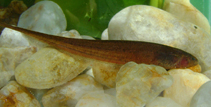 Brachyhypopomus draco
Female Afbeelding van Corrêa, F.
Afbeeldingen | Google afbeelding
Female Afbeelding van Corrêa, F.
Classificatie / Namen Lokale namen | Synoniemen | Catalog of Fishes(Genus, Soort(en)) | ITIS | CoL | WoRMS | Cloffa
> Gymnotiformes (Knifefishes) > Hypopomidae (Bluntnose knifefishes)
Etymology: Brachyhypopomus: Greek, brachys, eia = short + Greek, hypo = under + Greek, poma, -atos = cover (Ref. 45335); draco: The specific names is from the Greek 'drakon' meaning dragon, in reference to the shape of distal portion of caudal filament in mature males, similar to that illustrated in these imaginary creatures.
Etymology: Brachyhypopomus: Greek, brachys, eia = short + Greek, hypo = under + Greek, poma, -atos = cover (Ref. 45335); draco: The specific names is from the Greek 'drakon' meaning dragon, in reference to the shape of distal portion of caudal filament in mature males, similar to that illustrated in these imaginary creatures.
Milieu: milieu / Klimaatzone / Diepte / verspreidingsgebied Ecologie
; zoet water benthopelagisch. Subtropical
Verspreiding Gebieden | FAO regio's | Ecosystemen | Voorkomen | Verspreidingskaart | Introducties | Faunafri
South America: Brazil, Uruguay and Paraguay.
Grootte / Gewicht / Leeftijd
Korte beschrijving Determinatiesleutels | Morfologie | Morfometrie
Anale zachte stralen: 155 - 198. Diagnosed from all congeners by the extreme broadening of the distal portion of the caudal filament in males during the reproductive period to form a distinct paddle shaped structure
(vs. moderately broadened distally in Brachyhypopomus pinnicaudatusand Brachyhypopomus brevirostris into paddle-shaped structures, and vs. broadened along most of the length of the caudal filament in Brachyhypopomus occidentalis, Brachyhypopomus diazi, Brachyhypopomus beebei, and Brachyhypopomus janeiroensis). Differs further from other species of the genus by the following characters: caudal filament length 17.3-35.2% of LEA; pectoral fin ray length 4.1-5.8% of LEA; body depth 8.8-12.2% of LEA; snout length 20.7- 30.0% of HL; gape width 9.5- 16.5% of HL; interorbital distance 22.7-35% of HL; branchial aperture 16.5-26% of HL; head width at operculum 48.4-65% of HL; head width at eyes 31.3-45.6% of HL; number of anal fin rays 155-198; upper jaw equal to lower jaw (Ref. 76853).
Body shape (shape guide): elongated.
Body shape (shape guide): elongated.
Facultative air-breathing in the genus (Ref. 126274); Occurs in river edges, slow-moving creeks, lagoons and flooded areas with muddy or sandy bottom and abundant emergent or floating vegetation (Ref. 76853). Length type refers to the length to the end of anal fin (LEA), measured as the distance from tip of snout to posterior end of anal fin base (Ref. 76853).
Levenscyclus en paargedrag Maturiteit | Voortplanting | Paaien | Eieren | Fecunditeit | Larven
Hoofdreferentie
Upload uw referenties | Referenties | Coördinator : Albert, James S. | Medewerkers
Giora, J., L.R. Malabarba and W. Crampton, 2008. Branchyhypopomus draco, a new sexually dimorphic species of Neotropical electric fish from Southern South America (Gymnotiformes: Hypopomidae). Neotrop. Ichthyol. 6(2):159-168. (Ref. 76853)
Status op de Rode Lijst van het IUCN (Ref. 130435: Version 2025-2 (Global))
Niet bedreigd (LC) ; Date assessed: 01 September 2020
CITES
Not Evaluated
Gevaar voor de mens
Harmless
Gebruik door de mens
FAO - Publication: search | FishSource |
Meer informatie
Trofische ecologie
Voedsel (prooien)
Dieetsamenstelling
Voedselconsumptie
Voedselrantsoenen
Predatoren
Voedsel (prooien)
Dieetsamenstelling
Voedselconsumptie
Voedselrantsoenen
Predatoren
Ecologie
Ecologie
Ecologie
Populatiedynamica
Groeiparameters
Max. leeftijden / maten
Lengte-gewicht rel.
Lengte-lengte rel.
Lengtefrequenties
Massaconversie
Rekrutering
Abundantie
Groeiparameters
Max. leeftijden / maten
Lengte-gewicht rel.
Lengte-lengte rel.
Lengtefrequenties
Massaconversie
Rekrutering
Abundantie
Levenscyclus
Voortplanting
Maturiteit
Rijpheid/kieuwen rel.
Fecunditeit
Paaien
Paaibestanden
Eieren
Ontwikkeling van de eieren
Larven
Larvale populatiedynamiek
Voortplanting
Maturiteit
Rijpheid/kieuwen rel.
Fecunditeit
Paaien
Paaibestanden
Eieren
Ontwikkeling van de eieren
Larven
Larvale populatiedynamiek
Anatomie
Kieuwoppervlak
Hersenen
Otoliet
Kieuwoppervlak
Hersenen
Otoliet
Fysiologie
Lichaamssamenstelling
Voedingsstoffen
Zuurstofverbruik
Type zwemmen
Zwemsnelheid
Visuele pigmenten
Vis geluid
Ziekten en parasieten
Toxiciteit (LC50)
Lichaamssamenstelling
Voedingsstoffen
Zuurstofverbruik
Type zwemmen
Zwemsnelheid
Visuele pigmenten
Vis geluid
Ziekten en parasieten
Toxiciteit (LC50)
Genetica
genoom
Genetica
Heterozygositeit
Erfelijkheid
Genetische diversiteit
genoom
Genetica
Heterozygositeit
Erfelijkheid
Genetische diversiteit
Menselijk gerelateerd
Aquacultuursystemen
Aquacultuurprofielen
Kweeklijnen
Ciguatera gevallen
Postzegels, munten, diversen.
Aquacultuursystemen
Aquacultuurprofielen
Kweeklijnen
Ciguatera gevallen
Postzegels, munten, diversen.
Tools
Speciale rapporten
Bekijk gegevens voor het houden in een aquarium | Bekijk Fact Sheets voor de soort | Bekijk Aquacultuur Fact Sheets
Download XML
Internetbronnen
AFORO (otoliths) | Aquatic Commons | BHL | Cloffa | Websites from users | Bekijk FishWatcher | CISTI | Catalog of Fishes: Genus, Soort(en) | DiscoverLife | ECOTOX | FAO - Publication: search | Faunafri | Fishipedia | Fishtrace | GloBI | Google Books | Google Scholar | Google | IGFA World Record | Nationale databanken | OneZoom | Open Tree of Life | Otolith Atlas of Taiwan Fishes | PubMed | Reef Life Survey | Socotra Atlas | TreeBase | Tree of Life | Wikipedia: ga naar, zoek | World Records Freshwater Fishing | Zoobank | Zoological Record
Schattingen op basis van modellen
Fylogenetische diversiteitsindex (Ref. 82804): PD50 = 0.5000 [Uniqueness, from 0.5 = low to 2.0 = high].
Bayesian length-weight: a=0.00372 (0.00141 - 0.00980), b=3.06 (2.83 - 3.29), in cm total length, based on LWR estimates for this (Sub)family-body shape (Ref. 93245).
Trofisch niveau (Ref. 69278): 3.1 ±0.4 se; based on size and trophs of closest relatives