>
Gobiiformes (Gobies) >
Gobiidae (Gobies) > Gobiinae
Eponymy: Professor Cornelius Jan van der Horst (1889–1951) was a Dutch zoologist who moved to South Africa (1928) and became Head of the Zoology Department, Witwatersrand University, Johannesburg. [...] (Ref. 128868), visit book page.
More on author: Randall.
Environment: milieu / climate zone / kisaran kedalaman / distribution range
Ekologi
laut bentopelagis; kisaran kedalaman 20 - 38 m (Ref. 78591). Tropical
Western Pacific.
Size / Weight / umur
Kematangan: Lm ? range ? - ? cm
Max length : 4.0 cm SL (female)
deskripsi pendek
Kunci identifiaksi (pengenalan) | Morfologi | Morfometrik
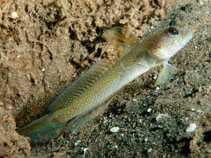
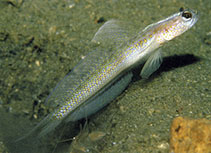
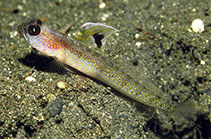
Duri punggung (Keseluruhan (total)) : 7; duri punggung lunak (Keseluruhan (total)) : 17; Duri dubur: 1; Sirip dubur lunak: 18. This species is distinguished by the following characters: D VI-I, 17; A I, 18; pectoral rays 18; scales in longitudinal series 78; scales absent on head, nape, or prepectoral area; body elongate, its depth 6.6 in SL; dorsal spines progressively longer to fourth, 4.05 in SL; caudal fin pointed and moderately long, 3.0 in SL; pectoral fins reaching to above anus, 3.8 in SL; pelvic fins not reaching anus, 4.65 in SL (Ref. 75899); characterized further by male with bluish body color, white abdomen, head and body covered with yellow spots, blue mid-dorsal stripe on head, yellow spotting on dorsal fin; female similar to male except for having irregular dark spots on first dorsal fin and yellow streaks instead of spotting; united pelvic fins, presence of well developed frenum; body covered with cycloid scales anteriorly, ctenoid posteriorly (Ref. 90102).
Body shape (shape guide): elongated; Cross section: compressed.
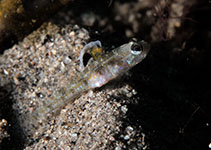
The alpheid Alpheus cf rapacida is the symbiotic snapping shrimp that shares the burrows with this species in both Papua New Guinea and Majuro (Ref. 78591). Found in estuaries, lagoons and sheltered reefs (Ref 90102).
Life cycle and mating behavior
Kematangan | Reproduksi, perkembang biakan | Pemijahan | telur-telur | Fecundity | Larva
Randall, J.E., 2007. Descriptions of four new shrimpgobies of the genus Vanderhorstia from the Western Pacific. aqua, Int. J. Ichthyol. 12(3):89-100. (Ref. 75899)
Status IUCN Red List (Ref. 130435: Version 2025-1)
ancaman kepada manusia
Harmless
penggunaan manusia
Alat, peralatan
laporan khas
muat turun XML
Sumber internet
Estimates based on models
Preferred temperature (Acuan
123201): 26.5 - 28.5, mean 27.4 °C (based on 28 cells).
Phylogenetic diversity index (Acuan
82804): PD
50 = 0.5000 [Uniqueness, from 0.5 = low to 2.0 = high].
Bayesian length-weight: a=0.00724 (0.00339 - 0.01546), b=3.10 (2.92 - 3.28), in cm total length, based on LWR estimates for this (Sub)family-body shape (Ref.
93245).
Trophic level (Acuan
69278): 3.2 ±0.3 se; based on size and trophs of closest relatives
Daya lenting (Acuan
120179): Tinggi, Waktu penggandaan populasi minimum kurang dari 15 bulan (Preliminary K or Fecundity.).
Fishing Vulnerability (Ref.
59153): Low vulnerability (10 of 100).
🛈