



Cephalopholis argus Schneider, 1801
Peacock hind
個人による観察記録の追加 Fish Watcher
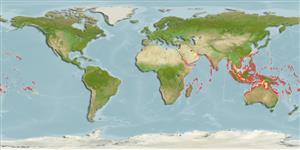
| Native range | All suitable habitat | Point map | Year 2050 |
|
| This map was computer-generated and has not yet been reviewed. |
| Cephalopholis argus AquaMaps Data sources: GBIF OBIS |
アップロード 写真 そして ビデオ
画像 | ビデオ | 切手、コイン、その他 | グーグルの画像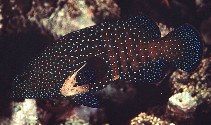 Cephalopholis argus
画像によって Randall, J.E.
画像 | ビデオ | 切手、コイン、その他 | グーグルの画像
画像によって Randall, J.E.
分類 / 名前 共通名の | 類義語 | Catalog of Fishes(部類, 種) | ITIS | CoL | WoRMS | Cloffa
> Perciformes/Serranoidei (Groupers) > Epinephelidae (Groupers)
Etymology: Cephalopholis: Greek, kephale = head + Greek, pholis = scale (Ref. 45335).
Eponymy: Argus (or Argos) was a 100–eyed watchman in Greek mythology. [...] (Ref. 128868), visit book page.
More on author: Schneider.
Etymology: Cephalopholis: Greek, kephale = head + Greek, pholis = scale (Ref. 45335).
Eponymy: Argus (or Argos) was a 100–eyed watchman in Greek mythology. [...] (Ref. 128868), visit book page.
More on author: Schneider.
環境:環境 / 気候帯 / 深さの範囲 / 分布範囲 生態学
海 関連する礁; 移住性ではない; 深さの範囲 0 - 40 m (Ref. 37816), usually 1 - 15 m (Ref. 90102). Tropical; 24°C - 28°C; 29°N - 34°S, 33°E - 122°W (Ref. 5222)
分布 領土 | 国連食糧農業機関の区域 | エコシステム | 事件 | 目的のマップ | 導入 | Faunafri
Indo-Pacific: Red Sea to Durban, South Africa and eastward to French Polynesia and the Pitcairn group, north to the Ryukyu and Ogasawara islands, south to northern Australia and Lord Howe Island. May be confused with Cephalopholis cyanostigma.
初回成熟時の長さ / サイズ / 重さ / 年齢
成熟: Lm ?, range 22 - ? cm
Max length : 60.0 cm TL オス/雌雄の選別がない; (Ref. 11441); common length : 40.0 cm TL オス/雌雄の選別がない; (Ref. 5450)
Max length : 60.0 cm TL オス/雌雄の選別がない; (Ref. 11441); common length : 40.0 cm TL オス/雌雄の選別がない; (Ref. 5450)
簡単な記述 検索表 | 形態学 | 形態計測学
背面の脊椎 (合計) : 9; 背鰭 (合計) : 15 - 17; 肛門の骨: 3; 臀鰭: 9. This species is distinguished by the following characters: greatest body depth 2.7-3.3 in SL; dorsal soft rays usually 16-17; pectoral fin rays usually 16-17; longitudinal scale series 95-110; caudal fin rounded; pelvic fins short , 1.9-2.4 in head length. Colour of body dark brown, with small black-edged blue spots; often with 5-6 pale bars on rear part of body and a large pale area over the chest (abdominal/pectoral region) (Ref. 39231, 90102).
Body shape (shape guide): fusiform / normal; Cross section: oval.
Body shape (shape guide): fusiform / normal; Cross section: oval.
A generally common species (Ref. 9710). Adults are benthic and benthopelagic in a variety of coral habitats (Ref. 58534, 58302) from tide pools to depths of at least 40 m; preferring the 1 to 10 m reef zone. Juveniles prefer shallow, protected coral thickets (Ref. 37816). Mature adults are found in social units comprising up to 12 adults, including 1 dominant male and each group occupies a specific area (up to 2,000 sq. m.) that is defended by the territorial male and subdivided into secondary territories, each inhabited by a single female (Ref. 39231). At times, they may also be solitary (Ref. 90102). Adults feed mainly on fishes (75-95%) and to a lesser extent on crustaceans. In the Red Sea, they feed early in the morning and late afternoon (Ref. 6775) but in Madagascar, they appear to feed more at night (Ref. 6774). They are implicated in ciguatera at some of the islands in the Pacific region. They can be seen in Hong Kong live fish markets (Ref. 27253). They are important to artisanal fisheries throughout the Indo-West Pacific region and often caught with hook-and-line, spear, and in traps (Ref. 39231). Minimum depth reported taken from Ref. 128797.
ライフサイクルと交尾行動 成熟 | 繁殖 | 放精 | 卵 | 生産力 | 幼生
主な参考文献
参考文献のアップロード | 参考文献 | コーディネーター | 協力者
Heemstra, P.C. and J.E. Randall, 1993. FAO Species Catalogue. Vol. 16. Groupers of the world (family Serranidae, subfamily Epinephelinae). An annotated and illustrated catalogue of the grouper, rockcod, hind, coral grouper and lyretail species known to date. Rome: FAO. FAO Fish. Synop. 125(16):382 p. (Ref. 5222)
CITES
Not Evaluated
人間に対する脅威
Reports of ciguatera poisoning (Ref. 4690)
人間の用途
水産業: 商業; ゲームフィッシュ: はい; 水族館・水槽: 商業
FAO - 水産業: 着陸; Publication: search | FishSource | 私達の周りの海
より多くの情報
用具
オーガニック・クイズ | 電子書籍 | 野外観察図鑑 | 検索表 | 長さ-周波数ウィザード | 生活史の基盤ツール | 目的のマップ |
キャッチ-MSY |
特記事項
XMLをダウンロードして下さい
インターネットの情報源
AFORO (otoliths) | Alien/Invasive Species database | Aquatic Commons | BHL | Cloffa | Websites from users | Check FishWatcher | CISTI | Catalog of Fishes: 部類, 種 | DiscoverLife | DORIS | ECOTOX | FAO - 水産業: 着陸; Publication: search | Faunafri | Fishipedia | Fishtrace | GloBI | Google Books | Google Scholar | Google | IGFA World Record | 国のデーターベース | OneZoom | Open Tree of Life | Otolith Atlas of Taiwan Fishes | 公共の水族館 | PubMed | Reef Life Survey | Socotra Atlas | TreeBase | 生命の木 | Wikipedia: 行く, 検索する | World Records Freshwater Fishing | Zoobank | 動物に関する記録
モデルに基づく推定値
好ましい温度 (参照 123201): 24.9 - 29.3, mean 28.4 °C (based on 3533 cells).
系統多様性指数 (参照 82804): PD50 = 0.5000 [Uniqueness, from 0.5 = low to 2.0 = high].
Bayesian length-weight: a=0.01230 (0.01070 - 0.01414), b=3.05 (3.02 - 3.08), in cm total length, based on LWR estimates for this species (Ref. 93245).
栄養段階 (参照 69278): 4.5 ±0.0 se; based on diet studies.
回復力 (参照 120179): 手段, 1.4年~4.4年の倍増期間の最小個体群 (Preliminary K or Fecundity.).
栄養素 (Ref. 124155): Calcium = 35.8 [20.4, 60.7] mg/100g; Iron = 0.489 [0.277, 0.892] mg/100g; Protein = 18.7 [16.9, 20.4] %; Omega3 = 0.152 [0.098, 0.235] g/100g; Selenium = 35.2 [19.9, 59.3] μg/100g; VitaminA = 148 [53, 474] μg/100g; Zinc = 0.673 [0.495, 1.087] mg/100g (wet weight); based on nutrient studies.