>
Eupercaria/misc (Various families in series Eupercaria) >
Labridae (Wrasses) > Cheilininae
Etymology: Cirrhilabrus: Latin, cirrus = curl fringe + Greek, labros = furious (Ref. 45335); cenderawasih: Named for its type locality, Cenderawasih Bay; noun in apposition.
Environment: milieu / Zona climática / intervalo de profundidade / distribution range
Ecologia
marinhas associadas(os) a recifes; intervalo de profundidade 22 - 60 m (Ref. 75881). Tropical
Western Pacific: Indonesia.
Tamanho / Peso / Idade
Maturidade: Lm ? range ? - ? cm
Max length : 6.5 cm SL macho/indeterminado; (Ref. 75881); 4.7 cm SL (female)
Descrição suscinta
Chaves de identificação | Morfologia | Morfometria
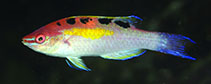
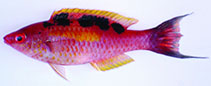
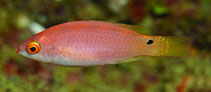
Espinhos dorsais (total) : 11; Raios dorsais (total) : 9; Espinhos anais: 3; Raios anais : 9. This species is distinguished by the following characters: D XI, 9; A III, 9; pectoral rays 15; lateral-line scales 14-16 + 6-9; median predorsal scales 5; horizontal scale rows on cheek below eye 2; gill rakers 14-17; body depth 2.9-3.2 in SL; head length 2.9-3.2 in SL; snout length 3.8-4.7 in head; males' caudal fin strongly lunate with produced lobes; pelvic fins relatively short, not reaching anal fin origin when depressed; live colour pattern features of males include a pink overall coloration with broad, irregular yellow stripe or rectangular blotch on middle of side, and series of 4-5 large, irregular black blotches along back, extending on to adjacent basal portion of dorsal fin; female mainly reddish pink with pupil sized black spot on upper caudal peduncle (Ref. 75881).
Body shape (shape guide): fusiform / normal.
This species is common on sheltered seaward reefs, primarily on the inner and eastern portions of the Cenderawasih Bay at depths between about 22 to 60 m, although it is more abundant below about 35 m. Observed to be in groups of about 10 to 20 individuals, including one to five males, and were typically encountered on rubble slopes or on rubble substrates at the base of slopes. Apparently feeds on zooplankton, which is typical for the genus, at a short distance above the bottom (Ref. 75881).
Ciclo de vida ou comportamento de acasalamento
Maturidade | Reprodução | Desova | Ovos | Fecundidade | Larvas
Distinct pairing during breeding (Ref. 205).
Allen, G.R. and M.V. Erdmann, 2006. Cirrhilabrus cenderawasih, a new wrasse (Pisces: Labridae) from Papua, Indonesia. aqua, J. Ichthyol. Aquat. Biol. 11(3):125-131. (Ref. 75881)
Status na Lista Vermelha da UICN (Ref. 130435: Version 2025-1)
Ameaça para os humanos
Harmless
Uso pelos humanos
Ferramentas
Relatórios especiais
Baixar XML
Fontes da internet
Estimates based on models
Preferred temperature (Ref.
123201): 27.2 - 28.5, mean 28.1 °C (based on 15 cells).
Índice de diversidade filogenética (Ref.
82804): PD
50 = 0.5000 [Uniqueness, from 0.5 = low to 2.0 = high].
Bayesian length-weight: a=0.01585 (0.00700 - 0.03587), b=2.95 (2.76 - 3.14), in cm total length, based on LWR estimates for this (Sub)family-body shape (Ref.
93245).
Nível Trófico (Ref.
69278): 3.3 ±0.4 se; based on size and trophs of closest relatives
Resiliência (Ref.
120179): Elevada, tempo mínimo de duplicação da população menor que 15 meses (Preliminary K or Fecundity.).
Fishing Vulnerability (Ref.
59153): Low vulnerability (10 of 100).
🛈