>
Gobiiformes (Gobies) >
Gobiidae (Gobies) > Gobiinae
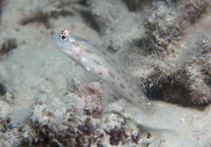
Etymology: Ctenogobiops: Greek, kteis, ktenos = comb + Latin, gobius = gudgeon + Greek, ops = appearance (Ref. 45335); mitodes: Name from Greek 'mitodes' meaning theadlike, refers to the filamentous 2nd dorsal spine of adults.
More on authors: Randall, Shao & Chen.
Environment: milieu / Zona climática / intervalo de profundidade / distribution range
Ecologia
marinhas associadas(os) a recifes; intervalo de profundidade 9 - 21 m (Ref. 75863). Tropical
Western Pacific.
Tamanho / Peso / Idade
Maturidade: Lm ? range ? - ? cm
Max length : 5.3 cm SL macho/indeterminado; (Ref. 75863)
Descrição suscinta
Chaves de identificação | Morfologia | Morfometria
Espinhos dorsais (total) : 6 - 7; Raios dorsais (total) : 11; Espinhos anais: 1; Raios anais : 11. Characterized by whitish body color with four longitudinal rows of dark brown spots (midlateral row spots largest and horizontally elongate); large anterior dark spots of midlateral row often encircled by blue dots; cheeks with row of three dark spots; behind lower edge of eye with oblique blue and yellow mark followed by similar marks on opercle and preopercle; curved blue and yellow line/dashes from behind upper eye to below of dorsal fin origin; lower part of pectoral fin with elliptical white spot; longitudinal scale series 52-56; opening of gill extending slightly anterior to vertical at posterior edge of preopercle; greatest depth of body 4.3-5.0 in SL; rounded caudal fin, shorter than length of head (Ref. 90102).
Body shape (shape guide): elongated; Cross section: circular.
Collected by rotenone and spear from silty, sand and rubble bottoms (Ref. 75863). Also found in lagoons (Ref 90102).
Ciclo de vida ou comportamento de acasalamento
Maturidade | Reprodução | Desova | Ovos | Fecundidade | Larvas
Randall, J.E., K.-T. Shao and J.-P. Chen, 2007. Two new shrimp gobies of the genus Ctenogobiops (Perciformes: Gobiidae), from the Western Pacific. Zool. Stud. 46(1):26-34. (Ref. 75863)
Status na Lista Vermelha da UICN (Ref. 130435: Version 2025-1)
Ameaça para os humanos
Harmless
Uso pelos humanos
Ferramentas
Relatórios especiais
Baixar XML
Fontes da internet
Estimates based on models
Preferred temperature (Ref.
123201): 25.6 - 29.3, mean 28.5 °C (based on 1064 cells).
Índice de diversidade filogenética (Ref.
82804): PD
50 = 0.5020 [Uniqueness, from 0.5 = low to 2.0 = high].
Bayesian length-weight: a=0.00724 (0.00339 - 0.01546), b=3.10 (2.92 - 3.28), in cm total length, based on LWR estimates for this (Sub)family-body shape (Ref.
93245).
Nível Trófico (Ref.
69278): 3.3 ±0.4 se; based on size and trophs of closest relatives
Resiliência (Ref.
120179): Elevada, tempo mínimo de duplicação da população menor que 15 meses (Preliminary K or Fecundity.).
Fishing Vulnerability (Ref.
59153): Low vulnerability (10 of 100).
🛈
Nutrients (Ref.
124155): Calcium = 215 [93, 463] mg/100g; Iron = 0.956 [0.473, 1.912] mg/100g; Protein = 17.8 [15.8, 19.5] %; Omega3 = 0.0977 [, ] g/100g; Selenium = 23.1 [9.5, 56.5] μg/100g; VitaminA = 151 [39, 564] μg/100g; Zinc = 2.66 [1.66, 4.09] mg/100g (wet weight);