Klassifizierung / Names
Namen | Synonyme | Catalog of Fishes(Gattung, Arten) | ITIS | CoL | WoRMS | Cloffa
>
Siluriformes (Catfishes) >
Loricariidae (Armored catfishes) > Hypoptopomatinae
Etymology: Hisonotus: Greek, isos = equal + Greek, noton = back (Ref. 45335); chromodontus: From the Greek chroma (color), and odontos (tooth), in reference to the reddish-brown tip of teeth of this species.
Environment: milieu / climate zone / Tiefenbereich / distribution range
Ökologie
; süßwasser demersal. Tropical
South America: Upper Rio Tapajós drainage in Brazil.
Size / Gewicht / Alter
Geschlechtsreife: Lm ? range ? - ? cm
Max length : 3.3 cm SL Männchen/unbestimmt; (Ref. 75061)
Kurzbeschreibung
Bestimmungsschlüssel | Morphologie | Morphometrie
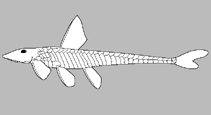
Rückenflossenweichstrahlen (insgesamt) : 8; Afterflossenweichstrahlen: 6. Diagnosed from its congeners by having reddish-brown tipped teeth. Can be differentiated also by the following combination of characters: 20-40 teeth on premaxillary and 15-38 on the dentary bones; 23-24 plates in longitudinal series; lateral line almost complete, represented by 19-22 perforated +1 or 2 non-perforated plates; dorsal surface of pectoral spine with
about five longitudinal series of odontodes; abdomen in adults (about 2.30 cm SL) entirely covered with large plates, two to four in lateral series between the tip of the cleithrum and pelvic-fin base; a large dark brown lateral stripe extending from tip of snout, through inferior orbit, to end of caudal peduncle; transverse dark bars very inconspicuous or absent (Ref. 75061).
Body shape (shape guide): elongated.
Facultative air-breathing in the genus (Ref. 126274); Found in flat areas in creeks of headwaters of Rio Tapajós in places of shallow clear waters with low current and sandy substrate. The holotype of this species was encountered in a creek severely altered by human activities; alongside a trail with very shallow water, the margin deprived of vegetation at the opposite side of swampy area, where vegetation was mainly represented by Tipha and Grammineae (Ref. 75061).
Life cycle and mating behavior
Geschlechtsreife | Fortpflanzung | Ablaichen | Eier | Fecundity | Larven
Britski, H.A. and J.C. Garavello, 2007. Description of two new sympatric species of the genus Hisonotus Eigenmann and Eigenmann, 1889, from upper Rio Tapajós, Mato Grosso state, Brazil (Pisces: Ostariophysi: Loricariidae). Brazilian Journal of Biology 67(3):413-420. (Ref. 75061)
IUCN Rote Liste Status (Ref. 130435: Version 2025-1)
Bedrohung für Menschen
Harmless
Nutzung durch Menschen
Fischereien: nicht kommerziell
Tools
Zusatzinformationen
Download XML
Internet Quellen
Estimates based on models
Phylogenetic diversity index (Ref.
82804): PD
50 = 0.5000 [Uniqueness, from 0.5 = low to 2.0 = high].
Bayesian length-weight: a=0.00851 (0.00374 - 0.01935), b=3.09 (2.90 - 3.28), in cm total length, based on LWR estimates for this (Sub)family-body shape (Ref.
93245).
Trophic level (Ref.
69278): 2.4 ±0.1 se; based on size and trophs of closest relatives
Fishing Vulnerability (Ref.
59153): Low vulnerability (10 of 100).
🛈