Klassifizierung / Names
Namen | Synonyme | Catalog of Fishes(Gattung, Arten) | ITIS | CoL | WoRMS | Cloffa
>
Cypriniformes (Carps) >
Psilorhynchidae (Mountain carps)
Etymology: Psilorhynchus: Greek, psilos = hairless + Greek, rhyngchos = snout (Ref. 45335); robustus: From the Latin adjective robustus, meaning strong or robust, in allusion to the overall robust
appearance of this species.
More on authors: Conway & Kottelat.
Environment: milieu / climate zone / Tiefenbereich / distribution range
Ökologie
; süßwasser benthopelagisch. Tropical
Asia: Myanmar. Known from headwaters of the Ataran basin.
Size / Gewicht / Alter
Geschlechtsreife: Lm ? range ? - ? cm
Max length : 6.8 cm SL Männchen/unbestimmt; (Ref. 75619)
Kurzbeschreibung
Bestimmungsschlüssel | Morphologie | Morphometrie
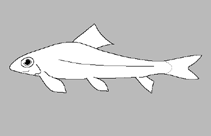
Rückenflossenstacheln (insgesamt) : 3; Rückenflossenweichstrahlen (insgesamt) : 9; Afterflossenstacheln: 2; Afterflossenweichstrahlen: 6. Psilorhynchus robustus is most similar to P. gracilis and P. balitora in overall body shape, meristics and colour pattern. It is distinguished from both species by the presence of a large dark blotch situated posterodorsally to opercle opening, extending along lateral-line scales 3–6 (vs. absence) and in having upper lip separated from the rostral cap by a shallow groove (vs. upper lip separated from rostral cap by a deep groove).
Body shape (shape guide): elongated.
Life cycle and mating behavior
Geschlechtsreife | Fortpflanzung | Ablaichen | Eier | Fecundity | Larven
Conway, K.W. and M. Kottelat, 2007. A new species of Psilorhynchus (Teleostei: Psilorhynchidae) from the Ataran River Basin, Myanmar, with comments on the generic name Psilorhynchoides. Zootaxa 1663:47-57. (Ref. 75619)
IUCN Rote Liste Status (Ref. 130435: Version 2025-1)
Bedrohung für Menschen
Harmless
Nutzung durch Menschen
Tools
Zusatzinformationen
Download XML
Internet Quellen
Estimates based on models
Phylogenetic diversity index (Ref.
82804): PD
50 = 0.5000 [Uniqueness, from 0.5 = low to 2.0 = high].
Bayesian length-weight: a=0.00417 (0.00183 - 0.00952), b=3.16 (2.95 - 3.37), in cm total length, based on LWR estimates for this (Sub)family-body shape (Ref.
93245).
Trophic level (Ref.
69278): 2.9 ±0.2 se; based on size and trophs of closest relatives
Fishing Vulnerability (Ref.
59153): Low vulnerability (10 of 100).
🛈