Klassifizierung / Names
Namen | Synonyme | Catalog of Fishes(Gattung, Arten) | ITIS | CoL | WoRMS | Cloffa
Environment: milieu / climate zone / Tiefenbereich / distribution range
Ökologie
; süßwasser demersal; pH range: 7.0 - 7.7; dH range: 10 - 15; potamodrom (Ref. 51243). Temperate; ? - 18°C (Ref. 13371); 67°N - 39°N, 6°W - 59°E
Eurasia: Europe north of Caucasus, Pyrénées and Alps, from Loire and Rhone drainages eastward; British Isles ( except northern Scotland), southern Sweden and Finland (northward to about 66°N); northeastern Italy; Danube and Vardar drainages (Ref. 59043); Asia to China (Ref. 6111).
Size / Gewicht / Alter
Geschlechtsreife: Lm ? range ? - ? cm
Max length : 21.0 cm TL Männchen/unbestimmt; (Ref. 1441); common length : 12.0 cm SL Männchen/unbestimmt; (Ref. 5504); max. veröff. Gewicht: 200.00 g (Ref. 5504); max. veröff. Alter: 7 Jahre (Ref. 6111)
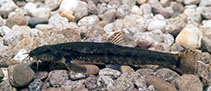
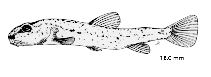
Rückenflossenstacheln (insgesamt) : 3; Rückenflossenweichstrahlen (insgesamt) : 6 - 8; Afterflossenstacheln: 3; Afterflossenweichstrahlen: 5 - 6. Distinguished from its congeners in Europe by the following combination of characters: caudal fin usually slightly emarginate (truncate in a few populations); pelvic origin beneath dorsal origin or under branched dorsal rays 1-2; caudal peduncle depth 1.4-2.2 (usually 1.6-2.0) times in its length, 1.2-1.8 times in body depth; often lacking dark blotches along back between nape and dorsal (Ref. 59043).
Body elongated, anteriorly somewhat depressed, posteriorly laterally compressed. Three pairs of mouth barbels. No erectile spine below eye. Posterior margin of caudal fin slightly notched. Caudal fin with 15-17 rays (Ref. 2196).
Body shape (shape guide): fusiform / normal; Cross section: circular.
Facultative or obligate air-breathing (Ref. 126274); Usually found in flowing stretches of streams and medium-sized rivers with gravel to stone bottom, but also in a variety of other habitats, including sandy canals and lake shores. Larvae are benthic. Larvae and small juveniles prefer sand bottom and slow current, shifting to gravel bottom and fast current when growing. Adults prey on relatively large benthic invertebrates such as gammarids, chironomids, insect larvae. They breed on gravel, sand or among aquatic vegetation. Tolerate moderate organic pollution and stream canalization and very sensitive to pollution by heavy metals (Ref. 59043). Sensitive to pollution and low oxygen levels, therefore, its presence in a river can be taken as an indication of good water quality (Ref. 6111).
Spawns once a year for several years in low productivity streams, but exhibits multiple spawning within a season in high productivity environments (Ref. 40290, 40756). Releases eggs in open open water, often close to surface. Eggs drift and adhere to different substrates and are often covered by sand or detritus. Individual females may spawn daily for a short period (Ref. 59043).
Kottelat, M. and J. Freyhof, 2007. Handbook of European freshwater fishes. Publications Kottelat, Cornol and Freyhof, Berlin. 646 pp. (Ref. 59043)
IUCN Rote Liste Status (Ref. 130435: Version 2025-1)
Bedrohung für Menschen
Harmless
Nutzung durch Menschen
Fischereien: weniger kommerziell; Aquarium: Öffentliche Aquarien; Köder: occasionally
Tools
Zusatzinformationen
Download XML
Internet Quellen
Estimates based on models
Phylogenetic diversity index (Ref.
82804): PD
50 = 0.5000 [Uniqueness, from 0.5 = low to 2.0 = high].
Bayesian length-weight: a=0.01000 (0.00391 - 0.02557), b=3.04 (2.82 - 3.26), in cm total length, based on LWR estimates for this (Sub)family-body shape (Ref.
93245).
Trophic level (Ref.
69278): 3.3 ±0.0 se; based on diet studies.
Generation time: 4.6 ( na - na) years. Estimated as median ln(3)/K based on 1
growth studies.
Widerstandsfähigkeit (Ref.
120179): mittel, Verdopplung der Population dauert 1,4 - 4,4 Jahre. (tm=2-3).
Fishing Vulnerability (Ref.
59153): Moderate vulnerability (37 of 100).
🛈