Classificação / Names
Nomes comuns | Sinónimos | Catalog of Fishes(Género, Espécies) | ITIS | CoL | WoRMS | Cloffa
>
Gobiiformes (Gobies) >
Gobiidae (Gobies) > Gobiinae
Etymology: steelei: Named for Mark H. Steele, California State University, Northridge, California.
Eponymy: Professor Cornelius Jan van der Horst (1889–1951) was a Dutch zoologist who moved to South Africa (1928) and became Head of the Zoology Department, Witwatersrand University, Johannesburg. [...] Dr Mark Adams Steele (d: 1967) is a biologist and ichthyologist who is a Professor in the Department of Biology, California State University, Northridge. [...] (Ref. 128868), visit book page.
More on authors: Randall & Munday.
Environment: milieu / climate zone / intervalo de profundidade / distribution range
Ecologia
marinhas demersal; intervalo de profundidade 0 - 5 m (Ref. 74955). Tropical
Eastern Pacific: Society Islands (French Polynesia).
Tamanho / Peso / Idade
Maturidade: Lm ? range ? - ? cm
Max length : 5.2 cm SL macho/indeterminado; (Ref. 74955)
Descrição breve
Chaves de identificação | Morfologia | Morfometria
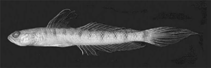
Espinhos dorsais (total) : 7; Raios dorsais moles (total) : 15; Espinhos anais: 1; Raios anais moles: 16. This species is characterized by the following: D VI-I,15; A I,15 or 16 (rarely 15); pectoral rays 17 or 18; scales in longitudinal series 55-58; absence of scales on head, or predorsal or prepectoral areas; body elongate, with depth 6.4-7.25 in SL; orbit diameter 3.55-4.0 in HL; fourth dorsal spine longest, 3.85-4.3 in SL; caudal fin lanceolate and terminally bilobed, with the sixth and tenth branched rays longest, 2.3-2.5 in SL; pectoral fins extending to above or slightly beyond anus, 4.25-4.3 in SL; pelvic fins reaching beyond anus, 4.15-4.35 in SL; pelvic fins reaching beyond anus, 4.15-4.35 in SL; color in alcohol pale yellowish, the edges of scales brown; upper side of body with narrow dark bars from darker brown scale edges; a series of dark spots dorsally on body from dark brown scale edges; cheek and opercle light gray-brown with pale spots, some nearly as large as pupil; a blackish streak in groove above upper lip; median fins spotted (Ref. 74955).
Body shape (shape guide): fusiform / normal; Cross section: oval.
Life cycle and mating behavior
Maturidade | Reprodução | Desova | Ovos | Fecundidade | Larvas
Randall, J.E. and P.L. Munday, 2008. Vanderhorstia steelei, a new shrimpgoby from the Society Islands. aqua, Int. J. Ichthyol. 14(1):35-41. (Ref. 74955)
Categoria na Lista Vermelha da IUCN (Ref. 130435: Version 2025-1)
Ameaça para o homem
Harmless
Utilização humana
Ferramentas
Relatórios especiais
Descarregue XML
Fontes da internet
Estimates based on models
Preferred temperature (Ref.
123201): 26.9 - 29, mean 27.9 °C (based on 95 cells).
Phylogenetic diversity index (Ref.
82804): PD
50 = 0.5000 [Uniqueness, from 0.5 = low to 2.0 = high].
Bayesian length-weight: a=0.01023 (0.00477 - 0.02194), b=3.01 (2.83 - 3.19), in cm total length, based on LWR estimates for this (Sub)family-body shape (Ref.
93245).
Nível Trófico (Ref.
69278): 3.2 ±0.3 se; based on size and trophs of closest relatives
Resiliência (Ref.
120179): Elevada, tempo mínimo de duplicação da população menor que 15 meses (Preliminary K or Fecundity.).
Fishing Vulnerability (Ref.
59153): Low vulnerability (10 of 100).
🛈