



Karalla dussumieri (Valenciennes, 1835)
Dussumier's ponyfish
添加你自己的观测位置在 Fish Watcher
| Native range | All suitable habitat | Point map | Year 2050 |
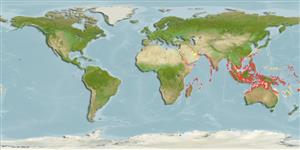
|
| This map was computer-generated and has not yet been reviewed. |
| Karalla dussumieri AquaMaps Data sources: GBIF OBIS |

分类 / 名称 俗名 | 同种异名 | Catalog of Fishes(属, 种) | ITIS | CoL | WoRMS | Cloffa
Teleostei > Acanthuriformes (Surgeonfishes) > Leiognathidae (Slimys, slipmouths, or ponyfishes) > Gazzinae
Etymology: Karalla: Karalla is the local name for ponyfishes in Sri Lanka and the surrounding region where members of this genus commonly occur.
Eponymy: Jean-Jacques Dussumier (1792–1883) was a French merchant, collector, traveller and ship owner. [...] (Ref. 128868), visit book page.
More on author: Valenciennes.
Etymology: Karalla: Karalla is the local name for ponyfishes in Sri Lanka and the surrounding region where members of this genus commonly occur.
Eponymy: Jean-Jacques Dussumier (1792–1883) was a French merchant, collector, traveller and ship owner. [...] (Ref. 128868), visit book page.
More on author: Valenciennes.
环境:氛围 / 气候带 / 深度上下限 / 分布范围 生态学
海洋; 半咸淡水 居于水底的; 深度上下限 10 - 40 m (Ref. 47581). 热带
分布 领土 | FAO区域 | 生态系 | 标本纪录 | 分布图 | 简介 | Faunafri
Indo-West Pacific: Madagascar, Reunion, India, Sri Lanka, through Indonesia and the Philippines.
印度-西太平洋: 马达加斯加,留尼旺岛,印度,斯里兰卡, 经过印度尼西亚与菲律宾。
印度-西太平洋: 马达加斯加,留尼旺岛,印度,斯里兰卡, 经过印度尼西亚与菲律宾。
大小 / 重量 / 年龄
成熟度: Lm ? range ? - ? cm
Max length : 14.0 cm TL 雄鱼/尚未辨别雌雄; (Ref. 47581); common length : 11.0 cm TL 雄鱼/尚未辨别雌雄; (Ref. 47581)
Max length : 14.0 cm TL 雄鱼/尚未辨别雌雄; (Ref. 47581); common length : 11.0 cm TL 雄鱼/尚未辨别雌雄; (Ref. 47581)
简单描述 检索表 | 型态特徵 | 形态测量图
Body shape (shape guide): short and / or deep.
Found in coral sand bottoms of coastal waters, but also enters estuaries (Ref. 47581). Feeds on small crustaceans, polychaetes, bivalves, foraminiferans, gastropods and nematodes (Ref. 47581). Forms schools (Ref. 47581). Sold dried salted in markets, and also used for fishmeal (Ref. 3424).
发现于沿岸水域的珊瑚砂质底部了, 也进入河口.(参考文献 47581) 吃小型甲壳动物,多毛类动物,二枚贝,有孔虫,腹足动物与线虫类。 (参考文献 47581) 形成鱼群。 (参考文献 47581) 贩卖干燥盐腌在市场中, 以及制成鱼浆.(参考文献 3424)
发现于沿岸水域的珊瑚砂质底部了, 也进入河口.(参考文献 47581) 吃小型甲壳动物,多毛类动物,二枚贝,有孔虫,腹足动物与线虫类。 (参考文献 47581) 形成鱼群。 (参考文献 47581) 贩卖干燥盐腌在市场中, 以及制成鱼浆.(参考文献 3424)
生命周期和交配行为 成熟度 | 繁殖 | 产卵场 | 卵 | 孕卵数 | 仔鱼
印度-西太平洋: 马达加斯加,留尼旺岛,印度,斯里兰卡, 经过印度尼西亚与菲律宾。
主要参考文献
上传您的参考资料 | 参考文献 | 合作者 : Woodland, David J. | 合作者
Woodland, D.J., S. Premcharoen and A.S. Cabanban, 2001. Leiognathidae. Slipmouths (ponyfishes). p. 2792-2823. In K.E. Carpenter and V.H. Niem (eds.) FAO species identification guide for fishery purposes. The living marine resources of the Western Central Pacific. Volume 5. Bony fishes part 3 (Menidae to Pomacentridae). Rome, FAO. pp. 2791-3380. (Ref. 47581)
CITES
Not Evaluated
对人类的威胁
无害处的
人类利用
渔业: 商业性
FAO - Publication: search | FishSource |
更多信息
工具
特别资料
下载 XML
网络资源
AFORO (otoliths) | Aquatic Commons | BHL | Cloffa | Websites from users | 核实 FishWatcher | CISTI | Catalog of Fishes: 属, 种 | DiscoverLife | ECOTOX | FAO - Publication: search | Faunafri | Fishipedia | Fishtrace | GloBI | Google Books | Google Scholar | Google | IGFA World Record | OneZoom | Open Tree of Life | Otolith Atlas of Taiwan Fishes | PubMed | Reef Life Survey | Socotra Atlas | TreeBase | 树状分类阶层 | Wikipedia: 转至, 搜寻 | World Records Freshwater Fishing | 动物学的记录
基于模型的估算
首选温度 (参考文献 123201): 25.3 - 29.1, mean 28.3 °C (based on 836 cells).
系统发育多样性指数 (参考文献 82804): PD50 = 0.7500 [Uniqueness, from 0.5 = low to 2.0 = high].
Bayesian length-weight: a=0.01445 (0.00748 - 0.02794), b=2.94 (2.77 - 3.11), in cm total length, based on LWR estimates for this species & (Sub)family-body (Ref. 93245).
营养阶层 (参考文献 69278): 3.2 ±0.38 se; based on food items.
回复力 (参考文献 120179): 高度, 族群倍增时间少于 15个月 (Preliminary K or Fecundity.).
营养素 (Ref. 124155): Calcium = 568 [75, 1,776] mg/100g; Iron = 3.66 [0.98, 10.46] mg/100g; Protein = 18.8 [16.7, 20.8] %; Omega3 = 0.228 [0.106, 0.498] g/100g; Selenium = 60.1 [19.0, 186.9] μg/100g; VitaminA = 15.1 [4.6, 47.1] μg/100g; Zinc = 2.22 [0.97, 4.10] mg/100g (wet weight); based on nutrient studies.