>
Gobiiformes (Gobies) >
Gobiidae (Gobies) > Gobiinae
Etymology: Grallenia: Named for Gerald R. Allen, (G+R+Allen+suffix '-ia'), in honor of his great contribution to our knowledge of the diversity of coral-reef fishes; lipi: Named for the Lembaga Ilmu Pengetahuan Indonesia (or Indonesian Institute of Science), abbreviation of the institute.
Eponymy: Dr Gerald Ray Allen (d: 1942) The genus was named to honour “…his great contribution to our knowledge of the diversity of coral-reef fishes.” (See Allen, GR) This is an acronym of Lembaga Ilmu Pengetahuan Indonesia (Indonesian Institute of Science), referring to the fact that all examined specimens were captured during the JSPS (Japan Society for the Promotion of Science)-LIPI cooperative research on [...] (Ref. 128868), visit book page.
Environment: milieu / climate zone / rango de profundidad / distribution range
Ecología
marino demersal; rango de profundidad 8 - 20 m (Ref. 90102). Tropical
Western Pacific: Indonesia.
Tamaño / Peso / Age
Madurez: Lm ? range ? - ? cm
Max length : 1.6 cm SL macho / no sexado; (Ref. 75132); 1.9 cm SL (female)
Short description
Claves de identificación | Morfología | Morfometría
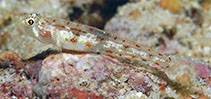
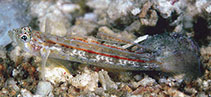
Espinas dorsales (total) : 7 - 8; Radios blandos dorsales (total) : 9 - 10; Espinas anales: 1; Radios blandos anales: 9. This species is distinguished by the following characters: second dorsal-fin rays I, 9-10; anal-fin rays I, 9; vertebrae 10+17-18= 27-28, usually 10+18=28); first spine of first dorsal-fin greatly elongated or filamentous in males; second dorsal fin usually reaching to, or beyond, caudal-fin base when adpressed in adult, length of longest ray 17.5-21.8% of SL; length of longest ray of anal fin 12.6-18.1% of SL); scales on body restricted on posterior half of body, except for isolated patch of scales just behind pectoral-fin base; no pelvic frenum; length of pectoral fin 23.2-30.6% of SL); caudal-peduncle length 20.3-23.6% of SL; cephalic sensory canals and associated pores absent; an orange line present at the middle of dorsal fin in life (Ref. 75132).
Body shape (shape guide): elongated.
Collected around an isolated, relatively large coral patch on flat, clean and fine sandy bottom
at a depth of 15 m; the area is typical for other sandy-bottom dwellers (e.g., Fusigobius inframaculatus, Limnichthys nitidus). Similar to its congener G. arenicola, as observed, this species did not display symbiotic association with any other organisms. Found to be widespread in Indonesia, and often found on light coloured sand or rubble to
about 15 m depth (Ref. 75132).
Life cycle and mating behavior
Madurez | Reproducción | Puesta | Huevos | Fecundidad | Larva
Shibukawa, K. and A. Iwata, 2007. Grallenia, a new goby genus from the western Pacific, with descriptions of two new species (Perciformes: Gobiidae: Gobiinae). Bull. Natl. Mus. Nat. Sci., Ser. A, Suppl. 1:123-136. (Ref. 75132)
IUCN Red List Status (Ref. 130435: Version 2025-1)
Threat to humans
Harmless
Human uses
Herramientas
Special reports
Download XML
Fuentes de Internet
Estimates based on models
Preferred temperature (Referencia
123201): 28.5 - 29.2, mean 28.8 °C (based on 284 cells).
Phylogenetic diversity index (Referencia
82804): PD
50 = 0.5020 [Uniqueness, from 0.5 = low to 2.0 = high].
Bayesian length-weight: a=0.00724 (0.00339 - 0.01546), b=3.10 (2.92 - 3.28), in cm total length, based on LWR estimates for this (Sub)family-body shape (Ref.
93245).
Nivel trófico (Referencia
69278): 3.0 ±0.3 se; based on size and trophs of closest relatives
Resiliencia (Referencia
120179): Alto, población duplicada en un tiempo mínimo inferior a 15 meses (Preliminary K or Fecundity.).
Fishing Vulnerability (Ref.
59153): Low vulnerability (10 of 100).
🛈