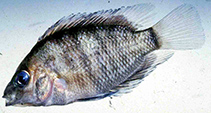
Cryptoheros chetumalensis

You can sponsor this page

Cryptoheros chetumalensis Schmitter-Soto, 2007

Hochladen Photos und videos
Bilder | Google Bild
Image of Cryptoheros chetumalensis
Cryptoheros chetumalensis
Photo von Bahena, H. / Schmitter Soto, J.J.

Klassifizierung / Names Namen | Synonyme | Catalog of Fishes(Gattung, Arten) | ITIS | CoL | WoRMS | Cloffa

> Cichliformes (Cichlids, convict blennies) > Cichlidae (Cichlids) > Cichlinae
Etymology: chetumalensis: Named for the city, Chetumal; an adjective.

Environment: milieu / climate zone / Tiefenbereich / distribution range Ökologie

; süßwasser benthopelagisch. Tropical

Verbreitung Länder | FAO Gebiete | Ecosystems | Vorkommen | Punkt Karte | Einführungen | Faunafri

North America: Belize and Mexico.

Size / Gewicht / Alter

Geschlechtsreife: Lm ?  range ? - ? cm
Max length : 9.7 cm SL Männchen/unbestimmt; (Ref. 74403)

Kurzbeschreibung Bestimmungsschlüssel | Morphologie | Morphometrie

Rückenflossenstacheln (insgesamt) : 17 - 19; Rückenflossenweichstrahlen (insgesamt) : 8 - 10; Afterflossenstacheln: 8 - 10; Afterflossenweichstrahlen: 7 - 9. This species differs from C. spilurus and C. cutteri in having the secondary pored scales on caudal fin not forming rows (vs. forming rows); the rostral end of maxilla is convex (vs. notched or concave); first neural spine slanting rostrad instead of caudad; with 3 (vs. 2) dorsal elements between first two epineural spines; a spinous anterodorsal process on first dorsal pterygiophore present (vs. absent) (Ref. 74403).

Biologie     Fachlexikon (Englisch) (z.B. epibenthic)

Life cycle and mating behavior Geschlechtsreife | Fortpflanzung | Ablaichen | Eier | Fecundity | Larven

Hauptreferenz Upload your references | Referenzen | Koordinator : Kullander, Sven O. | Partner

Schmitter-Soto, J.J., 2007. A systematic revision of the genus Archocentrus (Perciformes: Cichlidae), with the description of two new genera and six new species. Zootaxa 1603:1-78. (Ref. 74403)

IUCN Rote Liste Status (Ref. 130435: Version 2025-1)

  nicht bedroht (LC) ; Date assessed: 22 August 2018

CITES

Not Evaluated

CMS (Ref. 116361)

Not Evaluated

Bedrohung für Menschen

  Harmless


Nutzung durch Menschen

FAO - Publication: search | FishSource |

Mehr Information

Trophic ecology
Food items (preys)
Nahrungszusammensetzung
Nahrungsaufnahme
Food rations
Räuber
Ökologie
Ökologie
Home ranges
Population dynamics
Growth parameters
Max. ages / sizes
Length-weight rel.
Length-length rel.
Längenhäufigkeiten
Mass conversion
Rekrutierung
Dichte
Life cycle
Fortpflanzung
Geschlechtsreife
Maturity/Gills rel.
Fecundity
Ablaichen
Spawning aggregations
Eier
Eientwicklung
Larven
Larven Pop.Dyn.
Verbreitung
Länder
FAO Gebiete
Ecosystems
Vorkommen
Einführungen
BRUVS - Videos
Anatomy
Kiemenoberfläche
Brain
Otolith
Physiology
Body composition
Nutrients
Oxygen consumption
Swimming type
Swimming speed
Visual pigments
Fish sound
Diseases & Parasites
Toxicity (LC50s)
Genetik
Genom
Genetik
Heterozygosity
Vererbbarkeit
Human related
Aquaculture systems
Aquakultur Profile
Zuchtlinien
Ciguatera cases
Stamps, coins, misc.
Outreach
Partner
Taxonomy
Namen
Synonyme
Morphologie
Morphometrie
Bilder
Referenzen
Referenzen

Tools

Zusatzinformationen

Download XML

Internet Quellen

AFORO (otoliths) | Aquatic Commons | BHL | Cloffa | Websites from users | FishWatcher Einträge suchen | CISTI | Catalog of Fishes: Gattung, Arten | DiscoverLife | ECOTOX | FAO - Publication: search | Faunafri | Fishipedia | Fishtrace | GloBI | Google Books | Google Scholar | Google | IGFA World Record | Nationale Datenbanken | OneZoom | Open Tree of Life | Otolith Atlas of Taiwan Fishes | PubMed | Reef Life Survey | Socotra Atlas | TreeBase | Tree of Life | Wikipedia: Gehe zu, Suchen | Zoobank | Zoological Record

Estimates based on models

Phylogenetic diversity index (Ref. 82804):  PD50 = 0.6250   [Uniqueness, from 0.5 = low to 2.0 = high].
Bayesian length-weight: a=0.03020 (0.01346 - 0.06774), b=3.03 (2.84 - 3.22), in cm total length, based on LWR estimates for this (Sub)family-body shape (Ref. 93245).
Trophic level (Ref. 69278):  3.2   ±0.5 se; based on size and trophs of closest relatives
Widerstandsfähigkeit (Ref. 120179):  hoch, Verdopplung der Population dauert weniger als 15 Monate. (Preliminary K or Fecundity.).
Fishing Vulnerability (Ref. 59153):  Low vulnerability (10 of 100). 🛈