>
Eupercaria/misc (Various families in series Eupercaria) >
Haemulidae (Grunts) > Plectorhinchinae
Etymology: Plectorhinchus: Greek, plektos = plaited + Greek, rhyngchos = snout (Ref. 45335).
More on author: Lacepède.
Environment: milieu / climate zone / rango de profundidad / distribution range
Ecología
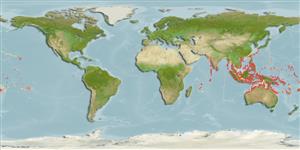
marino; salobre asociado a arrecife; rango de profundidad 1 - 30 m (Ref. 9710). Tropical; 31°N - 23°S, 57°E - 144°W
Indo_West Pacific: Maldives (Ref. 11303) and Cocos Islands (Ref. 9399); Sumatra to Fiji (Ref. 9710) and New Caledonia, north to Ryukyu Islands, south to Rowley Shoals.
Length at first maturity / Tamaño / Peso / Age
Madurez: Lm ?, range 40 - ? cm
Max length : 72.0 cm TL macho / no sexado; (Ref. 9710); common length : 60.0 cm SL macho / no sexado; (Ref. 37816); peso máximo publicado: 7.0 kg (Ref. 9710)
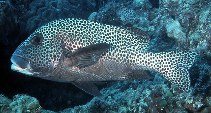
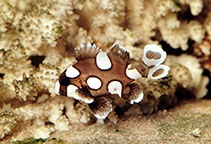
Espinas dorsales (total) : 11 - 12; Radios blandos dorsales (total) : 18 - 20; Espinas anales: 3; Radios blandos anales: 7 - 9. This species is distinguished by the following characters: chin with 6 pores, no median pit; gill rakers on first gill arch 9-12 + 1 + 27-32 = 36-43; D XII (rarely XI),18-20; longest dorsal-fin ray 16-25% of standard length, almost equal to length of soft dorsal-fin base in small specimens, more than 1/2 length of soft dorsal-fin base in adults; lips fleshy, moderately swollen with age; scales ctenoid (rough to touch); lateral line tubed scales about 52-59; body depth 2.4-2.5 in SL; caudal fin deeply forked with broadly rounded lobes in juveniles; only slightly forked to emarginate in adults. Colour of body with numerous dark brown spots, generally larger than pupil; pelvic fins spotted, darkening with age; juveniles brownish with large, well-defined creamy white blotches on body that include brown spots with age; colour gradually changing into a greyish background with large, deep brown spots (Ref. 47695, 90102).
Body shape (shape guide): short and / or deep; Cross section: compressed.
Inhabits coral-rich areas of clear lagoon and seaward reefs. Adults are solitary, near and under ledges or caves by day. Juveniles are found among corals (Ref. 9710). Feeds on crustaceans, mollusks, and fishes at night. Juveniles are used in the aquarium industry (Ref. 9137). Small juveniles may mimic a toxic flatworm (Ref. 9710). Marketed fresh, a small quantity is salted. Large fish have coarse and dry flesh (Ref. 47695).
Life cycle and mating behavior
Madurez | Reproducción | Puesta | Huevos | Fecundidad | Larva
Oviparous, distinct pairing during breeding (Ref. 205).
Myers, R.F., 1991. Micronesian reef fishes. Second Ed. Coral Graphics, Barrigada, Guam. 298 p. (Ref. 1602)
IUCN Red List Status (Ref. 130435: Version 2025-1)
Threat to humans
Harmless
Human uses
Pesquerías: escaso valor comercial; Acuario: Comercial
Herramientas
Special reports
Download XML
Fuentes de Internet
Estimates based on models
Preferred temperature (Referencia
123201): 25.5 - 29.3, mean 28.6 °C (based on 2654 cells).
Phylogenetic diversity index (Referencia
82804): PD
50 = 0.5000 [Uniqueness, from 0.5 = low to 2.0 = high].
Bayesian length-weight: a=0.01778 (0.01068 - 0.02961), b=2.97 (2.83 - 3.11), in cm total length, based on LWR estimates for this species & (Sub)family-body (Ref.
93245).
Nivel trófico (Referencia
69278): 3.8 ±0.60 se; based on food items.
Resiliencia (Referencia
120179): Bajo, población duplicada en un tiempo mínimo de 4.5-14 años (Preliminary K or Fecundity.).
Fishing Vulnerability (Ref.
59153): Moderate to high vulnerability (49 of 100).
🛈
Nutrients (Ref.
124155): Calcium = 23.4 [10.8, 51.3] mg/100g; Iron = 0.448 [0.229, 0.851] mg/100g; Protein = 19.3 [17.4, 21.3] %; Omega3 = 0.0978 [, ] g/100g; Selenium = 32.8 [16.8, 63.1] μg/100g; VitaminA = 42.6 [12.0, 152.2] μg/100g; Zinc = 0.972 [0.626, 1.520] mg/100g (wet weight);