Klassifizierung / Names
Namen | Synonyme | Catalog of Fishes(Gattung, Arten) | ITIS | CoL | WoRMS | Cloffa
>
Cypriniformes (Carps) >
Cyprinidae (Minnows or carps) > Barbinae
Etymology: Barbus: Latin, barbus = barbel (Ref. 45335).
Eponymy: Sir Charles Alfred Payton (1843–1926) was a British adventurer, writer, fisherman and diplomat who was British Consul to Morocco, where this barb is found. [...] Salamon János Petényi (1799–1855) was a Hungarian Lutheran pastor, zoologist, palaeontologist and ornithologist. [...] (Ref. 128868), visit book page.
More on author: Heckel.
Environment: milieu / climate zone / Tiefenbereich / distribution range
Ökologie
; süßwasser benthopelagisch. Subtropical
Europe: Danube drainage in Bulgaria and Romania; Kamchyia drainage (Black Sea basin) in Bulgaria.
Size / Gewicht / Alter
Geschlechtsreife: Lm ? range ? - ? cm
Max length : 25.0 cm SL Männchen/unbestimmt; (Ref. 59043)
Kurzbeschreibung
Bestimmungsschlüssel | Morphologie | Morphometrie
Diagnosed from other species of Barbus and Luciobarbus in Balkan Peninsula and Danube drainage by the following characters: last simple dorsal ray weak, not serrated posteriorly, segmented along entire length; lower lip thick, with a pendulous median lobe; usually 9-11 scale rows between lateral line and dorsal-fin origin; usually 8-10 scale rows between lateral and pelvic-fin origin; top of head plain with small black dots, smaller than pupil; check and opercle with dark dots; paired fins unspotted, rays unpigmented or with a few dark pigments not forming dark bars; body with dark dots and blotches much darker than background; and caudal fin with elongate spots, larger than pupil diameter (Ref. 59043).
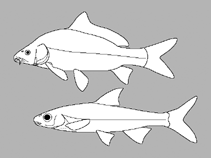
Body shape (shape guide): elongated.
Inhabits the upper and middle stretches of streams and small rivers with fast, clear and well oxygenated water. Still common in suitable habitats. Decline of its population is suspected and expected to continue gradually due to on-going economic development. Attains a maximum size up to at least 25 cm SL (Ref. 59043).
Life cycle and mating behavior
Geschlechtsreife | Fortpflanzung | Ablaichen | Eier | Fecundity | Larven
Kottelat, M. and J. Freyhof, 2007. Handbook of European freshwater fishes. Publications Kottelat, Cornol and Freyhof, Berlin. 646 pp. (Ref. 59043)
IUCN Rote Liste Status (Ref. 130435: Version 2025-1)
Bedrohung für Menschen
Harmless
Nutzung durch Menschen
Tools
Zusatzinformationen
Download XML
Internet Quellen
Estimates based on models
Phylogenetic diversity index (Ref.
82804): PD
50 = 0.5000 [Uniqueness, from 0.5 = low to 2.0 = high].
Bayesian length-weight: a=0.00631 (0.00304 - 0.01311), b=3.08 (2.90 - 3.26), in cm total length, based on LWR estimates for this (Sub)family-body shape (Ref.
93245).
Trophic level (Ref.
69278): 3.1 ±0.4 se; based on size and trophs of closest relatives
Widerstandsfähigkeit (Ref.
120179): mittel, Verdopplung der Population dauert 1,4 - 4,4 Jahre. (Preliminary K or Fecundity.).
Fishing Vulnerability (Ref.
59153): Low vulnerability (21 of 100).
🛈