



Rhinobatos jimbaranensis Last, White & Fahmi, 2006
Jimbaran shovelnose ray
Загрузить свой Фото и Видео
Изображение на Google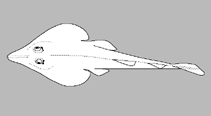 No image available for this species;
drawing shows typical species in Rhinobatidae.
Изображение на Google
drawing shows typical species in Rhinobatidae.
Классификация / Имена народные названия | синонимы | Catalog of Fishes(род, виды) | ITIS | CoL | WoRMS | Cloffa
Пластиножаберные (акулы и скаты) (sharks and rays) > Rhinopristiformes (Shovelnose rays) > Rhinobatidae (Guitarfishes)
Etymology: Rhinobatos: Greek, rhinos = nose + Greek, batis, -idos = a ray (Raja sp.) (Ref. 45335); jimbaranensis: Named for its type locality, the Jimbaran Bay.
More on authors: Last, White & Fahmi.
Etymology: Rhinobatos: Greek, rhinos = nose + Greek, batis, -idos = a ray (Raja sp.) (Ref. 45335); jimbaranensis: Named for its type locality, the Jimbaran Bay.
More on authors: Last, White & Fahmi.
Окружающая среда: среда / климатическая зона / пределы глубины / диапазон распространения экология
морской донно-пелагический. Tropical
распространение Территории | регионы FAO | Экосистемы | места находок | карта точек | интродукции | Faunafri
Eastern Indian Ocean: endemic to central Indonesia (Ref. 114953).
Длина при первой зрелости / Размер / Вес / Возраст
половая зрелость: Lm 76.5 range ? - ? cm
Max length : 89.2 cm TL самец/пол неопределен; (Ref. 74367); 99.4 cm TL (female)
Max length : 89.2 cm TL самец/пол неопределен; (Ref. 74367); 99.4 cm TL (female)
Краткое описание определительные ключи | морфология | морфометрия
This species is defined by the following set of adult characters: disc wedge-shaped, width 32-33% TL, length more than 1.3 (1.35-1.39) times width; snout moderately elongate, length 3.4-3.6 times interspiracular distance, 5-5.5 times interorbital width; orbit medium-sized, 1.5-1.6 times spiracle length; nostrils weakly oblique, length 1.3-1.4 times internarial distance; preoral length 7.7-8.1 times internarial distance; anterior nasal flaps penetrating slightly into internarial space, however, well separated at their insertion; posterior nasal flaps broad; spiracular folds 2, outermost fold only slightly taller than inner fold; ridges of rostral cartilage almost parallel, converging slightly anteriorly but not constricted medially; anterior cartilage sickle shaped, pointed posteriorly; distance between fifth gill slits 3.1-3.4 times in ventral head length; prebranchial sensory pore patch obvious, extending to first gill slit; postscapular sensory canal obscure, without exposed lateral pores, not grooved; thorn patches on supraorbit, scapular region, and dorsal midline rudimentary, inconspicuous; inner margin of pelvic-fin slightly shorter than its base; interdorsal distance more than 2.5 (2.8-3.1) times first dorsal-fin base; dorsal caudal margin about 2.1 times preventral margin; upper jaw with 62-77 tooth rows; post-synarcual centra 176-180; nasal lamellae more than 50 (51-55); dorsal fin not distinctly bicolored; white spots absent on dorsal disc (Ref. 72461).
Body shape (shape guide): elongated.
Body shape (shape guide): elongated.
Demersal inshore on inner insular shelf. Mainly feeds on small crustaceans (Ref. 114953). The smallest pregnant female observed from this species was 74.7 cm TL; with pregnant females having 6-11 embryos, birth size unknown, but embryos well developed at 13 cm TL (Ref. 72461). Males mature at 77-80 cm TL. Females produces litters of 6-11 pups (Ref. 114953).
Жизненный цикл и брачное поведение половая зрелость | размножение | нерест | икра | Плодовитость | личинки
Основная ссылка
Загрузите свои рекомендации | ссылки | координатор : McEachran, John | соавторы
Last, P.R., W.T. White and Fahmi, 2006. Rhinobatos jimbaranensis and R. penggali, two new shovelnose rays (Batoidea: Rhinobatidae) from eastern Indonesia. Cybium 30(3):261-271. (Ref. 72461)
Статус Красного Списка МСОП (Ref. 130435: Version 2025-2 (Global))
В критическом состоянии (CR) (A2d); Date assessed: 19 May 2020
Угроза для людей
Harmless
Использование человеком
FAO - Publication: search | FishSource |
дополнительная информация
Трофическая экология
Пищевые предметы (добыча)
состав пищи
потребление пищи
Продовольственные пайки
хищники
Пищевые предметы (добыча)
состав пищи
потребление пищи
Продовольственные пайки
хищники
экология
экология
экология
Динамика численности населения
Параметры роста
Макс. возраст / размер
Отношение длины к весу.
Отношение длины к длине.
Размерный состав
Преобразование массы
пополнение
численность
Параметры роста
Макс. возраст / размер
Отношение длины к весу.
Отношение длины к длине.
Размерный состав
Преобразование массы
пополнение
численность
Жизненный цикл
размножение
половая зрелость
Зрелость/Жиры относительно.
Плодовитость
нерест
Нерестовые скопления
икра
Развитие икры
личинки
динамика численности личинок
размножение
половая зрелость
Зрелость/Жиры относительно.
Плодовитость
нерест
Нерестовые скопления
икра
Развитие икры
личинки
динамика численности личинок
Анатомия
жаберная область
Мозг
Отолит
жаберная область
Мозг
Отолит
Физиология
Состав тела
Питательные вещества
Потребление кислорода
Тип плавания
Скорость плавания
Зрительные пигменты
Звук рыбы
Болезни и паразиты
Токсичность (LC50s)
Состав тела
Питательные вещества
Потребление кислорода
Тип плавания
Скорость плавания
Зрительные пигменты
Звук рыбы
Болезни и паразиты
Токсичность (LC50s)
генетика
Геном
генетика
Гетерозиготность
наследуемость
Генетическое разнообразие
Геном
генетика
Гетерозиготность
наследуемость
Генетическое разнообразие
Связанные с человеком
Системы аквакультуры
особенности рыбоводства
степень растяжения
Случаи заболевания сигуатерой
Марки, монеты и прочее.
Системы аквакультуры
особенности рыбоводства
степень растяжения
Случаи заболевания сигуатерой
Марки, монеты и прочее.
инструменты
Специальные отчеты
Проверить содержание в аквариумах | Проверить опубликованные видовые данные | Проверить опубликованные данные по аквакультуре
Скачать в формате XML
ресурсы в Интернет
AFORO (otoliths) | Aquatic Commons | BHL | Cloffa | Websites from users | Проверить FishWatcher | CISTI | Catalog of Fishes: род, виды | DiscoverLife | ECOTOX | FAO - Publication: search | Faunafri | Fishipedia | Fishtrace | GloBI | Google Books | Google Scholar | Google | IGFA World Record | OneZoom | Open Tree of Life | Otolith Atlas of Taiwan Fishes | PubMed | Reef Life Survey | Socotra Atlas | TreeBase | Tree of Life | Wikipedia: Вперёд, поиск | World Records Freshwater Fishing | Zoobank | Зоологическая летопись
Оценки, основанные на моделях
Индекс филогенетического разнообразия (ссылка 82804): PD50 = 0.5000 [Uniqueness, from 0.5 = low to 2.0 = high].
Bayesian length-weight: a=0.00295 (0.00150 - 0.00581), b=3.13 (2.96 - 3.30), in cm total length, based on LWR estimates for this (Sub)family-body shape (Ref. 93245).
Трофический уровень (ссылка 69278): 3.8 ±0.4 se; based on size and trophs of closest relatives
устойчивость к внешним воздействиям (ссылка 120179): низкий, минимальное время удвоения популяции 4.5-14 лет (Preliminary low fecundity).