This website uses cookies to enhance your browsing experience and ensure the functionality of our site. For more detailed information about the types of cookies we use and how we protect your privacy, please visit our Privacy Information page.
×
Cookie Settings
This website uses different types of cookies to enhance your experience. Please select your preferences below:
Élasmobranches (requins et raies) (sharks and rays) > Hexanchiformes (Frill and cow sharks) > Hexanchidae (Cow sharks)
Etymology: Heptranchias:hept[a] (Gr.), seven; ranchias, etymology unclear, possibly a variant spelling of anchos (Gr.), gill, possibly with the addition of -ias, borrowed from karkharías, ancient Greek for shark (cf. Carcharias Rafinesque 1810), referring to how the seven gill openings extend down onto the throat (See ETYFish); perlo:From the French vernacular “Le Perlon,” pearl, probably referring to its smooth and grayish (“lisse & grisâtre”) skin (See ETYFish). More on author: Bonnaterre.
Environnement : milieu / zone climatique / profondeur / gamme de distribution Écologie
marin bathydémersal; profondeur 0 - 1000 m (Ref. 41394), usually 180 - 450 m (Ref. 45445). Deep-water; 58°N - 58°S, 98°W - 173°W
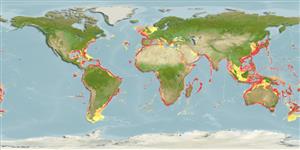
Circumglobal in tropical and temperate seas, excluding the northeast Pacific (Ref. 13573). Western Atlantic: North Carolina, USA and northern Gulf of Mexico to Cuba, then from Venezuela to Argentina (Ref. 6871). Eastern Atlantic: Morocco to Namibia, including the Mediterranean Sea (Ref. 247). Indian Ocean: southwestern India, Aldabra Island, southern Mozambique, and South Africa (Ref. 247). Western Pacific: Japan to China, Indonesia, Australia and New Zealand. Southeast Pacific: off northern Chile (Ref. 247).
Longueur à la première maturité / Taille / Poids / Âge
Maturité: Lm87.7, range 75 - 98 cm Max length : 137 cm TL mâle / non sexé; (Ref. 247); 140.0 cm TL (female); common length : 100.0 cm TL mâle / non sexé; (Ref. 26999)
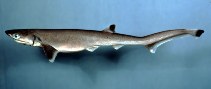
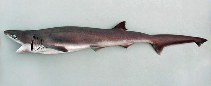
Épines dorsales (Total) : 0; Épines anales: 0; Vertèbres: 125 - 161. A narrow-headed, big-eyed small seven-gilled shark (Ref. 247). Body fusiform and slender; dorsal fin small, originating over inner margins of pelvic fins; anal fin small (Ref. 6871). Teeth wide, low and comb-shaped (Ref. 6871). Brownish grey above, paler below, sometimes with indistinct dark blotches on body; juveniles with dark-tipped dorsal and caudal fins, adults with light fin margins (Ref. 5578, 6574, 6871). Live specimens with fluorescent green eyes (Ref. 6871). Body shape (shape guide): elongated.
Found on the outer continental and insular shelves and upper slopes in depths of 100 to 400 (Ref. 13573, 11230), also inshore and down to 1,000 m (Ref. 6871, 11230). Feeds on small sharks and rays, small bony fish, shrimps, crabs, lobsters, squid, and cuttlefish (Ref. 5578). Ovoviviparous (Ref. 205), with 9-12 young born per litter (Ref. 247). Very active and aggressive when captured and quick to bite but too small to be very dangerous to people (Ref. 247). Liver utilized as a source of oil. Maximum length may reach 214 cm, but this is uncertain.
Ovoviviparous, number of young 9 to 20 in a litter (Ref. 247). Size at birth about 25 cm (Ref. 6871). Distinct pairing with embrace (Ref. 205). No apparent seasonality in its reproduction cycle (Ref.58048).
Compagno, L.J.V., 1984. FAO Species Catalogue. Vol. 4. Sharks of the world. An annotated and illustrated catalogue of shark species known to date. Part 1 - Hexanchiformes to Lamniformes. FAO Fish. Synop. 125(4/1):1-249. Rome, FAO. (Ref. 247)
Statut dans la liste rouge de l'IUCN (Ref. 130435: Version 2025-2 (Global))
Cycle de vie Reproduction Maturité Maturité/épines rel. Fécondité Frai Agrégats de frai Œufs Développement de l'œuf Larves Dynamique des populations larvaires
Physiologie Composition corporelle Nutriments Consommation d'oxygène Type de natation Vitesse de nage Pigments visuels Son de poisson Maladies et parasites Toxicité (CL50)