>
Eupercaria/misc (Various families in series Eupercaria) >
Labridae (Wrasses) > Xyrichtyinae
Etymology: Iniistius: Latin, in = in + Greek, istion = sail; griffithsi: Named for the collector, Jeremy Griffiths.
Eponymy: Jeremy Griffiths is the son of Owen Griffiths who noted that this was a ‘new’ fish and arranged for a photograph to be taken and a second specimen collected. [...] (Ref. 128868), visit book page.
More on author: Randall.
Environment: milieu / Klimaatzone / Diepte / distribution range
Ecologie
marien pelagic-neritic; diepte 8 - 120 m (Ref. 58466). Tropical
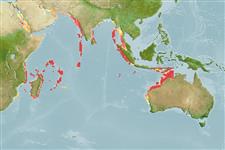
Indian Ocean: Mauritius, Madagascar and Christmas Island.
Grootte / Gewicht / Leeftijd
Maturiteit: Lm ? range ? - ? cm
Max length : 14.3 cm SL mannelijk / geslacht onbekend; (Ref. 58466)
Korte beschrijving
Determinatiesleutels | Morfologie | Morfometrie
Dorsale stekels (totaal) : 9; Dorsale zachte stralen (totaal) : 12; Anale stekels: 3; Anale zachte stralen: 12; Wervels: 25. This species is characterized by the following: Dorsal rays IX,12; anal rays III,12; pectoral rays 12; lateral line interrupted, the pored scales 19-20 + 5 or 6; cheek is naked except for a curved oblique row of 6 small scales from behind to below eye; 1 or 2 small scales dorsoanteriorly on the opercle; gill rakers 19-20; body depth 2.5-2.6 in SL; dorsal profile of snout nearly vertical; first two dorsal spines slender and flexible, the first slightly longer, 2.45-2.55 in head length; space between second and third dorsal spines more than twice that between first and second spines; color when fresh, pale grey, scale edges dorsally on body grey-brown; head grey-brown, operculum suffused with orange, with vertical blue bands; a broad oblique pale blue band containing numerous small black spots
from interorbital space to above opercle; one to several black spots, edged in pale blue, on side of body above tip of pectoral fin; a dusky streak below posterior end of maxilla and lower lip; orangish patch on side of caudal peduncle, each scale with a pale blue spot; median fins bluish grey; pectoral fins orange (Ref. 58466).
Body shape (shape guide): fusiform / normal; Cross section: compressed.
Found on sandy bottoms and dives into sand to sleep safely at night or to hide when alarmed (Ref. 90102).
Levenscyclus en paargedrag
Maturiteit | Voortplanting | Paaien | Eieren | Fecunditeit | Larven
Distinct pairing during breeding (Ref. 205).
Randall, J.E., 2007. Iniistius griffithsi, a new razorfish (Perciformes: Labridae) from Mauritius. Smithiana Bull. 7:9-13. (Ref. 58466)
Status op de Rode Lijst van het IUCN (Ref. 130435: Version 2025-1)
Gevaar voor de mens
Harmless
Gebruik door de mens
Visserij: commercieel
Tools
Speciale rapporten
Download XML
Internetbronnen
Estimates based on models
Preferred temperature (Ref.
123201): 24.7 - 28.7, mean 27.2 °C (based on 108 cells).
Fylogenetische diversiteitsindex (Ref.
82804): PD
50 = 0.5000 [Uniqueness, from 0.5 = low to 2.0 = high].
Bayesian length-weight: a=0.01047 (0.00408 - 0.02689), b=3.06 (2.84 - 3.28), in cm total length, based on LWR estimates for this (Sub)family-body shape (Ref.
93245).
Trofisch niveau (Ref.
69278): 3.4 ±0.5 se; based on size and trophs of closest relatives
Weerstandsvermogen (Ref.
120179): Hoog, minimale populatieverdubbelingstijd minder dan 15 maanden (Preliminary K or Fecundity.).
Fishing Vulnerability (Ref.
59153): Low vulnerability (10 of 100).
🛈