



Envoyez vos Photos et vidéos
Images | Images Google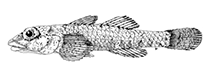 Pleurosicya larsonae
Female Photo de Greenfield, D.W./J.E. Randall
Images | Images Google
Female Photo de Greenfield, D.W./J.E. Randall
Classification / Noms Noms communs | Synonymes | Catalog of Fishes(Genre, Espèce) | ITIS | CoL | WoRMS | Cloffa
> Gobiiformes (Gobies) > Gobiidae (Gobies) > Gobiinae
Etymology: Pleurosicya: Greek, pleura = side, ribe + Greek, sikya, -as = cucumber (Ref. 45335); larsonae: Named for Helen K. Larson, Northern Territory Museum of Arts and Sciences, Darwin, Australia.
Eponymy: Dr Helen K Larson was Curator of Fishes, Museum and Art Gallery of the Northern Territory, Darwin, Australia (1981–2009), retiring as Emeritus Curator, and is now a Research Associate at the Museum of Tropical Queensland, Townsville. [...] (Ref. 128868), visit book page.
More on authors: Greenfield & Randall.
Etymology: Pleurosicya: Greek, pleura = side, ribe + Greek, sikya, -as = cucumber (Ref. 45335); larsonae: Named for Helen K. Larson, Northern Territory Museum of Arts and Sciences, Darwin, Australia.
Eponymy: Dr Helen K Larson was Curator of Fishes, Museum and Art Gallery of the Northern Territory, Darwin, Australia (1981–2009), retiring as Emeritus Curator, and is now a Research Associate at the Museum of Tropical Queensland, Townsville. [...] (Ref. 128868), visit book page.
More on authors: Greenfield & Randall.
Environnement : milieu / zone climatique / profondeur / gamme de distribution Écologie
marin récifal; profondeur 0 - 6 m (Ref. 58271). Tropical
Distribution Territoires | Zones FAO | Écosystèmes | Occurrences | Carte par point | Introductions | Faunafri
Eastern Central Pacific: Hawaii.
Taille / Poids / Âge
Description synthétique Clés d'identification | Morphologie | Morphométrie
Épines dorsales (Total) : 7; Rayons mous dorsaux (Total) : 7 - 8; Épines anales: 1; Rayons mous anaux: 7 - 8. This small species has the following characteristics: a broad head and moderate snout, eyes set dorsolaterally; second dorsal- and anal-fin rays I,7-I,8 (usually I,8); pectoral-fin rays 17-18 (usually 17); longitudinal scales 24; TRB 6; nape naked; pelvic fin rounded, cup-like, with fleshy, rounded pelvic spine lobes; tongue round; lower gill opening margin attached at level of preopercular margin; gill membranes broadly joined to isthmus; live color translucent with orange markings and some melanophores (Ref. 58271).
Body shape (shape guide): fusiform / normal; Cross section: oval.
Body shape (shape guide): fusiform / normal; Cross section: oval.
This species appears to be extremely cryptic, collected five times only in a total of 75 general ichthyocide collections, with 4 of those collections from a specific habitat, shallow patch reefs (0-4.6 m) with good circulation. The sixth collection from that specific habitat only occurred after a number of futile attempts to collect more individuals for photographs. This particular species was reported to have been at Haleiwa, O’ahu, living on Porites compressa (Ref. 58271). Benthic (Ref. 58302).
Cycle de vie et comportement reproducteur Maturité | Reproduction | Frai | Œufs | Fécondité | Larves
Référence principale
Téléchargez vos références | Références | Coordinateur | Collaborateurs
Greenfield, D.W. and J.E. Randall, 2004. The marine gobies of the Hawaiian Islands. Proc. Calif. Acad. Sci. 55(27):498-549. (Ref. 58271)
Statut dans la liste rouge de l'IUCN (Ref. 130435: Version 2025-2 (Global))
Données manquantes (DD) ; Date assessed: 19 March 2024
CITES
Not Evaluated
Menace pour l'homme
Harmless
Utilisations par l'homme
Pêcheries: sans intérêt
FAO - Publication: search | FishSource |
Plus d'informations
Écologie trophique
Aliments (proies)
Composition du régime alimentaire
Consommation alimentaire
Rations alimentaires
Prédateurs
Aliments (proies)
Composition du régime alimentaire
Consommation alimentaire
Rations alimentaires
Prédateurs
Écologie
Écologie
Écologie
Dynamique des populations
Paramètres de croissance
Âges / tailles maximales
Longueur-poids rel.
Rel. longueur-longueur.
Fréquences de longueurs
Conversion de masse
Recrutement
Abondance
Paramètres de croissance
Âges / tailles maximales
Longueur-poids rel.
Rel. longueur-longueur.
Fréquences de longueurs
Conversion de masse
Recrutement
Abondance
Cycle de vie
Reproduction
Maturité
Maturité/épines rel.
Fécondité
Frai
Agrégats de frai
Œufs
Développement de l'œuf
Larves
Dynamique des populations larvaires
Reproduction
Maturité
Maturité/épines rel.
Fécondité
Frai
Agrégats de frai
Œufs
Développement de l'œuf
Larves
Dynamique des populations larvaires
Anatomie
Surface branchiale
Cerveau
Otolithe
Surface branchiale
Cerveau
Otolithe
Physiologie
Composition corporelle
Nutriments
Consommation d'oxygène
Type de natation
Vitesse de nage
Pigments visuels
Son de poisson
Maladies et parasites
Toxicité (CL50)
Composition corporelle
Nutriments
Consommation d'oxygène
Type de natation
Vitesse de nage
Pigments visuels
Son de poisson
Maladies et parasites
Toxicité (CL50)
Génétique
génôme
Génétique
Hétérozygotie
Héritabilité
Diversité génétique
génôme
Génétique
Hétérozygotie
Héritabilité
Diversité génétique
Liées à l'homme
Systèmes d'aquaculture
Profils d'aquaculture
Souches
Cas de ciguatera
Timbres, pièces de monnaie, divers
Systèmes d'aquaculture
Profils d'aquaculture
Souches
Cas de ciguatera
Timbres, pièces de monnaie, divers
Outils
E-book | Guide de terrain | Générateur de fréquences de longueur | Outil de dynamique de population | Carte par point |
Capture-MSY |
Articles particuliers
Télécharger en XML
Sources Internet
AFORO (otoliths) | Aquatic Commons | BHL | Cloffa | Websites from users | FishWatcher | CISTI | Catalog of Fishes: Genre, Espèce | DiscoverLife | ECOTOX | FAO - Publication: search | Faunafri | Fishipedia | Fishtrace | GloBI | Google Books | Google Scholar | Google | IGFA World Record | OneZoom | Open Tree of Life | Otolith Atlas of Taiwan Fishes | PubMed | Reef Life Survey | Socotra Atlas | TreeBase | Arbre de Vie | Wikipedia: aller à, chercher | World Records Freshwater Fishing | Zoobank | Zoological Record
Estimations basées sur des modèles
Indice de diversité phylogénétique (Réf. 82804): PD50 = 0.5000 [Uniqueness, from 0.5 = low to 2.0 = high].
Bayesian length-weight: a=0.01023 (0.00477 - 0.02194), b=3.01 (2.83 - 3.19), in cm total length, based on LWR estimates for this (Sub)family-body shape (Ref. 93245).
Niveau trophique (Réf. 69278): 3.0 ±0.3 se; based on size and trophs of closest relatives
Résilience (Réf. 120179): Haut, temps minimum de doublement de population inférieur à 15 mois (Preliminary K or Fecundity.).