



Ogilbia jewettae Møller, Schwarzhans & Nielsen, 2005
Jewett's coralbrotula
Ajouter votre observation dans Fish Watcher
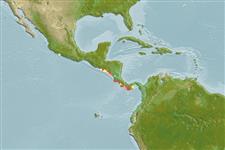
| Native range | All suitable habitat | Point map | Year 2050 |
|
| This map was computer-generated and has not yet been reviewed. |
| Ogilbia jewettae AquaMaps Data sources: GBIF OBIS |
Envoyez vos Photos et vidéos
Images | Images Google Ogilbia jewettae
Photo de Møller, P.R.
Images | Images Google
Photo de Møller, P.R.
Classification / Noms Noms communs | Synonymes | Catalog of Fishes(Genre, Espèce) | ITIS | CoL | WoRMS | Cloffa
> Ophidiiformes (Cusk eels) > Dinematichthyidae (Viviparous brotula)
Etymology: Ogilbia: Taken from Ogilby, 1887-1915, icthiologist and zoologist (Ref. 45335); jewettae: Named for Susan Jewett, USNM.
Eponymy: James Douglas Ogilby (1853–1925) was an Irish-born Australian ichthyologist and taxonomist, son of the famous zoologist William Ogilby (below). [...] Susan Lee Jewett (formerly Susan J Karnella) (d: 1945) is an American ichthyologist who was Collections Manager, Division of Fishes, Smithsonian Institution. [...] (Ref. 128868), visit book page.
More on authors: Møller, Schwarzhans & Nielsen.
Etymology: Ogilbia: Taken from Ogilby, 1887-1915, icthiologist and zoologist (Ref. 45335); jewettae: Named for Susan Jewett, USNM.
Eponymy: James Douglas Ogilby (1853–1925) was an Irish-born Australian ichthyologist and taxonomist, son of the famous zoologist William Ogilby (below). [...] Susan Lee Jewett (formerly Susan J Karnella) (d: 1945) is an American ichthyologist who was Collections Manager, Division of Fishes, Smithsonian Institution. [...] (Ref. 128868), visit book page.
More on authors: Møller, Schwarzhans & Nielsen.
Environnement : milieu / zone climatique / profondeur / gamme de distribution Écologie
marin démersal; profondeur 0 - 18 m (Ref. 57883). Tropical
Distribution Territoires | Zones FAO | Écosystèmes | Occurrences | Carte par point | Introductions | Faunafri
Eastern Pacific: from El Salvador to Costa Rica.
Taille / Poids / Âge
Description synthétique Clés d'identification | Morphologie | Morphométrie
Rayons mous dorsaux (Total) : 73 - 84; Rayons mous anaux: 52 - 62; Vertèbres: 40 - 44. This species is characterized by the following: vertebrae 11-13 + 29-32 = 40-44, dorsal fin rays 73-84, anal fin rays 52-62; outer pseudoclasper is wingshaped with single broad, curved supporter anteriorly; inner pseudoclasper is club-shaped, tip much expanded, with broad posterior lobe; small fleshy lobe at base of hood adjacent to outer pseudoclasper, penis gradually tapering; opercular spine with single, sharp tip; scale patch on cheeks with 6-7 vertical scale rows; otolith elongate, length: height ratio 2.4 to 2.6 (Ref. 57883).
Known from rocky bottoms, including tide pools (Ref. 57883).
Cycle de vie et comportement reproducteur Maturité | Reproduction | Frai | Œufs | Fécondité | Larves
Référence principale
Téléchargez vos références | Références | Coordinateur | Collaborateurs
Møller, P.R., W. Schwarzhans and J.G. Nielsen, 2005. Review of the American Dinematichthyini (Teleostei: Bythitidae). Part II. Ogilbia. aqua, J. Ichthyol. Aquat. Biol. 10(4):133-207. (Ref. 57883)
Statut dans la liste rouge de l'IUCN (Ref. 130435: Version 2025-2 (Global))
Préoccupation mineure (LC) ; Date assessed: 29 April 2008
CITES
Not Evaluated
Menace pour l'homme
Harmless
Utilisations par l'homme
FAO - Publication: search | FishSource |
Plus d'informations
Écologie trophique
Aliments (proies)
Composition du régime alimentaire
Consommation alimentaire
Rations alimentaires
Prédateurs
Aliments (proies)
Composition du régime alimentaire
Consommation alimentaire
Rations alimentaires
Prédateurs
Dynamique des populations
Paramètres de croissance
Âges / tailles maximales
Longueur-poids rel.
Rel. longueur-longueur.
Fréquences de longueurs
Conversion de masse
Recrutement
Abondance
Paramètres de croissance
Âges / tailles maximales
Longueur-poids rel.
Rel. longueur-longueur.
Fréquences de longueurs
Conversion de masse
Recrutement
Abondance
Cycle de vie
Reproduction
Maturité
Maturité/épines rel.
Fécondité
Frai
Agrégats de frai
Œufs
Développement de l'œuf
Larves
Dynamique des populations larvaires
Reproduction
Maturité
Maturité/épines rel.
Fécondité
Frai
Agrégats de frai
Œufs
Développement de l'œuf
Larves
Dynamique des populations larvaires
Anatomie
Surface branchiale
Cerveau
Otolithe
Surface branchiale
Cerveau
Otolithe
Physiologie
Composition corporelle
Nutriments
Consommation d'oxygène
Type de natation
Vitesse de nage
Pigments visuels
Son de poisson
Maladies et parasites
Toxicité (CL50)
Composition corporelle
Nutriments
Consommation d'oxygène
Type de natation
Vitesse de nage
Pigments visuels
Son de poisson
Maladies et parasites
Toxicité (CL50)
Génétique
génôme
Génétique
Hétérozygotie
Héritabilité
Diversité génétique
génôme
Génétique
Hétérozygotie
Héritabilité
Diversité génétique
Liées à l'homme
Systèmes d'aquaculture
Profils d'aquaculture
Souches
Cas de ciguatera
Timbres, pièces de monnaie, divers
Systèmes d'aquaculture
Profils d'aquaculture
Souches
Cas de ciguatera
Timbres, pièces de monnaie, divers
Outils
E-book | Guide de terrain | Générateur de fréquences de longueur | Outil de dynamique de population | Carte par point |
Capture-MSY |
Articles particuliers
Télécharger en XML
Sources Internet
AFORO (otoliths) | Aquatic Commons | BHL | Cloffa | Websites from users | FishWatcher | CISTI | Catalog of Fishes: Genre, Espèce | DiscoverLife | ECOTOX | FAO - Publication: search | Faunafri | Fishipedia | Fishtrace | GloBI | Google Books | Google Scholar | Google | IGFA World Record | OneZoom | Open Tree of Life | Otolith Atlas of Taiwan Fishes | PubMed | Reef Life Survey | Socotra Atlas | TreeBase | Arbre de Vie | Wikipedia: aller à, chercher | World Records Freshwater Fishing | Zoobank | Zoological Record
Estimations basées sur des modèles
Température préférée (Réf. 123201): 28 - 29.1, mean 28.5 °C (based on 97 cells).
Indice de diversité phylogénétique (Réf. 82804): PD50 = 0.5000 [Uniqueness, from 0.5 = low to 2.0 = high].
Bayesian length-weight: a=0.00389 (0.00180 - 0.00842), b=3.12 (2.94 - 3.30), in cm total length, based on all LWR estimates for this body shape (Ref. 93245).
Niveau trophique (Réf. 69278): 3.3 ±0.5 se; based on size and trophs of closest relatives