



Cruciglanis pacifici Ortega-Lara & Lehmann A., 2006
Envoyez vos Photos et vidéos
Images Google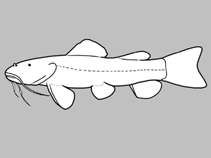 No image available for this species;
drawing shows typical species in Pseudopimelodidae.
Images Google
drawing shows typical species in Pseudopimelodidae.
Classification / Noms Noms communs | Synonymes | Catalog of Fishes(Genre, Espèce) | ITIS | CoL | WoRMS | Cloffa
> Siluriformes (Catfishes) > Pseudopimelodidae (Bumblebee catfishes, dwarf marbled catfishes) > Pseudopimelodinae
Etymology: Cruciglanis: Name from the Latin 'crucis' meaning cross and 'glanis' for catfish, referring to the crucifix shape of the second basibranchial in the branchial arch; pacifici: Name refers to its endemic distribution in the coastal rivers draining the western slope of the Cordillera Occidental of Colombia; noun in apposition.
Etymology: Cruciglanis: Name from the Latin 'crucis' meaning cross and 'glanis' for catfish, referring to the crucifix shape of the second basibranchial in the branchial arch; pacifici: Name refers to its endemic distribution in the coastal rivers draining the western slope of the Cordillera Occidental of Colombia; noun in apposition.
Environnement : milieu / zone climatique / profondeur / gamme de distribution Écologie
; eau douce benthopélagique. Tropical
Distribution Territoires | Zones FAO | Écosystèmes | Occurrences | Carte par point | Introductions | Faunafri
South America: Colombia.
Taille / Poids / Âge
Description synthétique Clés d'identification | Morphologie | Morphométrie
This species is distinguished by the following characters: subdorsal and subadipose spots are joined forming an oval-shaped clear spot; second basibranchial is ossified, cross-shaped with lateral processes; ectopterygoid bone shaped like an inverted comma, with its distal end narrow and directed medially towards the endopterygoid (=mesopterygoid); elongated anterior fontanel, reaching posteriorly to the level of the infraorbital sensory canal opening of the sphenotic bone; emarginate caudal fin with rounded edges, and ventral lobe larger than the dorsal one; caudal fin base with a dark spot and fused with the peduncular spot, covering the anterior three quarters of its length, and distal rim totally hyaline (Ref. 57850).
Inhabits undisturbed clear and shallow rivers in strong current and on gravel to small stone substrates (riffles or runs). Associated with Gobiesox sp., Chaetostoma marginatum, Cordilancistrus daguae, Astroblepus trifasciatus, Trichomycterus taenia; as well as shrimps (Atya). Stomach contents of 5 specimens caught in the Aguaclara River, revealed immature aquatic insects belonging to Trichoptera, Diptera, Ephemeroptera and Odonata, and terrestrial insects of the orders Hymenoptera and Coleoptera (Ref. 57850).
Cycle de vie et comportement reproducteur Maturité | Reproduction | Frai | Œufs | Fécondité | Larves
Référence principale
Téléchargez vos références | Références | Coordinateur : Shibatta, Oscar Akio | Collaborateurs
Ortega-Lara, A. and P. Lehmann A., 2006. Cruciglanis, a new genus of pseudopimelodid catfish (Ostariophysi: Siluriformes) with description of a new species from the Colombian Pacific coast. Neotrop. Ichthyol. 4(2):147-156. (Ref. 57850)
Statut dans la liste rouge de l'IUCN (Ref. 130435: Version 2025-2 (Global))
Préoccupation mineure (LC) ; Date assessed: 09 October 2014
CITES
Not Evaluated
Menace pour l'homme
Harmless
Utilisations par l'homme
FAO - Publication: search | FishSource |
Plus d'informations
Écologie trophique
Aliments (proies)
Composition du régime alimentaire
Consommation alimentaire
Rations alimentaires
Prédateurs
Aliments (proies)
Composition du régime alimentaire
Consommation alimentaire
Rations alimentaires
Prédateurs
Écologie
Écologie
Écologie
Dynamique des populations
Paramètres de croissance
Âges / tailles maximales
Longueur-poids rel.
Rel. longueur-longueur.
Fréquences de longueurs
Conversion de masse
Recrutement
Abondance
Paramètres de croissance
Âges / tailles maximales
Longueur-poids rel.
Rel. longueur-longueur.
Fréquences de longueurs
Conversion de masse
Recrutement
Abondance
Cycle de vie
Reproduction
Maturité
Maturité/épines rel.
Fécondité
Frai
Agrégats de frai
Œufs
Développement de l'œuf
Larves
Dynamique des populations larvaires
Reproduction
Maturité
Maturité/épines rel.
Fécondité
Frai
Agrégats de frai
Œufs
Développement de l'œuf
Larves
Dynamique des populations larvaires
Anatomie
Surface branchiale
Cerveau
Otolithe
Surface branchiale
Cerveau
Otolithe
Physiologie
Composition corporelle
Nutriments
Consommation d'oxygène
Type de natation
Vitesse de nage
Pigments visuels
Son de poisson
Maladies et parasites
Toxicité (CL50)
Composition corporelle
Nutriments
Consommation d'oxygène
Type de natation
Vitesse de nage
Pigments visuels
Son de poisson
Maladies et parasites
Toxicité (CL50)
Génétique
génôme
Génétique
Hétérozygotie
Héritabilité
Diversité génétique
génôme
Génétique
Hétérozygotie
Héritabilité
Diversité génétique
Liées à l'homme
Systèmes d'aquaculture
Profils d'aquaculture
Souches
Cas de ciguatera
Timbres, pièces de monnaie, divers
Systèmes d'aquaculture
Profils d'aquaculture
Souches
Cas de ciguatera
Timbres, pièces de monnaie, divers
Outils
E-book | Guide de terrain | Générateur de fréquences de longueur | Outil de dynamique de population | Carte par point |
Capture-MSY |
Articles particuliers
Télécharger en XML
Sources Internet
AFORO (otoliths) | Aquatic Commons | BHL | Cloffa | Websites from users | FishWatcher | CISTI | Catalog of Fishes: Genre, Espèce | DiscoverLife | ECOTOX | FAO - Publication: search | Faunafri | Fishipedia | Fishtrace | GloBI | Google Books | Google Scholar | Google | IGFA World Record | OneZoom | Open Tree of Life | Otolith Atlas of Taiwan Fishes | PubMed | Reef Life Survey | Socotra Atlas | TreeBase | Arbre de Vie | Wikipedia: aller à, chercher | World Records Freshwater Fishing | Zoobank | Zoological Record
Estimations basées sur des modèles
Indice de diversité phylogénétique (Réf. 82804): PD50 = 1.0000 [Uniqueness, from 0.5 = low to 2.0 = high].
Bayesian length-weight: a=0.00550 (0.00230 - 0.01313), b=3.11 (2.90 - 3.32), in cm total length, based on LWR estimates for this (Sub)family-body shape (Ref. 93245).
Niveau trophique (Réf. 69278): 3.5 ±0.5 se; based on size and trophs of closest relatives