



Envoyez vos Photos et vidéos
Images Google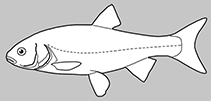 No image available for this species;
drawing shows typical species in Leuciscidae.
Images Google
drawing shows typical species in Leuciscidae.
Classification / Noms Noms communs | Synonymes | Catalog of Fishes(Genre, Espèce) | ITIS | CoL | WoRMS | Cloffa
> Cypriniformes (Carps) > Leuciscidae (Minnows) > Leuciscinae
Etymology: orpheus: The name orpheus means a legendary Thracian musician and poet, son of the Thracian river-god Oiagros and of the Muse Calliopte.
Eponymy: This is not a true eponym as it refers to Orpheus, the legendary Thracian musician and poet, son of King Oeagrus (or, in some versions, the god Apollo) and the Muse Calliope. The name reflects the dace’s occurrence in Thrace, Greece. (Ref. 128868), visit book page.
More on authors: Kottelat & Economidis.
Etymology: orpheus: The name orpheus means a legendary Thracian musician and poet, son of the Thracian river-god Oiagros and of the Muse Calliopte.
Eponymy: This is not a true eponym as it refers to Orpheus, the legendary Thracian musician and poet, son of King Oeagrus (or, in some versions, the god Apollo) and the Muse Calliope. The name reflects the dace’s occurrence in Thrace, Greece. (Ref. 128868), visit book page.
More on authors: Kottelat & Economidis.
Environnement : milieu / zone climatique / profondeur / gamme de distribution Écologie
; eau douce pélagique. Subtropical
Distribution Territoires | Zones FAO | Écosystèmes | Occurrences | Carte par point | Introductions | Faunafri
Eurasia: Maritza to Struma drainages in Greece, Bulgaria and Turkey.
Taille / Poids / Âge
Description synthétique Clés d'identification | Morphologie | Morphométrie
Differs from its congeners in Balkan Peninsula by having the following characters: origin of dorsal fin above pelvic base; dorso-hypural distance reaching between eye and nostril when reported forward from dorsal origin; free margin of flank scales faintly marked, not much contrasted against rest of scale, which is also pigmented; scale pocket dark brown; anal fin with blackish membranes and hyaline rays; head length equal to or slightly greater than body depth; mouth subterminal, upper lip conspicuously projecting beyond lower jaw, sometimes including tip of lower jaw; 44-46 + 2 scales on lateral line; dorsal fin and anal fin with 8½ branched rays; posterior margin of anal convex; in stretched anal of individuals larger than about 10 cm SL, distance between tips of first and last branched rays ( with the fin stretched out) 1.0-1.3 times caudal peduncle depth; and head length 26-29% SL (Ref. 59043).
Body shape (shape guide): fusiform / normal.
Body shape (shape guide): fusiform / normal.
Occurs in small to larger streams and rivers with standing water to moderate current (Ref. 57141). Found mainly in pools (Ref. 57141). Feeds in the water column and in the upper layers on fallen terrestrial insects but it is otherwise omnivorous (Ref. 57141). Spawns in shallow areas with gravel bottom. Some populations are under threat due to water abstraction in dry season (Ref. 59043).
Cycle de vie et comportement reproducteur Maturité | Reproduction | Frai | Œufs | Fécondité | Larves
Référence principale
Téléchargez vos références | Références | Coordinateur | Collaborateurs
Kottelat, M. and P.S. Economidis, 2006. Squalius orpheus, a new species of cyprinid fish from Evros drainage, Greece (Teleostei: Cyprinidae). Ichthyol. Explor. Freshwat. 17(2):181-186. (Ref. 57141)
Statut dans la liste rouge de l'IUCN (Ref. 130435: Version 2025-2 (Global))
Préoccupation mineure (LC) ; Date assessed: 14 December 2023
CITES
Not Evaluated
Menace pour l'homme
Harmless
Utilisations par l'homme
FAO - Publication: search | FishSource |
Plus d'informations
Écologie trophique
Aliments (proies)
Composition du régime alimentaire
Consommation alimentaire
Rations alimentaires
Prédateurs
Aliments (proies)
Composition du régime alimentaire
Consommation alimentaire
Rations alimentaires
Prédateurs
Écologie
Écologie
Écologie
Dynamique des populations
Paramètres de croissance
Âges / tailles maximales
Longueur-poids rel.
Rel. longueur-longueur.
Fréquences de longueurs
Conversion de masse
Recrutement
Abondance
Paramètres de croissance
Âges / tailles maximales
Longueur-poids rel.
Rel. longueur-longueur.
Fréquences de longueurs
Conversion de masse
Recrutement
Abondance
Cycle de vie
Reproduction
Maturité
Maturité/épines rel.
Fécondité
Frai
Agrégats de frai
Œufs
Développement de l'œuf
Larves
Dynamique des populations larvaires
Reproduction
Maturité
Maturité/épines rel.
Fécondité
Frai
Agrégats de frai
Œufs
Développement de l'œuf
Larves
Dynamique des populations larvaires
Anatomie
Surface branchiale
Cerveau
Otolithe
Surface branchiale
Cerveau
Otolithe
Physiologie
Composition corporelle
Nutriments
Consommation d'oxygène
Type de natation
Vitesse de nage
Pigments visuels
Son de poisson
Maladies et parasites
Toxicité (CL50)
Composition corporelle
Nutriments
Consommation d'oxygène
Type de natation
Vitesse de nage
Pigments visuels
Son de poisson
Maladies et parasites
Toxicité (CL50)
Génétique
génôme
Génétique
Hétérozygotie
Héritabilité
Diversité génétique
génôme
Génétique
Hétérozygotie
Héritabilité
Diversité génétique
Liées à l'homme
Systèmes d'aquaculture
Profils d'aquaculture
Souches
Cas de ciguatera
Timbres, pièces de monnaie, divers
Systèmes d'aquaculture
Profils d'aquaculture
Souches
Cas de ciguatera
Timbres, pièces de monnaie, divers
Outils
E-book | Guide de terrain | Générateur de fréquences de longueur | Outil de dynamique de population | Carte par point |
Capture-MSY |
Articles particuliers
Télécharger en XML
Sources Internet
AFORO (otoliths) | Aquatic Commons | BHL | Cloffa | Websites from users | FishWatcher | CISTI | Catalog of Fishes: Genre, Espèce | DiscoverLife | ECOTOX | FAO - Publication: search | Faunafri | Fishipedia | Fishtrace | GloBI | Google Books | Google Scholar | Google | IGFA World Record | Bases de données nationales | OneZoom | Open Tree of Life | Otolith Atlas of Taiwan Fishes | PubMed | Reef Life Survey | Socotra Atlas | TreeBase | Arbre de Vie | Wikipedia: aller à, chercher | World Records Freshwater Fishing | Zoobank | Zoological Record
Estimations basées sur des modèles
Indice de diversité phylogénétique (Réf. 82804): PD50 = 0.5000 [Uniqueness, from 0.5 = low to 2.0 = high].
Bayesian length-weight: a=0.00692 (0.00433 - 0.01106), b=3.09 (2.95 - 3.23), in cm total length, based on LWR estimates for this species & Genus-body shape (Ref. 93245).
Niveau trophique (Réf. 69278): 3.3 ±0.4 se; based on size and trophs of closest relatives
Résilience (Réf. 120179): Milieu, temps minimum de doublement de population : 1,4 à 4,4 années (Preliminary K or Fecundity.).