Classification / Names
आम नाम | उपशब्द | Catalog of Fishes(वर्ग, प्रजाति) | ITIS | CoL | WoRMS | Cloffa
>
Siluriformes (Catfishes) >
Loricariidae (Armored catfishes) > Hypostominae
Etymology: Cordylancistrus: Greek, kordyle, -es = young tunna + Greek, agkistron = hook (Ref. 45335); nephelion: Derived from the Greek nephelion, meaning cloudlike spots, in reference to the color pattern of the species.
Environment: milieu / climate zone / गहराई सीमा / distribution range
पारिस्थितिकी
; स्वच्छ जल, अलवण जल ड़िमरसल. Tropical; 15°C - 20°C (Ref. 56900)
South America: Tuy River basin in Venezuela.
आकार / वज़न / Age
परिपक्व अवधि: Lm ? range ? - ? cm
Max length : 12.9 cm SL पुल्लिंग / अलिंग; (Ref. 56900)
Short description
पहचान कुंजी | आकृति विज्ञान | मौरफोमैटरिक्स
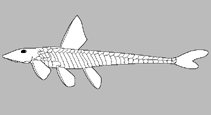
पृष्ठीय रीढ़ (सम्पूर्ण) : 1; पृष्ठीय सौफट रेज़ (सम्पूर्ण) : 8. Differs from other species of Cordylancistrus by its unique color pattern: head and body blackish to greenish brown with white irregular spots; abdomen uniformly white; and all fins with whitish spots that simulate bands (Ref. 56900).
Body shape (shape guide): elongated.
Inhabits rivers with transparent waters, moderate to strong flow and bottom generally consisting of stone, gravel and sand (Ref. 56900).
Life cycle and mating behavior
परिपक्व अवधि | पुनरुत्पत्ति | मछलीऔ का अंडे देना | अंडे | Fecundity | लार्वा
Provenzano, F. and N. Milani, 2006. Cordylancistrus nephelion (Siluriformes, Loricariidae), a new and endangered species of suckermouth armored catfish from the Tuy River, north-central Venezuela. Zootaxa 1116:29-41. (Ref. 56900)
IUCN Red List Status (Ref. 130435: Version 2025-1)
Threat to humans
Harmless
Human uses
मात्स्यिकी: कोई रुचि बग़ैर
साधन
Special reports
Download XML
इंटरनेट स्रोत
Estimates based on models
Phylogenetic diversity index (संदर्भ
82804): PD
50 = 0.5156 [Uniqueness, from 0.5 = low to 2.0 = high].
Bayesian length-weight: a=0.01549 (0.00719 - 0.03336), b=2.98 (2.81 - 3.15), in cm total length, based on LWR estimates for this (Sub)family-body shape (Ref.
93245).
लौटाव (संदर्भ
120179): माध्यम, न्यूनतम जनसंख्या दुगनी होने का समय 1.4 - 4.4 वर्ष। (Preliminary K or Fecundity.).
Fishing Vulnerability (Ref.
59153): Low vulnerability (10 of 100).
🛈