



Fontitrygon colarensis (Santos, Gomes & Charvet-Almeida, 2004)
Colares stingray
Envoyez vos Photos et vidéos
Images | Images Google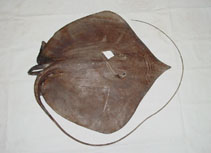 Fontitrygon colarensis
Male Photo de Charvet-Almeida, P.
Images | Images Google
Male Photo de Charvet-Almeida, P.
Classification / Noms Noms communs | Synonymes | Catalog of Fishes(Genre, Espèce) | ITIS | CoL | WoRMS | Cloffa
Élasmobranches (requins et raies) (sharks and rays) > Myliobatiformes (Stingrays) > Dasyatidae (Stingrays) > Urogymninae
Etymology: colarensis: Named for its type locality, from the proximities of Colares Island, Marajó Bay, close to Colares I., district of Colares, Pará State, Brazil.
Etymology: colarensis: Named for its type locality, from the proximities of Colares Island, Marajó Bay, close to Colares I., district of Colares, Pará State, Brazil.
Environnement : milieu / zone climatique / profondeur / gamme de distribution Écologie
marin pelagic-neritic; profondeur 6 - ? m (Ref. 56441). Tropical
Distribution Territoires | Zones FAO | Écosystèmes | Occurrences | Carte par point | Introductions | Faunafri
Southwest Atlantic: endemic to Brazil.
Taille / Poids / Âge
Description synthétique Clés d'identification | Morphologie | Morphométrie
Diagnosis: Disc diamond-shaped (rhomboid). Snout elongated, preorbital distance 35.7-37.7% in DW. Lower lip outline with a dark, well-defined band. Shoulder region to base of tail with a row of small tubercles along the midline of disc, tubercles somewhat randomly distributed. Posterior margin of the pectoral fins uniformly rounded; of the triangular-shaped pelvic fins, almost straight or slightly sinuous, with its tips exceeding posterior margin of disc. Dorsal caudal keel absent in the holotype, vestigial in the 2 paratypes (Ref. 56441).
Body shape (shape guide): other.
Body shape (shape guide): other.
Minimum depth from Ref. 58018.
Cycle de vie et comportement reproducteur Maturité | Reproduction | Frai | Œufs | Fécondité | Larves
Référence principale
Téléchargez vos références | Références | Coordinateur : McEachran, John | Collaborateurs
Santos, H.R.S., U.L. Gomes and P. Charvet-Almeida, 2004. A new species of whiptail stingray of the genus Dasyatis Rafinesque, 1810 from the Southwestern Atlantic ocean (Chondrichthyes: Myliobatiformes: Dasyatidae). Zootaxa 492:1-12. (Ref. 56441)
Statut dans la liste rouge de l'IUCN (Ref. 130435: Version 2025-2 (Global))
Niveau de menace critique (CR) (A2d); Date assessed: 01 July 2019
CITES
Not Evaluated
Menace pour l'homme
Harmless
Utilisations par l'homme
FAO - Publication: search | FishSource |
Plus d'informations
Écologie trophique
Aliments (proies)
Composition du régime alimentaire
Consommation alimentaire
Rations alimentaires
Prédateurs
Aliments (proies)
Composition du régime alimentaire
Consommation alimentaire
Rations alimentaires
Prédateurs
Écologie
Écologie
Écologie
Dynamique des populations
Paramètres de croissance
Âges / tailles maximales
Longueur-poids rel.
Rel. longueur-longueur.
Fréquences de longueurs
Conversion de masse
Recrutement
Abondance
Paramètres de croissance
Âges / tailles maximales
Longueur-poids rel.
Rel. longueur-longueur.
Fréquences de longueurs
Conversion de masse
Recrutement
Abondance
Cycle de vie
Reproduction
Maturité
Maturité/épines rel.
Fécondité
Frai
Agrégats de frai
Œufs
Développement de l'œuf
Larves
Dynamique des populations larvaires
Reproduction
Maturité
Maturité/épines rel.
Fécondité
Frai
Agrégats de frai
Œufs
Développement de l'œuf
Larves
Dynamique des populations larvaires
Anatomie
Surface branchiale
Cerveau
Otolithe
Surface branchiale
Cerveau
Otolithe
Physiologie
Composition corporelle
Nutriments
Consommation d'oxygène
Type de natation
Vitesse de nage
Pigments visuels
Son de poisson
Maladies et parasites
Toxicité (CL50)
Composition corporelle
Nutriments
Consommation d'oxygène
Type de natation
Vitesse de nage
Pigments visuels
Son de poisson
Maladies et parasites
Toxicité (CL50)
Génétique
génôme
Génétique
Hétérozygotie
Héritabilité
Diversité génétique
génôme
Génétique
Hétérozygotie
Héritabilité
Diversité génétique
Liées à l'homme
Systèmes d'aquaculture
Profils d'aquaculture
Souches
Cas de ciguatera
Timbres, pièces de monnaie, divers
Systèmes d'aquaculture
Profils d'aquaculture
Souches
Cas de ciguatera
Timbres, pièces de monnaie, divers
Outils
E-book | Guide de terrain | Générateur de fréquences de longueur | Outil de dynamique de population | Carte par point |
Capture-MSY |
Articles particuliers
Télécharger en XML
Sources Internet
AFORO (otoliths) | Aquatic Commons | BHL | Cloffa | Websites from users | FishWatcher | CISTI | Catalog of Fishes: Genre, Espèce | DiscoverLife | ECOTOX | FAO - Publication: search | Faunafri | Fishipedia | Fishtrace | GloBI | Google Books | Google Scholar | Google | IGFA World Record | OneZoom | Open Tree of Life | Otolith Atlas of Taiwan Fishes | PubMed | Reef Life Survey | Socotra Atlas | TreeBase | Arbre de Vie | Wikipedia: aller à, chercher | World Records Freshwater Fishing | Zoological Record
Estimations basées sur des modèles
Indice de diversité phylogénétique (Réf. 82804): PD50 = 0.5156 [Uniqueness, from 0.5 = low to 2.0 = high].
Bayesian length-weight: a=0.01023 (0.00482 - 0.02174), b=3.06 (2.86 - 3.26), in cm total length, based on LWR estimates for this (Sub)family-body shape (Ref. 93245).
Niveau trophique (Réf. 69278): 3.7 ±0.3 se; based on size and trophs of closest relatives