



Oryzias marmoratus (Aurich, 1935)
Marmorated medaka
Uploaden van uw Foto's en video's
Afbeeldingen | Google afbeelding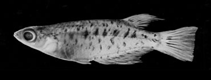 Oryzias marmoratus
Male Afbeelding van Parenti, L.R.
Afbeeldingen | Google afbeelding
Male Afbeelding van Parenti, L.R.
Classificatie / Namen Lokale namen | Synoniemen | Catalog of Fishes(Genus, Soort(en)) | ITIS | CoL | WoRMS | Cloffa
> Beloniformes (Needle fishes) > Adrianichthyidae (Ricefishes) > Oryziinae
Etymology: Oryzias: Greek, oryza = rice; because of the habitat used by this fish (Ref. 45335).
Etymology: Oryzias: Greek, oryza = rice; because of the habitat used by this fish (Ref. 45335).
Milieu: milieu / Klimaatzone / Diepte / verspreidingsgebied Ecologie
; zoet water benthopelagisch; pH range: 7.5 - 8.5; standvastig. Tropical; 22°C - 25°C (Ref. 31267)
Verspreiding Gebieden | FAO regio's | Ecosystemen | Voorkomen | Verspreidingskaart | Introducties | Faunafri
Asia: Indonesia.
Grootte / Gewicht / Leeftijd
Korte beschrijving Determinatiesleutels | Morfologie | Morfometrie
Dorsale zachte stralen (totaal) : 9 - 10; Anale zachte stralen: 22 - 25. This species is distinguished (from O. profundicola, O. loxolepis) by the following characters: abdominal vertebrae usually 12, total vertebrae 29-31; D 9-10, A 22-25; transverse scales 10-11; body depth at anal-fin origin 24.8-30.1% SL and at dorsal-fin origin 20.2-25.3% SL; caudal peduncle length 12.0-16.3% SL; distinct nuchal concavity; lateral scales are more-or-less aligned parallel to midlateral stripe; male with elongated-shaped dorsal fin without yellow margin (Ref. 133090).
Cross section: compressed.
Cross section: compressed.
Non-annual breeder. Is very difficult to maintain in aquarium (Ref. 27139). In 2013 and 2018, the collected and observed specimens were only during the day and at TanjungTimbala, slightly south of the type locality, and at Lengkona in Lake Towuti. This species is collected with O. loxolepis and O. profundicola that form schools in gently sloping, shallow (< 1.5 m) shore areas with large boulders and submerged wood over sand and gravel. Other taxa occurring in samples included Paratherina spp., Glossogobius flavipinnis, G. intermedius, Glossogobius sp., Mugilogobius rexi, M. latifrons, and Nomorhamphus megarrhamphus. In Lake Lantoa, it inhabits gently sloping, shallow shores (1 m depth) with a large area of plants on a muddy substratum. It swims in schools and was collected in association with Telmatherina celebensis and Glossogobius sp. (an undescribed lake endemic: HK, pers. obsv.). Some individuals were infested with parasitic copepods. In Lake Mahalona, it also inhabits gently sloping, shallow shores (1 m depth) with large boulders over a sand and gravel substratum, covered with aquatic vegetation. Often, it also forms schools and co-occurring with Tominanga aurea, Glossogobius sp. (as for Lake Towuti), Glossogobius mahalonensis, G. intermedius, M. rexi, and Mugilogobius cf. hitam (Ref. 133093).
Levenscyclus en paargedrag Maturiteit | Voortplanting | Paaien | Eieren | Fecunditeit | Larven
Egg clusters are carried by females under the ventral fin (Ref. 26687).
Hoofdreferentie
Upload uw referenties | Referenties | Coördinator : Seegers, Lothar | Medewerkers
Kottelat, M., A.J. Whitten, S.N. Kartikasari and S. Wirjoatmodjo, 1993. Freshwater fishes of Western Indonesia and Sulawesi. Periplus Editions, Hong Kong. 221 p. (Ref. 7050)
Status op de Rode Lijst van het IUCN (Ref. 130435: Version 2025-2 (Global))
Gevoelig (NT) (B1b(i,ii,iii,iv)+2b(i,ii,iii,iv)); Date assessed: 13 June 2018
CITES
Not Evaluated
Gevaar voor de mens
Harmless
Gebruik door de mens
Visserij: commercieel; Aquarium: Commercieel
FAO - Publication: search | FishSource |
Meer informatie
Trofische ecologie
Voedsel (prooien)
Dieetsamenstelling
Voedselconsumptie
Voedselrantsoenen
Predatoren
Voedsel (prooien)
Dieetsamenstelling
Voedselconsumptie
Voedselrantsoenen
Predatoren
Ecologie
Ecologie
Ecologie
Populatiedynamica
Groeiparameters
Max. leeftijden / maten
Lengte-gewicht rel.
Lengte-lengte rel.
Lengtefrequenties
Massaconversie
Rekrutering
Abundantie
Groeiparameters
Max. leeftijden / maten
Lengte-gewicht rel.
Lengte-lengte rel.
Lengtefrequenties
Massaconversie
Rekrutering
Abundantie
Levenscyclus
Voortplanting
Maturiteit
Rijpheid/kieuwen rel.
Fecunditeit
Paaien
Paaibestanden
Eieren
Ontwikkeling van de eieren
Larven
Larvale populatiedynamiek
Voortplanting
Maturiteit
Rijpheid/kieuwen rel.
Fecunditeit
Paaien
Paaibestanden
Eieren
Ontwikkeling van de eieren
Larven
Larvale populatiedynamiek
Fysiologie
Lichaamssamenstelling
Voedingsstoffen
Zuurstofverbruik
Type zwemmen
Zwemsnelheid
Visuele pigmenten
Vis geluid
Ziekten en parasieten
Toxiciteit (LC50)
Lichaamssamenstelling
Voedingsstoffen
Zuurstofverbruik
Type zwemmen
Zwemsnelheid
Visuele pigmenten
Vis geluid
Ziekten en parasieten
Toxiciteit (LC50)
Genetica
genoom
Genetica
Heterozygositeit
Erfelijkheid
Genetische diversiteit
genoom
Genetica
Heterozygositeit
Erfelijkheid
Genetische diversiteit
Menselijk gerelateerd
Aquacultuursystemen
Aquacultuurprofielen
Kweeklijnen
Ciguatera gevallen
Postzegels, munten, diversen.
Aquacultuursystemen
Aquacultuurprofielen
Kweeklijnen
Ciguatera gevallen
Postzegels, munten, diversen.
Tools
E-boek | Veldgids | Determinatiesleutels | Lengtefrequentie Tool | Levenscyclus tool | Verspreidingskaart |
Vangst-MSY |
Speciale rapporten
Bekijk gegevens voor het houden in een aquarium | Bekijk Fact Sheets voor de soort | Bekijk Aquacultuur Fact Sheets
Download XML
Internetbronnen
AFORO (otoliths) | Aquatic Commons | BHL | Cloffa | Websites from users | Bekijk FishWatcher | CISTI | Catalog of Fishes: Genus, Soort(en) | DiscoverLife | ECOTOX | FAO - Publication: search | Faunafri | Fishipedia | Fishtrace | GloBI | Google Books | Google Scholar | Google | IGFA World Record | OneZoom | Open Tree of Life | Otolith Atlas of Taiwan Fishes | PubMed | Reef Life Survey | Socotra Atlas | TreeBase | Tree of Life | Wikipedia: ga naar, zoek | World Records Freshwater Fishing | Zoological Record
Schattingen op basis van modellen
Fylogenetische diversiteitsindex (Ref. 82804): PD50 = 0.5000 [Uniqueness, from 0.5 = low to 2.0 = high].
Bayesian length-weight: a=0.00479 (0.00190 - 0.01207), b=3.13 (2.91 - 3.35), in cm total length, based on LWR estimates for this (Sub)family-body shape (Ref. 93245).
Trofisch niveau (Ref. 69278): 3.4 ±0.4 se; based on size and trophs of closest relatives
Weerstandsvermogen (Ref. 120179): laag, minimale populatieverdubbelingstijd 4,5-14 jaar (Assuming fec < 100, egg cluster of 13-15 eggs).