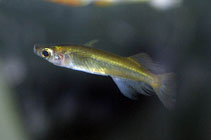
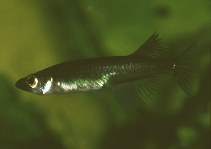
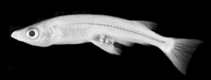
Classification / Names
ชื่อสามัญ | ชื่อพ้อง | Catalog of Fishes(สกุล, ชนิด) | ITIS | CoL | WoRMS | Cloffa
>
Beloniformes (Needle fishes) >
Adrianichthyidae (Ricefishes) > Oryziinae
Etymology: Oryzias: Greek, oryza = rice; because of the habitat used by this fish (Ref. 45335).
Eponymy: Paul Benedikt Sarasin (1856–1929) and Karl Friederich ‘Fritz’ Sarasin (1859–1942) were cousins. [...] (Ref. 128868), visit book page.
Environment: milieu / climate zone / ระดับความลึก / distribution range
นิเวศวิทยา
; น้ำจืด ผิวน้ำ; pH range: 7.5 - 8.5. Tropical; 24°C - 29°C (Ref. 31267)
Asia: Indonesia.
ขนาด / น้ำหนัก / Age
วัยเจริญพันธุ์: Lm ? range ? - ? cm
Max length : 8.0 cm TL เพศผู้/กระเทย; (Ref. 7050)
Oviparous (Ref. 84729). A pelvic-brooder, in which females carry an egg cluster until hatching (Ref. 126777). The eggs are carried between the pelvic fins with each egg attached to the body by 10-20 filaments (Ref. 7050).
Life cycle and mating behavior
วัยเจริญพันธุ์ | การสืบพันธุ์ | การวางไข่ | เซลสืบพันธ์ของเพศเมีย(ไข่) | ความดกของไข่ | ตัวอ่อน
Oviparous (Ref. 84729). Spawned eggs hung from the urogenital pore by attaching filaments on the chorion in the vegetal region. This batch of eggs lie in a belly concavity until hatching (Ref. 84729).
Parenti, L., 2008. A phylogenentic analysis and taxonomic revision of ricefishes, Oryzias and relatives (Beloniformes, Adrianichthyidae). Zool. J. Linn. Soc. 154(3):494-610. (Ref. 80012)
IUCN Red List Status (Ref. 130435: Version 2025-1)
Threat to humans
Harmless
Human uses
การประมง: ไม่มีผลประโยชน์
เครื่องมือ
Special reports
Download XML
แหล่งที่มาจากอินเตอร์เน็ต
Estimates based on models
Phylogenetic diversity index (อ้างอิง
82804): PD
50 = 0.5000 [Uniqueness, from 0.5 = low to 2.0 = high].
Bayesian length-weight: a=0.00479 (0.00189 - 0.01213), b=3.13 (2.91 - 3.35), in cm total length, based on LWR estimates for this (Sub)family-body shape (Ref.
93245).
ระดับชั้นอาหาร (อ้างอิง
69278): 3.6 ±0.5 se; based on size and trophs of closest relatives
Fishing Vulnerability (Ref.
59153): Low vulnerability (10 of 100).
🛈