التصنيف / Names
الأسماء الشائعة | مرادفات | Catalog of Fishes(جنس, الانواع) | ITIS | CoL | WoRMS | Cloffa
>
Synbranchiformes (Spiny eels) >
Mastacembelidae (Spiny eels)
Etymology: Mastacembelus: Greek, mastax, -agos = bite + Greek, emballo = to throw oneself (Ref. 45335); polli: Named in honor of Prof. Dr. Poll, a famous Belgian ichthyologist who pioneered ichthyological studies on Lake Tanganyika (Ref. 56055).
Eponymy: Dr Max Fernand Leon Poll (1908–1991) was a Belgian ichthyologist, and ‘connoisseur of the fish fauna’. [...] (Ref. 128868), visit book page.
Environment: milieu / climate zone / نطاق العمق / distribution range
البيئة
; المياه العذبة القاع. Tropical
Africa: endemic to and widely distributed in Lake Tanganyika (Ref. 56055).
الحجم / وزن / العمر
النضج: Lm ? range ? - ? cm
Max length : 14.0 cm SL ذكر/ مختلط الجنس; (Ref. 56055)
وصف مختصر
مفاتيح التعريف | الوصف الخارجي | قياسات المظهر الخارجي
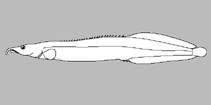
الأشواك الظهرية (المجموع) : 22 - 29; الأشعة الظهرية الناعمة (المجموع) : 68 - 87; شوكة شرجية: 2; أشعه شرجية لينه: 70 - 98; فقرات: 72 - 84. The species has protruding eyes, a small rostral appendage, a protruding lower jaw, a pointed caudal fin and a more elongated pectoral-fin shape (Ref. 56055). Posterior angle of lips is situated below the region from the middle from the eye up to a distance of about one-third of the diameter behind posterior border of eye (Ref. 56055). Upper corner of gill opening and dorsal edge of pectoral-fin base approximately at same level, clearly anterior to ventral edge of pectoral-fin base; dorsal edge of pectoral-fin base situated above upper corner of the gill opening (Ref. 56055). Lateral line continuous from posterior border of head up to one-third or half of distance between head and anus, discontinuous more posteriorly (Ref. 56055). Preanal length always shorter than postanal length; distance from anterior border of snout to last externally visible dorsal spine always longer than distance from anterior border of snout to last externally visible anal spine, and as a result origin of soft dorsal fin always posterior compared to origin of soft anal fin (Ref. 56055). Dorsal spines increasing in size from first to last (Ref. 56055). One well-developed, externally visible anal spine; a very small almost entirely reduced spine, hidden under the skin, can be present (Ref. 56055). Preopercular and preorbital spines are absent (Ref. 56055).
It has a uniformly light brown overall background colour with numerous small, round, dark brown spots on the dorsal part of head, body and tail (Ref. 56055). Background colour lighter, more yellowish white on lips, ventral region of head, belly and most ventral part of tail (Ref. 56055). Pectoral fins whitish transparent without spots; dorsal, caudal and anal fins also whitish transparent (Ref. 56055).
Body shape (shape guide): eel-like.
Coastal in distribution; habitat is rocky bottom, flagstone, rock slides and pebbles (Ref. 56055).
Life cycle and mating behavior
النضج | التكاثر | وضع البيض | بيض | الخصوبة | Larvae
Vreven, E.J., 2005. Redescription of Mastacembelus ophidium Günther, 1893 (Synbranchiformes: Mastacembelidae) and description of a new spiny eel from Lake Tanganyika. J. Nat. Hist. 39(18):1539-1560. (Ref. 56055)
IUCN Red List Status (Ref. 130435: Version 2025-1)
استخدامات بشرية
أدوات
تقارير خاصة
Download XML
مصادر علي الأنترنت
Estimates based on models
Phylogenetic diversity index (مرجع
82804): PD
50 = 0.5000 [Uniqueness, from 0.5 = low to 2.0 = high].
Bayesian length-weight: a=0.00269 (0.00128 - 0.00564), b=2.94 (2.76 - 3.12), in cm total length, based on LWR estimates for this (Sub)family-body shape (Ref.
93245).
مستوى غذائي (مرجع
69278): 3.6 ±0.6 se; based on size and trophs of closest relatives
المرونه (مرجع
120179): عالي, الحد الزمني الأدني لتضاعف عدد أفراد المجتمع أقل من 15 شهر (Preliminary K or Fecundity.).
Fishing Vulnerability (Ref.
59153): Low vulnerability (10 of 100).
🛈