Classification / Names
आम नाम | उपशब्द | Catalog of Fishes(वर्ग, प्रजाति) | ITIS | CoL | WoRMS | Cloffa
>
Siluriformes (Catfishes) >
Anchariidae (Vaonas)
Etymology: Gogo: Gogo is the Malagasy word most commonly used to refer to members of Anchariidae; arcuatus: The specific epithet come from the Latin arcuatus, meaning bent like a bow, in reference to the concave shape of the dorsoposterior margin of the dorsal fin (Ref. 56142).
Environment: milieu / climate zone / गहराई सीमा / distribution range
पारिस्थितिकी
; स्वच्छ जल, अलवण जल ड़िमरसल. Tropical
Africa: Sandrananta River drainage in southeastern highlands of Madagascar (Ref. 56142).
आकार / वज़न / Age
परिपक्व अवधि: Lm ? range ? - ? cm
Max length : 18.1 cm SL पुल्लिंग / अलिंग; (Ref. 56142)
Short description
पहचान कुंजी | आकृति विज्ञान | मौरफोमैटरिक्स
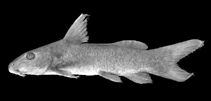
पृष्ठीय रीढ़ (सम्पूर्ण) : 2; पृष्ठीय सौफट रेज़ (सम्पूर्ण) : 7; गुदा कांटा: 0; ऐनल सौफट रेज़: 12; जानवरों की रीड़ का जोड़: 43. Diagnosis: Gogo arcuatus is distinguished from other members of Anchariidae by the following unique characters: a larger eye, 17.7-18.0% of head length vs. 9.2-15.9%; mottled brownish-gray colouration vs. highly mottled dark gray and cream, solid purplish-gray or lead gray; and a concave dorsoposterior margin of the dorsal fin vs. straight (Ref. 56142). It can be further distinguished from G. brevibarbis in having unicuspid teeth vs. bicuspid (Ref. 56142).
Body shape (shape guide): fusiform / normal.
Gogo arcuatus is found in pools surrounded by large, exposed boulders from a clear, shallow, forested stretch of the river, where the substrate is very rocky and the current swift (Ref. 56142).
Life cycle and mating behavior
परिपक्व अवधि | पुनरुत्पत्ति | मछलीऔ का अंडे देना | अंडे | Fecundity | लार्वा
Ng, H.H. and J.S. Sparks, 2005. Revision of the endemic Malagasy catfish family Anchariidae (Teleostei: Siluriformes), with descriptions of a new genus and three new species. Ichthyol. Explor. Freshwat. 16(4):303-323. (Ref. 56142)
IUCN Red List Status (Ref. 130435: Version 2025-1)
Threat to humans
Harmless
Human uses
साधन
Special reports
Download XML
इंटरनेट स्रोत
Estimates based on models
Phylogenetic diversity index (संदर्भ
82804): PD
50 = 0.5781 [Uniqueness, from 0.5 = low to 2.0 = high].
Bayesian length-weight: a=0.00389 (0.00180 - 0.00842), b=3.12 (2.94 - 3.30), in cm total length, based on all LWR estimates for this body shape (Ref.
93245).
Trophic level (संदर्भ
69278): 3.4 ±0.5 se; based on size and trophs of closest relatives
Fishing Vulnerability (Ref.
59153): Low vulnerability (12 of 100).
🛈