



Neosebastes occidentalis Motomura, 2004
Orangebanded gurnard perch
Masukkan pemerhatian anda di Fish Watcher
| Native range | All suitable habitat | Point map | Year 2050 |

|
| This map was computer-generated and has not yet been reviewed. |
| Neosebastes occidentalis AquaMaps Data sources: GBIF OBIS |
muatnaik fotos/gambar dan video
Gambar | imej Google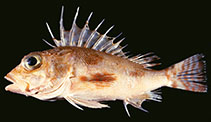 Neosebastes occidentalis
foto/gambar oleh CSIRO Australian National Fish Collection
Gambar | imej Google
foto/gambar oleh CSIRO Australian National Fish Collection
klasifikasi / Nama Nama-nama umum | Sinonim (persamaan) | Catalog of Fishes(Marga, Jenis) | ITIS | CoL | WoRMS | Cloffa
> Perciformes/Scorpaenoidei (Scorpionfishes) > Neosebastidae (Gurnard scorpionfishes)
Etymology: Neosebastes: Greek, neos = new + Greek, sebastes = august, venerable (Ref. 45335); occidentalis: Name from the Latin 'occidentalis' meaning west, referring to the distribution of the species being the westernmost in the genus.
Etymology: Neosebastes: Greek, neos = new + Greek, sebastes = august, venerable (Ref. 45335); occidentalis: Name from the Latin 'occidentalis' meaning west, referring to the distribution of the species being the westernmost in the genus.
Lingkungan: lingkungan / zona iklim / kisaran kedalaman / jangkauan distribusi Ekologi
laut dasar (demersal); kisaran kedalaman 100 - 185 m (Ref. 54394). Tropical; 20°S - 30°S (Ref. 54394)
Penyebaran Wilayah | Daerah-daerah FAO | Ekosistem | Kemunculan | peta titik | Introduksi | Faunafri
Eastern Indian Ocean: Off the central western coast of Western Australia.
Ukuran / Berat / umur
deskripsi pendek Kunci identifiaksi (pengenalan) | Morfologi | Morfometrik
Duri punggung (Keseluruhan (total)) : 8; duri punggung lunak (Keseluruhan (total)) : 8; Duri dubur: 3; Sirip dubur lunak: 5. Diagnosis: Underside of mandible with numerous tiny pores, no ridges. Preocular spine usually divided into 2 points, and flattened anteriorly and posteriorly. There are no additional spines between lacrimal and suborbital ridges; upper opercular spine usually divided into 2-4 points; midinterorbital space extremely deep, usually not covered with scales; interorbital ridge distinct. Pored lateral-line scales 32-36 (mode 33); longitudinal scale rows 50-56 (55). Pectoral-fin rays 18-21 (21); pectoral fin long (2.4-3.0, mean 2.7 in SL), reaching or extending beyond a vertical at origin of last dorsal-fin spine. First anal-fin spine 1.5-1.7 (1.6) in third spine. Posterior margin of maxilla not reaching a vertical at posterior margin of pupil. Interorbital width wide (5.7-7.5, 6.8 in HL). Bilobed portion of swimbladder less than half of total swimbladder length; head and body whitish in preservative specimens. Body, head, and pelvic and anal fins nearly white or yellowish when fresh; no distinct small black spots on head or lateral line (Ref. 54394).
Body shape (shape guide): short and / or deep.
Body shape (shape guide): short and / or deep.
Found on the continental shelf (Ref. 75154). Most specimens taken in trawls have sand grains inside the mouth indicating occurrence on open, predominantly sandy substrata (Ref. 54394).
Siklus hidup dan perilaku kawin Kematangan | Reproduksi, perkembang biakan | Pemijahan | telur-telur | Fekunditas | Larva
rujukan utama
Unggah referensi Anda | Acuan | Koordinator | mitra
Motomura, H., 2003. Revision of the scorpionfish genus Neosebastes (Scorpaeniformes: Neosebastidae), with descriptions of five new species. Indo-Pac. Fish. (37):46 p. (Ref. 54394)
CITES
Not Evaluated
ancaman kepada manusia
Harmless
penggunaan manusia
FAO - Publication: search | FishSource |
informasi lanjut
Ekologi trofik
Item makanan (mangsa)
Komposisi makanan
Konsumsi makanan
Ransum makanan
Pemangsa
Item makanan (mangsa)
Komposisi makanan
Konsumsi makanan
Ransum makanan
Pemangsa
Ekologi
Ekologi
Ekologi
Dinamika populasi
Parameter pertumbuhan
Maks. usia / ukuran
Panjang-berat rel.
Panjang-panjang rel.
ukuran frekuensi
Konversi massa
pemulihan
Kelimpahan
Parameter pertumbuhan
Maks. usia / ukuran
Panjang-berat rel.
Panjang-panjang rel.
ukuran frekuensi
Konversi massa
pemulihan
Kelimpahan
Siklus hidup
Reproduksi, perkembang biakan
Kematangan
Kedewasaan / insang rel.
Fekunditas
Pemijahan
Agregasi pemijahan
telur-telur
pekembangan telor
Larva
Dinamika larva
Reproduksi, perkembang biakan
Kematangan
Kedewasaan / insang rel.
Fekunditas
Pemijahan
Agregasi pemijahan
telur-telur
pekembangan telor
Larva
Dinamika larva
Anatomi
Area insang
Otak
Otolith
Area insang
Otak
Otolith
Fisiologi
Komposisi tubuh
Nutrisi
Konsumsi oksigen
Jenis renang
Kecepatan berenang
Pigmen visual
Suara ikan
Penyakit & Parasit
Toksisitas (LC50)
Komposisi tubuh
Nutrisi
Konsumsi oksigen
Jenis renang
Kecepatan berenang
Pigmen visual
Suara ikan
Penyakit & Parasit
Toksisitas (LC50)
Genetika
genom
Genetika
Heterozigositas
Diturunkan
Keanekaragaman Genetik
genom
Genetika
Heterozigositas
Diturunkan
Keanekaragaman Genetik
Yang berhubungan dengan manusia
Sistem akuakultur
profil budidaya air
Strain
Kasus Ciguatera
Perangko, koin, dll.
Sistem akuakultur
profil budidaya air
Strain
Kasus Ciguatera
Perangko, koin, dll.
Alat, peralatan
E-book | Penuntun lapangan | tanda freqkuenci panjang | peringkat sejarah hidup | peta titik |
Tangkap-MSY |
laporan khas
muat turun XML
Sumber internet
AFORO (otoliths) | Aquatic Commons | BHL | Cloffa | Websites from users | semak peneliti ikan | CISTI | Catalog of Fishes: Marga, Jenis | DiscoverLife | ECOTOX | FAO - Publication: search | Faunafri | Fishipedia | Fishtrace | GloBI | Google Books | Google Scholar | Google | IGFA World Record | OneZoom | Open Tree of Life | Otolith Atlas of Taiwan Fishes | PubMed | Reef Life Survey | Socotra Atlas | TreeBase | Tree of Life | Wikipedia: pergi, Cari | World Records Freshwater Fishing | Zoobank | Catatan Zoologi
Estimasi berdasarkan model
Suhu yang disukai (Acuan 123201): 19.2 - 22.7, mean 20.1 °C (based on 7 cells).
Indeks keanekaragaman filogenetik (Acuan 82804): PD50 = 0.5002 [Uniqueness, from 0.5 = low to 2.0 = high].
Bayesian length-weight: a=0.01995 (0.00906 - 0.04395), b=3.01 (2.83 - 3.19), in cm total length, based on all LWR estimates for this body shape (Ref. 93245).
Tingkat Trofik (Acuan 69278): 3.6 ±0.4 se; based on size and trophs of closest relatives