Klassifizierung / Names
Namen | Synonyme | Catalog of Fishes(Gattung, Arten) | ITIS | CoL | WoRMS | Cloffa
>
Cypriniformes (Carps) >
Leuciscidae (Minnows) > Leuciscinae
Etymology: Iberochondrostoma: Name referring to the Iberian Peninsula where the genus is distributed; almacai: Named for Carlos Almaça, for his contributions on differentiation patterns and evolutionary processes of Euro-Mediterranean cyprinids.
Eponymy: Dr Carlos Alberto da Silva Almaça (1934–2010) was a biologist and zoologist. [...] (Ref. 128868), visit book page.
Environment: milieu / climate zone / Tiefenbereich / distribution range
Ökologie
; süßwasser pelagisch. Subtropical
Europe: southern Portugal (Mira, Arade and Bensafrim drainages) (Ref. 55426). Reported from the Iberian Peninsula in Spain (Ref. 119049).
Size / Gewicht / Alter
Geschlechtsreife: Lm ? range ? - ? cm
Max length : 14.8 cm TL Männchen/unbestimmt; (Ref. 55426); max. veröff. Alter: 4 Jahre (Ref. 55426)
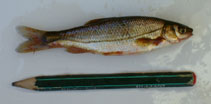
Rückenflossenstacheln (insgesamt) : 3; Rückenflossenweichstrahlen (insgesamt) : 7 - 8; Afterflossenstacheln: 3; Afterflossenweichstrahlen: 7 - 8. Diagnosis: Lateral line scales (45)47-51(53); above lateral line 10.5-11.5 (12); right pharyngeal teeth (4) 5. In comparison to C. lusitanicum, Chondrostoma almacai has a higher mean number of scales on the lateral line and above the lateral line, a smaller number of right pharyngeal teeth, a smaller head, but a larger snout and eye. There is one allozyme diagnostic locus, PGDH, with the presence of two exclusive and fixed alleles for Chondrostoma almacai (Ref. 55426).
Body shape (shape guide): fusiform / normal.
The new species is a rheophilic fish, inhabiting Mediterranean-type streams that have typical seasonal habitat heterogeneity, and low to medium flowing clear waters. The species has a short life-span living up to four (4) years, and becomes sexually mature early at the age of two years, irrespective of sex. However, 81.5% of males are mature at 70-80 mm total length, whereas only 50% of females are mature at 80-90 mm total length. Magalhães (2002) also noticed high fecundity, apparently strongly correlated with total body length, with estimates of up to 3,999 eggs at 100 mm total length; egg size ranges from 1.12 to 1.43 mm and is independent of total body length. Spawning occurs early in the year, from January to April (Ref. 55426). Breeds in shallow riffle habitats with fast-flowing water. May be confined to very small pools during summer (Ref. 59043).
Life cycle and mating behavior
Geschlechtsreife | Fortpflanzung | Ablaichen | Eier | Fecundity | Larven
Coelho, M.M., N. Mesquita and M.J. Collares-Pereira, 2005. Chondrostoma almacai, a new cyprinid species from the southwest of Portugal, Iberian Peninsula. Folia Zool. 54(1-2):201-212. (Ref. 55426)
IUCN Rote Liste Status (Ref. 130435: Version 2025-1)
Bedrohung für Menschen
Harmless
Nutzung durch Menschen
Fischereien: kommerzielles potential
Tools
Zusatzinformationen
Download XML
Internet Quellen
Estimates based on models
Phylogenetic diversity index (Ref.
82804): PD
50 = 0.5312 [Uniqueness, from 0.5 = low to 2.0 = high].
Bayesian length-weight: a=0.00724 (0.00358 - 0.01465), b=3.14 (2.97 - 3.31), in cm total length, based on LWR estimates for this (Sub)family-body shape (Ref.
93245).
Trophic level (Ref.
69278): 2.9 ±0.4 se; based on size and trophs of closest relatives
Widerstandsfähigkeit (Ref.
120179): mittel, Verdopplung der Population dauert 1,4 - 4,4 Jahre. (Preliminary K or Fecundity.).
Fishing Vulnerability (Ref.
59153): Low vulnerability (10 of 100).
🛈