



Ladda upp din foton och Videor
Google image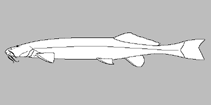 No image available for this species;
drawing shows typical species in Trichomycteridae.
Google image
drawing shows typical species in Trichomycteridae.
Klassificering / Namn Populärnamn | synonymer | Catalog of Fishes(Släkte, Arter) | ITIS | CoL | WoRMS | Cloffa
> Siluriformes (Catfishes) > Trichomycteridae (Pencil or parasitic catfishes) > Trichomycterinae
Etymology: Ituglanis: Greek, itys, ityos = circle + Greek, glanis = a fish that can eat the bait without touching the hook; a cat fish (Ref. 45335); bambui: Specific name in reference to the carbonate geological unit, the Bambui Group, where it occurs, and in recognition to the Brazilian speleological association, Grupo Bambui de Pesquisas Espeleologicas (GBPE), for its contribution to Brazilian speleology.
Etymology: Ituglanis: Greek, itys, ityos = circle + Greek, glanis = a fish that can eat the bait without touching the hook; a cat fish (Ref. 45335); bambui: Specific name in reference to the carbonate geological unit, the Bambui Group, where it occurs, and in recognition to the Brazilian speleological association, Grupo Bambui de Pesquisas Espeleologicas (GBPE), for its contribution to Brazilian speleology.
Miljö: miljö / Klimatzon / djupintervall / distributionsområde Ekologi
; sötvatten bentopelagisk; pH range: 7.9 - 8.6. Tropical; ? - 24°C (Ref. 55401)
Utbredning Territorier | FAO områden | Ekosystem | Förekomster | Prickkarta | Utplanteringar | Faunafri
South America: tributaries of the mainstream in the Angelica Cave in central Brazil.
Storlek / Vikt / Ålder
Kort beskrivning Bestämningsnycklar | Morfologi | Morfometri
Taggstrålar i ryggfenan (totalt) : 0; Mjukstrålar i ryggfenan (totalt) : 10; Taggstrålar i analfenan: 0; Mjukstrålar i analfenan: 9; Ryggkotor: 36 - 37. Distinguished from its epigean and cave congeners by the combination of the following characters: small size (max. 4.63 cm SL); pigmentation pattern intermediate between epigean and cave Ituglanis species, with small light brown spots on body, spots twice larger than in I. epikarsticus and I. ramiroi; eyes relatively developed when compared to cave species but reduced when compared to the epigean ones, with diameter varying from 0.2-0.3 mm (3.4-6.1% HL) in adults to 0.5 mm (5.7% HL) in juveniles (vs. 0.8-1.1 mm, 10.4-13.7% HL in adults of epigean Ituglanis species; n=6, 5.57-6.3 cm SL). Maxilla with prominent medial-posterior projection; fronto-lachrymal as long as maxilla, posteriorly pointed; posterior process of palatine 1/2 of palatine length, with medial concavity accentuated; vomer elongate with a small constriction in neck; opercle with 11 odontodes and interopercle with 26 odontodes; caudal skeleton with upper hypural plate triangular and lower trapezoidal, neural spine of preural centrum with rounded extremity, dorsal procurrent rays 16 and ventral 14 (Ref. 55401).
Body shape (shape guide): elongated.
Body shape (shape guide): elongated.
Occurs in the upper mainstream tributaries inside a cave, near the sinkhole end (Ref. 55401). A solitary species with swimming activity on the bottom, in midwater and sometimes extending to the surface (Ref. 55401).
Livscykel och parningsbeteende Könsmognad | Reproduktion | Lek | Ägg | Fekunditet | Larver
Huvudreferens
Ladda upp dina referenser | referenser | Koordinator : Pinna, Mário de | Medarbetare
Bichuette, M.E. and E. Trajano, 2004. Three new subterranean species of Ituglanis from central Brazil (Siluriformes: Trichomycteridae). Ichthyol. Explor. Freshwat. 15(3):243-256. (Ref. 55401)
Status på IUCN:s rödlista (Ref. 130435: Version 2025-2 (Global))
Critically Endangered (CR) (B2ab(iii,v)); Date assessed: 07 November 2018
CITES
Not Evaluated
Hot mot människor
Harmless
Mänskliga användningsområden
FAO - Publication: search | FishSource |
Ytterligare information
Trofisk ekologi
Livsmedelsartiklar (preys)
Födosammansättning
Födointag
Matransoner
Predatorer
Livsmedelsartiklar (preys)
Födosammansättning
Födointag
Matransoner
Predatorer
Ekologi
Ekologi
Ekologi
Populationsdynamik
Tillväxtparametrar
Max. åldrar / storlekar
Längd-vikt rel.
Längd-längd rel.
Längd-frekvenser
Massakonvertering
Rekrytering
Abundans
Tillväxtparametrar
Max. åldrar / storlekar
Längd-vikt rel.
Längd-längd rel.
Längd-frekvenser
Massakonvertering
Rekrytering
Abundans
Livscykel
Reproduktion
Könsmognad
Mognad/Gills rel.
Fekunditet
Lek
Lekande aggregat
Ägg
Utveckling av ägg
Larver
Larvdynamik
Reproduktion
Könsmognad
Mognad/Gills rel.
Fekunditet
Lek
Lekande aggregat
Ägg
Utveckling av ägg
Larver
Larvdynamik
Anatomi
Gälyta
Hjärna
Otolit
Gälyta
Hjärna
Otolit
Fysiologi
Kroppssammansättning
Näringsämnen
Syreförbrukning
Typ av simning
Simhastighet
Visuella pigment
Ljud från fisk
Sjukdomar & Parasiter
Toxicitet (LC50)
Kroppssammansättning
Näringsämnen
Syreförbrukning
Typ av simning
Simhastighet
Visuella pigment
Ljud från fisk
Sjukdomar & Parasiter
Toxicitet (LC50)
Genetik
Genom
Genetik
Heterozygositet
Ärftlighet
Genetisk mångfald
Genom
Genetik
Heterozygositet
Ärftlighet
Genetisk mångfald
Människorelaterad
Vattenbrukssystem
Vattenbruksprofiler
Avelslinjer
Ciguatera-fall
Frimärken, mynt, diverse.
Vattenbrukssystem
Vattenbruksprofiler
Avelslinjer
Ciguatera-fall
Frimärken, mynt, diverse.
Verktyg
Särskilda rapporter
Kontrollera för underhåll av akvarium | Kontrollera om det finns faktablad om arter | Kontrollera om det finns faktablad om vattenbruk
Ladda ner XML
Internet-källor
AFORO (otoliths) | Aquatic Commons | BHL | Cloffa | Websites from users | Check FishWatcher | CISTI | Catalog of Fishes: Släkte, Arter | DiscoverLife | ECOTOX | FAO - Publication: search | Faunafri | Fishipedia | Fishtrace | GloBI | Google Books | Google Scholar | Google | IGFA World Record | OneZoom | Open Tree of Life | Otolith Atlas of Taiwan Fishes | PubMed | Reef Life Survey | Socotra Atlas | TreeBase | Tree of Life | Wikipedia: Go, sök | World Records Freshwater Fishing | Zoobank | Zoologiskt register
Uppskattningar baserade på modeller
Index för fylogenetisk mångfald (Ref. 82804): PD50 = 0.5000 [Uniqueness, from 0.5 = low to 2.0 = high].
Bayesian length-weight: a=0.00759 (0.00337 - 0.01709), b=3.00 (2.81 - 3.19), in cm total length, based on LWR estimates for this (Sub)family-body shape (Ref. 93245).
Trofisk nivå (Ref. 69278): 3.1 ±0.4 se; based on size and trophs of closest relatives