



Hypostomus macushi Armbruster & de Souza, 2005
Envoyez vos Photos et vidéos
Images Google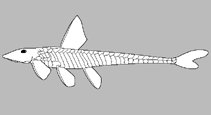 No image available for this species;
drawing shows typical species in Loricariidae.
Images Google
drawing shows typical species in Loricariidae.
Classification / Noms Noms communs | Synonymes | Catalog of Fishes(Genre, Espèce) | ITIS | CoL | WoRMS | Cloffa
> Siluriformes (Catfishes) > Loricariidae (Armored catfishes) > Hypostominae
Etymology: Hypostomus: Greek, hypo = under + Greek, stoma = mouth (Ref. 45335); macushi: Named for the Macushi people of the northern Rupununi who provided the authors with a lot of help and hospitality on their trips to Southern Guyana and who collected most of the best specimens in the type series.
Eponymy: The Macushi people of the northern Rupununi, southern Guyana, gave the authors a great deal of help and hospitality. They collected most of the best specimens in the type series. (Ref. 128868), visit book page.
Etymology: Hypostomus: Greek, hypo = under + Greek, stoma = mouth (Ref. 45335); macushi: Named for the Macushi people of the northern Rupununi who provided the authors with a lot of help and hospitality on their trips to Southern Guyana and who collected most of the best specimens in the type series.
Eponymy: The Macushi people of the northern Rupununi, southern Guyana, gave the authors a great deal of help and hospitality. They collected most of the best specimens in the type series. (Ref. 128868), visit book page.
Environnement : milieu / zone climatique / profondeur / gamme de distribution Écologie
; eau douce démersal. Tropical
Distribution Territoires | Zones FAO | Écosystèmes | Occurrences | Carte par point | Introductions | Faunafri
South America: Rupununi River, Essequibo River and Takutu and Ireng Rivers (Negro River drainage) along the Guyana-Brazil border.
Taille / Poids / Âge
Description synthétique Clés d'identification | Morphologie | Morphométrie
Épines dorsales (Total) : 2; Rayons mous dorsaux (Total) : 7; Épines anales: 1; Rayons mous anaux: 4. Distinguished from all other Hypostomus except the species of the H. cochliodon group based on the presence of large, spoon-shaped teeth; and from all members of the H. cochliodon group except H. cochliodon, H. ericae, H. ericius and H. paucipunctatus by the presence of very widely spaced black spots on a light background. Can be separated from H. cochliodon by absence of a longitudinal ridge on the pterotic-supracleithrum and absence of longitudinal dark stripes; from H. ericius by lacking keels formed from sharp odontodes on the lateral plates; from H. ericae and H. paucipunctatus by lacking a buccal papilla; from H. ericae by having spots in the distal dorsal and caudal fins not combining (vs. spots combining to form wavy lines); and from H. paucipunctatus by having medium to large spots. It is further distinguished by having seven to eight adipose-caudal plates and by generally having no odontodes on the opercle (zero to 10), vs. having a patch of greater than 10 odontodes on the opercle (Ref. 54531).
Body shape (shape guide): elongated.
Body shape (shape guide): elongated.
Facultative air-breathing in the genus (Ref. 126274); Occurs among submerged, dead wood in modest to swift flowing water (Ref. 54531). Inhabiting largest part of freshwaters, from headwaters to upstream of the lower falls, with rocky substrate consisting of boulders, stones, gravels, and sand; the exposed wet rocks are also often covered by the Podostemaceae Mourera fluviatilis and Apinagia richardiana (Ref. 90186).
Cycle de vie et comportement reproducteur Maturité | Reproduction | Frai | Œufs | Fécondité | Larves
Référence principale
Téléchargez vos références | Références | Coordinateur : Fisch-Muller, Sonia | Collaborateurs
Armbruster, J.W. and L.S. de Souza, 2005. Hypostomus macushi, a new species of the Hypostomus cochliodon group (Siluriformes: Loricariidae) from Guyana. Zootaxa 920:1-12. (Ref. 54531)
Statut dans la liste rouge de l'IUCN (Ref. 130435: Version 2025-2 (Global))
Préoccupation mineure (LC) ; Date assessed: 12 November 2020
CITES
Not Evaluated
Menace pour l'homme
Harmless
Utilisations par l'homme
Pêcheries: sans intérêt
FAO - Publication: search | FishSource |
Plus d'informations
Écologie trophique
Aliments (proies)
Composition du régime alimentaire
Consommation alimentaire
Rations alimentaires
Prédateurs
Aliments (proies)
Composition du régime alimentaire
Consommation alimentaire
Rations alimentaires
Prédateurs
Écologie
Écologie
Écologie
Dynamique des populations
Paramètres de croissance
Âges / tailles maximales
Longueur-poids rel.
Rel. longueur-longueur.
Fréquences de longueurs
Conversion de masse
Recrutement
Abondance
Paramètres de croissance
Âges / tailles maximales
Longueur-poids rel.
Rel. longueur-longueur.
Fréquences de longueurs
Conversion de masse
Recrutement
Abondance
Cycle de vie
Reproduction
Maturité
Maturité/épines rel.
Fécondité
Frai
Agrégats de frai
Œufs
Développement de l'œuf
Larves
Dynamique des populations larvaires
Reproduction
Maturité
Maturité/épines rel.
Fécondité
Frai
Agrégats de frai
Œufs
Développement de l'œuf
Larves
Dynamique des populations larvaires
Anatomie
Surface branchiale
Cerveau
Otolithe
Surface branchiale
Cerveau
Otolithe
Physiologie
Composition corporelle
Nutriments
Consommation d'oxygène
Type de natation
Vitesse de nage
Pigments visuels
Son de poisson
Maladies et parasites
Toxicité (CL50)
Composition corporelle
Nutriments
Consommation d'oxygène
Type de natation
Vitesse de nage
Pigments visuels
Son de poisson
Maladies et parasites
Toxicité (CL50)
Génétique
génôme
Génétique
Hétérozygotie
Héritabilité
Diversité génétique
génôme
Génétique
Hétérozygotie
Héritabilité
Diversité génétique
Liées à l'homme
Systèmes d'aquaculture
Profils d'aquaculture
Souches
Cas de ciguatera
Timbres, pièces de monnaie, divers
Systèmes d'aquaculture
Profils d'aquaculture
Souches
Cas de ciguatera
Timbres, pièces de monnaie, divers
Outils
E-book | Guide de terrain | Générateur de fréquences de longueur | Outil de dynamique de population | Carte par point |
Capture-MSY |
Articles particuliers
Télécharger en XML
Sources Internet
AFORO (otoliths) | Aquatic Commons | BHL | Cloffa | Websites from users | FishWatcher | CISTI | Catalog of Fishes: Genre, Espèce | DiscoverLife | ECOTOX | FAO - Publication: search | Faunafri | Fishipedia | Fishtrace | GloBI | Google Books | Google Scholar | Google | IGFA World Record | OneZoom | Open Tree of Life | Otolith Atlas of Taiwan Fishes | PubMed | Reef Life Survey | Socotra Atlas | TreeBase | Arbre de Vie | Wikipedia: aller à, chercher | World Records Freshwater Fishing | Zoobank | Zoological Record
Estimations basées sur des modèles
Indice de diversité phylogénétique (Réf. 82804): PD50 = 0.5000 [Uniqueness, from 0.5 = low to 2.0 = high].
Bayesian length-weight: a=0.01585 (0.00726 - 0.03460), b=2.95 (2.78 - 3.12), in cm total length, based on LWR estimates for this Genus-body shape (Ref. 93245).
Résilience (Réf. 120179): Milieu, temps minimum de doublement de population : 1,4 à 4,4 années (Preliminary K or Fecundity.).