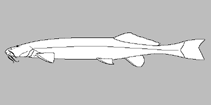
Classification / Names
Nomi Comuni | Sinonimi | Catalog of Fishes(Genere, Specie) | ITIS | CoL | WoRMS | Cloffa
>
Siluriformes (Catfishes) >
Trichomycteridae (Pencil or parasitic catfishes) > Trichomycterinae
Etymology: Trichomycterus: Greek, thrix = hair + Greek, mykter, -eros = nose (Ref. 45335); potschi: Named for the herpetologist Sérgio Potsch, who first collected the new species.
Eponymy: Dr Sergio Potsch de Carvalho e Silva is a Brazilian herpetologist in the Department of Zoology, Institute of Biology and Laboratory Head, Federal University of Rio de Janeiro. [...] (Ref. 128868), visit book page.
More on authors: Barbosa & Costa.
Environment: milieu / climate zone / distribuzione batimetrica / distribution range
Ecologia
; acqua dolce demersale. Tropical
South America: coastal basins between Mangaratiba and Itaguaí in Rio de Janeiro, southeastern Brazil.
Size / Peso / Age
Maturità: Lm ? range ? - ? cm
Max length : 8.1 cm SL maschio/sesso non determinato; (Ref. 52913)
Short description
Chiavi di identificazione | Morfologia | Morfometria
Raggi dorsali molli (totale) : 11 - 12; Raggi anali molli: 9 - 10; Vertebre: 37 - 39. Posterior tip of posterior ceratohyal slender, its depth 2.3-6.5% of longitudinal length of the hyoid bar; ventroposterior process of posterior ceratohyal absent or vestigial (1.7%, or less when present, of longitudinal length of the hyoid bar); opercular patch of odontodes slender, its depth 44.0-73.7% of base length of opercular dorsal projection; first pectoral-fin ray 28.8-37.0% of pectoral-fin length); 7 pectoral fin rays; 8 branchiostegal rays; 14-15 pleural ribs; infraorbital sensory pores i1 and i3 present; supraorbital sensory pores s6 nearer to each other than to eye; dorsal-fin origin in vertical through centrum of 20th or 21st vertebra; anal-fin origin in vertical through centrum of 23rd or 24th vertebra; pelvic fins anteriorly placed; prepelvic length 53.9-57.8% SL; orbital diameter 6.7-7.5% of head length; head length 20.0-21.8% SL; interorbital width 28.1-30.8% of head length; caudal peduncle depth 13.8-15.3% SL; body width 9.7-12.3% SL; body depth 15.1-16.4% SL; dorsal-fin base 10.6-11.4% SL; anal-fin base 8.6-10.2% SL; and pectoral-fin length 9.9-12.5% SL (Ref. 52913).
Body shape (shape guide): elongated.
Inhabits clear water, shallow stream (about 0.6 m deep), with sandy bottom (Ref. 52913). Some specimens were encountered entirely buried in the bottom (Ref. 52913).
Life cycle and mating behavior
Maturità | Riproduzione | Deposizione | Uova | Fecundity | Larve
Barbosa, M.A. and W.J.E.M. Costa, 2003. Trichomycterus potschi (Siluriformes: Loricarioidei): a new trichomycterid catfish from coastal streams of southeastern Brazil. Ichthyol. Explor. Freshwat. 14(3):281-287. (Ref. 52913)
IUCN Red List Status (Ref. 130435: Version 2025-1)
Threat to humans
Harmless
Human uses
Pesca: di nessun interesse
Strumenti
Special reports
Download XML
Fonti Internet
Estimates based on models
Phylogenetic diversity index (Fonte Biblio.
82804): PD
50 = 0.5000 [Uniqueness, from 0.5 = low to 2.0 = high].
Bayesian length-weight: a=0.00851 (0.00358 - 0.02025), b=2.93 (2.74 - 3.12), in cm total length, based on LWR estimates for this Genus-body shape (Ref.
93245).
Trophic level (Fonte Biblio.
69278): 3.2 ±0.4 se; based on size and trophs of closest relatives
Resilienza (Fonte Biblio.
120179): Basso, tempo minimo di raddoppiamento della popolazione 4.5 - 14 anni (Assuming Fec < 100).
Fishing Vulnerability (Ref.
59153): Low vulnerability (10 of 100).
🛈