Klassifizierung / Names
Namen | Synonyme | Catalog of Fishes(Gattung, Arten) | ITIS | CoL | WoRMS | Cloffa
>
Characiformes (Characins) >
Acestrorhamphidae (American tetras) > Hyphessobryconinae
Etymology: Hyphessobrycon: Greek, hyphesson, -on, -on = a little smaller + Greek, bryko = to bite (Ref. 45335); eilyos: From the Greek eilyos, den, lurking-place, in allusion to the habitat (backwaters chocked with vegetal matter) occupied by the new species (and according to local information, shared with anacondas, Eunectes murinus). Noun in apposition.
Environment: milieu / climate zone / Tiefenbereich / distribution range
Ökologie
; süßwasser pelagisch. Tropical
South America: Brazil.
Size / Gewicht / Alter
Geschlechtsreife: Lm ? range ? - ? cm
Max length : 2.5 cm Männchen/unbestimmt; (Ref. 52338)
Kurzbeschreibung
Bestimmungsschlüssel | Morphologie | Morphometrie
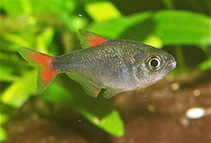
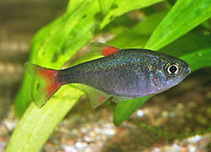
Wirbelzahl: 32 - 34. Diagnosis: Hyphessobrycon eilyos is distinguished from its congeners by the absence of humeral and caudal spots; by the presence of numerous dark chromatophores on the lateral surface of the body, with the chromatophores intensely concentrated on the ventral region from the pelvic-fin origin to the end of the caudal-fin base; dorsal, adipose, and caudal fins with carmine red pigmentation in life; the presence of 7-11 maxillary teeth; 6 or 7 horizontal scale rows between the dorsal fin origin and the lateral line; and 15 to 19 branched anal-fin rays. Detailed comparisons between H. eilyos and congeners sharing a general dark color pattern are presented in the "Discussion" (Ref. 52338).
Body shape (shape guide): elongated; Cross section: compressed.
Life cycle and mating behavior
Geschlechtsreife | Fortpflanzung | Ablaichen | Eier | Fecundity | Larven
Lima, F.C.T. and C.R. Moreira, 2003. Three new species of Hyphessobrycon (Characiformes: Characidae) from the upper rio Araguaia basin in Brazil. Neotrop. Ichthyol. 1(1):21-33. (Ref. 52338)
IUCN Rote Liste Status (Ref. 130435: Version 2025-1)
Bedrohung für Menschen
Harmless
Nutzung durch Menschen
Tools
Zusatzinformationen
Download XML
Internet Quellen
Estimates based on models
Phylogenetic diversity index (Ref.
82804): PD
50 = 0.5000 [Uniqueness, from 0.5 = low to 2.0 = high].
Bayesian length-weight: a=0.00955 (0.00428 - 0.02132), b=3.12 (2.93 - 3.31), in cm total length, based on LWR estimates for this (Sub)family-body shape (Ref.
93245).
Trophic level (Ref.
69278): 2.9 ±0.3 se; based on size and trophs of closest relatives
Widerstandsfähigkeit (Ref.
120179): hoch, Verdopplung der Population dauert weniger als 15 Monate. (Preliminary K or Fecundity.).
Fishing Vulnerability (Ref.
59153): Low vulnerability (10 of 100).
🛈