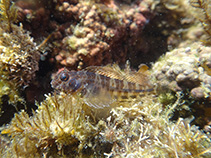
>
Blenniiformes (Blennies) >
Blenniidae (Combtooth blennies) > Salariinae
Etymology: Hypleurochilus: Greek, hypo = under + Greek, pleura = in the side of + Greek, cheilos = lip.
Environment: milieu / Klimaatzone / Diepte / distribution range
Ecologie
marien rifbewoner. Tropical
Western Central Atlantic: Caribbean to South Florida.
Grootte / Gewicht / Leeftijd
Maturiteit: Lm ? range ? - ? cm
Max length : 6.8 cm SL mannelijk / geslacht onbekend; (Ref. 52938)
Dorsale stekels (totaal) : 12; Anale stekels: 2. Species distinguished by: black spot on membrane between first 2 dorsal-fin spines; mandibular sensory pore series with 5 pores per side (south Florida to Brazil); upper half of body with groups of spots forming 6 partial bars along dorsum; no orange spots in life; pelvic fins with 1 spine and 4 soft rays; pectoral-fin soft rays usually 13 or 14; segmented caudal-fin soft rays usually 13; dorsal fin not separated into 2 portions by deep notch (notch, when present, not reaching nearly to dorsal contour of body); dorsal-fin spines usually 12, the last easy to see; total dorsal-fin elements 25 to 30; an enlarged canine tooth present posteriorly on both sides of 1 or both jaws (sometimes absent on 1 side); no teeth on vomer; gill openings not continuous, each restricted to side of head, extending ventrally to about midlevel of pectoral-fin base or further (may extend completely around lower side of head and form common opening with gill opening of opposite side); cirri present only on eyes; ventral edge of upper lip smooth; lateral line never consisting of 2 disconnected, overlapping portions. Common amongst Blenniids: small, slender fishes, largest species to about 13 cm SL, most under 7.5 cm SL. Eyes high on sides of head; mouth ventral, upper jaw not protractile. A single row of incisor-like teeth in each jaw and often an enlarged canine-like tooth posteriorly on each side of lower jaw and sometimes upper jaw; no teeth on palatines. Dorsal and anal fins long, their spines usually flexible; dorsal fin with fewer spines than segmented (soft) rays; 2 spines in anal fin, scarcely differentiated from the segmented rays, the first not visible in females, both often supporting fleshy, bulbous, rugose swellings at their tips in males; pelvic fins inserted anterior to base of pectoral fins, with 1 spine (not visible) and segmented rays; all segmented fin rays, except those of caudal fin, unbranched (simple), caudal-fin rays of adults branched. All species lack scales (Ref.52855).
Body shape (shape guide): elongated.
Oviparous. Eggs are demersal and adhesive (Ref. 205), and are attached to the substrate via a filamentous, adhesive pad or pedestal (Ref. 94114). Larvae are planktonic, often found in shallow, coastal waters (Ref. 94114).
Levenscyclus en paargedrag
Maturiteit | Voortplanting | Paaien | Eieren | Fecunditeit | Larven
Oviparous, distinct pairing (Ref. 205).
Floeter, S.R., J.L. Gasparini, L.A. Rocha, C.E.L. Ferreira, C.A. Rangel and B.M. Feitoza, 2003. Brazilian reef fish fauna: checklist and remarks (updated Jan. 2003). Brazilian Reef Fish Project: www.brazilianreeffish.cjb.net. (Ref. 57756)
Status op de Rode Lijst van het IUCN (Ref. 130435: Version 2025-1)
Gevaar voor de mens
Harmless
Gebruik door de mens
Tools
Speciale rapporten
Download XML
Internetbronnen
Estimates based on models
Preferred temperature (Ref.
123201): 25.5 - 28.2, mean 27.4 °C (based on 637 cells).
Fylogenetische diversiteitsindex (Ref.
82804): PD
50 = 0.5005 [Uniqueness, from 0.5 = low to 2.0 = high].
Bayesian length-weight: a=0.00776 (0.00356 - 0.01695), b=3.00 (2.81 - 3.19), in cm total length, based on LWR estimates for this (Sub)family-body shape (Ref.
93245).
Trofisch niveau (Ref.
69278): 3.2 ±0.3 se; based on size and trophs of closest relatives
Weerstandsvermogen (Ref.
120179): Hoog, minimale populatieverdubbelingstijd minder dan 15 maanden (Preliminary K or Fecundity.).
Fishing Vulnerability (Ref.
59153): Low vulnerability (10 of 100).
🛈