



Caecobarbus geertsii Boulenger, 1921
Congo blind barb
Carregue seu(sua) Fotos e vídeos
Imagem do Google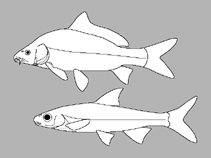 No image available for this species;
drawing shows typical species in Cyprinidae.
Imagem do Google
drawing shows typical species in Cyprinidae.
Classificação / Nomes Nomes comuns | Sinônimos | Catalog of Fishes(Gênero, Espécies) | ITIS | CoL | WoRMS | Cloffa
> Cypriniformes (Carps) > Cyprinidae (Minnows or carps) > Smiliogastrinae
Etymology: Caecobarbus: Latin, caecus = blind + Latin, barbus = barbel (Ref. 45335).
Eponymy: G Geerts was an engineer and railway director in the Belgian Congo. [...] (Ref. 128868), visit book page.
More on author: Boulenger.
Etymology: Caecobarbus: Latin, caecus = blind + Latin, barbus = barbel (Ref. 45335).
Eponymy: G Geerts was an engineer and railway director in the Belgian Congo. [...] (Ref. 128868), visit book page.
More on author: Boulenger.
Meio ambiente: milieu / Zona climática / intervalo de profundidade / faixa de distribuição Ecologia
; Água doce bentopelágico. Tropical; 0°S - 5°S
Distribuição Territórios | Áreas da FAO | Ecossistemas | Ocorrências | Mapa de pontos | Introduções | Faunafri
Africa: known only from some caves near Mbanza-Ngungu (lower Congo River basin), Democratic Republic of the Congo (Ref. 86866).
Tamanho / Peso / Idade
Descrição suscinta Chaves de identificação | Morfologia | Morfometria
Blind fish which lives in caves (Ref. 86866), about (700)750-850 m above sea-level (Ref. 2801, 86866). Feeds on small crustaceans living in the caves and also on animals washed into the caves (Ref. 557), although this needs confirmation (Ref. 86866). Estimated longevity 9-14 years, but may exceed 15 years (Ref. 86866). Not closely related to any extant epigean species of the Congo region. Classified as `textbook and popular press fish' in Ref. 4537.
Ciclo de vida ou comportamento de acasalamento Maturidade | Reprodução | Desova | Ovos | Fecundidade | Larvas
Expels eggs in a more or less haphazard fashion, the substrate on which the species spawns must have crevices and pores into which the adhesive eggs can roll and be hidden so to prevent predation by its parents or other cave inhabitants.
Referência principal
Carregar suas referências | Referências | Coordenador | Colaboradores
Vreven, E., A. Kimbembi ma Ibaka and S. Wamuini Lunkayilakio, 2011. The Congo blind barb: Mbanza-Ngungu’s albino cave fish. p.74-75. In W.R.T. Darwall, K.G. Smith, D.J. Allen, R.A. Holland, I.J. Harrison and E.G.E. Brooks (eds.). The diversity of life in African freshwaters: under water, under threat. An analysis of the status and distribution of freshwater species throughout mainland Africa. IUCN, Cambridge, United Kingdom and Gland, Switzerland, 348p. (Ref. 86866)
Status na Lista Vermelha da UICN (Ref. 130435: Version 2025-2 (Global))
Vulnerável (VU) (B1ab(i,ii,iii,iv)+2ab(i,ii,iii,iv)); Date assessed: 16 February 2009
Ameaça para os humanos
Harmless
Uso pelos humanos
Pescarias: sem interesse; Aquário: Espécies comerciais
FAO - Publication: search | FishSource |
Mais informação
Ecologia Trófica
Itens alimentares (presas)
Composição da dieta
Consumo alimentar
Rações alimentares
Predadores
Itens alimentares (presas)
Composição da dieta
Consumo alimentar
Rações alimentares
Predadores
Dinâmica populacional
Parâmetros de crescimento
Idade máxima / tamanhos
Relação comprimento-peso.
Relação comprimento-comprimento.
Frequências de comprimento
Conversão de massa
Recrutamento
Abundância
Parâmetros de crescimento
Idade máxima / tamanhos
Relação comprimento-peso.
Relação comprimento-comprimento.
Frequências de comprimento
Conversão de massa
Recrutamento
Abundância
Ciclo de vida
Reprodução
Maturidade
Maturidade/Rel. das guelras
Fecundidade
Desova
Agregações de desova
Ovos
Desenvolvimento dos ovos
Larvas
Dinâmica larval
Reprodução
Maturidade
Maturidade/Rel. das guelras
Fecundidade
Desova
Agregações de desova
Ovos
Desenvolvimento dos ovos
Larvas
Dinâmica larval
Anatomia
Área branquial
Cérebro
Otólito
Área branquial
Cérebro
Otólito
Fisiologia
Composição corporal
Nutrientes
Consumo de oxigênio
Tipo de natação
Velocidade de natação
Pigmentos visuais
Som de peixe
Doenças e Parasitas
Toxicidade (LC50s)
Composição corporal
Nutrientes
Consumo de oxigênio
Tipo de natação
Velocidade de natação
Pigmentos visuais
Som de peixe
Doenças e Parasitas
Toxicidade (LC50s)
Relacionado a humanos
Sistemas de aquicultura
Perfis para aquacultura
Estirpes
Casos de Ciguatera
Selos, moedas, diversos.
Sistemas de aquicultura
Perfis para aquacultura
Estirpes
Casos de Ciguatera
Selos, moedas, diversos.
Ferramentas
Livro eletrônico | Guia de campo | Ferramenta auxiliar de frequências de comprimento | Ferramenta sobre a história de vida | Mapa de pontos |
Catch-MSY |
Relatórios especiais
Checar Manutenção em Aquário | Checar Planilhas de Fatos sobre as Espécies | Checar Planilhas de Fatos sobre Aquicultura
Baixar XML
Fontes da internet
AFORO (otoliths) | Aquatic Commons | BHL | Cloffa | Websites from users | Checar Observador de Peixes (FishWatcher) | CISTI | Catalog of Fishes: Gênero, Espécies | DiscoverLife | ECOTOX | FAO - Publication: search | Faunafri | Fishipedia | Fishtrace | GloBI | Google Books | Google Scholar | Google | IGFA World Record | OneZoom | Open Tree of Life | Otolith Atlas of Taiwan Fishes | PubMed | Reef Life Survey | Socotra Atlas | TreeBase | Árvore da vida | Wikipedia: Ir para, procura | World Records Freshwater Fishing | Zoobank | Registro zoológico
Estimativas baseadas em modelos
Índice de diversidade filogenética (Ref. 82804): PD50 = 1.0000 [Uniqueness, from 0.5 = low to 2.0 = high].
Bayesian length-weight: a=0.00603 (0.00282 - 0.01286), b=3.06 (2.87 - 3.25), in cm total length, based on LWR estimates for this (Sub)family-body shape (Ref. 93245).
Nível Trófico (Ref. 69278): 3.5 ±0.45 se; based on food items.
Resiliência (Ref. 120179): Elevada, tempo mínimo de duplicação da população menor que 15 meses (Preliminary K or Fecundity.).