



Beobachtung melden im Fish Watcher
| Native range | All suitable habitat | Point map | Year 2050 |

|
| This map was computer-generated and has not yet been reviewed. |
| Puck pinnata AquaMaps Data sources: GBIF OBIS |
Hochladen Photos und videos
Google Bild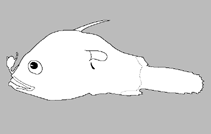 No image available for this species;
drawing shows typical species in Oneirodidae.
Google Bild
drawing shows typical species in Oneirodidae.
Klassifizierung / Names Namen | Synonyme | Catalog of Fishes(Gattung, Arten) | ITIS | CoL | WoRMS | Cloffa
> Lophiiformes (Anglerfishes) > Oneirodidae (Dreamers)
Etymology: Puck: From the Germanic folklore, a minor order of mischievous devils, sprites, goblins, and demons; a devilish trickster (Ref. 86949).
Eponymy: Puck is a fairy in the service of Oberon (see Shakespeare’s: A Midsummers Night’s Dream), one of three Shakespearean names coined in the same paper (see O. [...] (Ref. 128868), visit book page.
Etymology: Puck: From the Germanic folklore, a minor order of mischievous devils, sprites, goblins, and demons; a devilish trickster (Ref. 86949).
Eponymy: Puck is a fairy in the service of Oberon (see Shakespeare’s: A Midsummers Night’s Dream), one of three Shakespearean names coined in the same paper (see O. [...] (Ref. 128868), visit book page.
Umwelt: Milieu / Klimazone / Tiefenbereich / Verbreitungsgebiet Ökologie
seewasser bathypelagisch; tiefenbereich 1464 - 4073 m (Ref. 86949). Deep-water
Verbreitung Territorien | FAO Gebiete | Ökosysteme | Vorkommen | Punkt Karte | Einführungen | Faunafri
Northwest Pacific: known from the type locality, 38°16'N, 152°34'E and Galapagos Islands (Ref. 86949).
Größe / Gewicht / Alter
Kurzbeschreibung Bestimmungsschlüssel | Morphologie | Morphometrie
Rückenflossenweichstrahlen (insgesamt) : 5; Afterflossenweichstrahlen: 4. Metamorphosed females distinguished by the following characteristics: wide ethmoid cartilage and vomer, wider than distance between anterolateral tips of lateral ethmoids and frontals; presence of vomerine teeth; nasal foramina large and oval in shape; short frontals, lying posterior to the ethmoid region, strongly convex dorsal margin; ventromedial extensions of frontals approach each other on midline, making contact with parasphenoid; frontals separated from prootics; presence of pterosphenoid; anterior end of illicial trough wider and shallower than posterior end; extremely well developed sphenotic spines; symphysial cartilage of upper jaw longer than wide; lower jaw with well developed symphysial spine; hyomandibula with double head; extremely well developed quadrate spine, nearly six times the length of articular spine; deeply notched posterior margin of opercle; subopercle small, elongate and narrow throughout its length, dorsal end tapering to a point, rounded ventral end; absence of first pharyngobranchial; well developed second pharyngobranchial; second hypobranchial directly articulates with second basibranchial; caudal fin rays without internal pigmentation; illicium longer than length of esca bulb; pterygoiphore of illicium cylindrical throughout its length, emerging on snout from between frontal bones, anterior end slightly exposed, posterior end concealed beneath skin; well developed first ray of dorsal fin; dorsal fin rays 5; anal fin rays 4; long and narrow pectoral fin lobe, longer than longest rays of pectoral fin; pectoral fin rays 19-20; coracoid lacking posteroventral process; simple pelvic bones, slightly expanded distally; skin is naked, without dermal spinules; darkly pigmented skin of caudal peduncle extends well past base of caudal fin (Ref. 86949).
Presumably bathypelagic.
Lebenszyklus und Paarungsverhalten Geschlechtsreife | Fortpflanzung | Ablaichen | Eier | Fruchtbarkeit | Larven
Hauptreferenz
Laden Sie Ihre Referenzen hoch | Referenzen | Koordinator | Partner
Eschmeyer, W.N. (ed.), 2003. Catalog of fishes. Updated database version of March 2003. Database dump. Catalog databases as made available to FishBase in March 2003. (Ref. 46206)
IUCN Rote Liste Status (Ref. 130435: Version 2025-2 (Global))
nicht bedroht (LC) ; Date assessed: 11 October 2018
CITES
Not Evaluated
Bedrohung für Menschen
Harmless
Nutzung durch Menschen
Fischereien: nicht kommerziell
FAO - Publication: search | FishSource |
Mehr Information
Trophische Ökologie
Lebensmittel (Beutetiere)
Nahrungszusammensetzung
Nahrungsaufnahme
Lebensmittelrationen
Räuber
Lebensmittel (Beutetiere)
Nahrungszusammensetzung
Nahrungsaufnahme
Lebensmittelrationen
Räuber
Ökologie
Ökologie
Ökologie
Populationsdynamik
Wachstumsparameter
Max. Alter/Größen
Länge-Gewicht-Rel.
Länge-Länge-Verhältnis.
Längenhäufigkeiten
Massenkonvertierung
Rekrutierung
Dichte
Wachstumsparameter
Max. Alter/Größen
Länge-Gewicht-Rel.
Länge-Länge-Verhältnis.
Längenhäufigkeiten
Massenkonvertierung
Rekrutierung
Dichte
Lebenszyklus
Fortpflanzung
Geschlechtsreife
Reifung/Kiemen rel.
Fruchtbarkeit
Ablaichen
Laichaggregationen
Eier
Eientwicklung
Larven
Larven Pop.Dyn.
Fortpflanzung
Geschlechtsreife
Reifung/Kiemen rel.
Fruchtbarkeit
Ablaichen
Laichaggregationen
Eier
Eientwicklung
Larven
Larven Pop.Dyn.
Anatomie
Kiemenoberfläche
Gehirn
Otolith
Kiemenoberfläche
Gehirn
Otolith
Physiologie
Körperliche Zusammensetzung
Nährstoffe
Sauerstoffverbrauch
Schwimmart
Schwimmgeschwindigkeit
Visuelle Pigmente
Fischgeräusche
Krankheiten und Parasiten
Toxizität (LC50s)
Körperliche Zusammensetzung
Nährstoffe
Sauerstoffverbrauch
Schwimmart
Schwimmgeschwindigkeit
Visuelle Pigmente
Fischgeräusche
Krankheiten und Parasiten
Toxizität (LC50s)
Genetik
Genom
Genetik
Heterozygotie
Vererbbarkeit
Genetische Vielfalt
Genom
Genetik
Heterozygotie
Vererbbarkeit
Genetische Vielfalt
Menschenbezogen
Aquakultur-Systeme
Aquakultur Profile
Zuchtlinien
Ciguatera-Fälle
Briefmarken, Münzen, Verschiedenes.
Aquakultur-Systeme
Aquakultur Profile
Zuchtlinien
Ciguatera-Fälle
Briefmarken, Münzen, Verschiedenes.
Tools
Zusatzinformationen
Download XML
Zusammenfassung | Punktdaten | Namen | Photos
Internet Quellen
AFORO (otoliths) | Aquatic Commons | BHL | Cloffa | Websites from users | FishWatcher Einträge suchen | CISTI | Catalog of Fishes: Gattung, Arten | DiscoverLife | ECOTOX | FAO - Publication: search | Faunafri | Fishipedia | Fishtrace | GloBI | Google Books | Google Scholar | Google | IGFA World Record | OneZoom | Open Tree of Life | Otolith Atlas of Taiwan Fishes | PubMed | Reef Life Survey | Socotra Atlas | TreeBase | Tree of Life | Wikipedia: Gehe zu, Suchen | World Records Freshwater Fishing | Zoobank | Zoologischer Rekord
Schätzungen auf der Grundlage von Modellen
Bevorzugte Temperatur (Ref. 123201): 1.7 - 2.6, mean 2.3 °C (based on 71 cells).
Phylogenetischer Diversitätsindex (Ref. 82804): PD50 = 1.0000 [Uniqueness, from 0.5 = low to 2.0 = high].
Bayesian length-weight: a=0.01995 (0.00906 - 0.04395), b=3.01 (2.83 - 3.19), in cm total length, based on all LWR estimates for this body shape (Ref. 93245).
Trophische Ebene (Ref. 69278): 3.8 ±0.6 se; based on size and trophs of closest relatives
Widerstandsfähigkeit (Ref. 120179): hoch, Verdopplung der Population dauert weniger als 15 Monate. (Preliminary K or Fecundity.).