



Parupeneus crassilabris (Valenciennes, 1831)
Triplebar goatfish
Adicionar as suas observações no Fish Watcher
| Native range | All suitable habitat | Point map | Year 2050 |

|
| This map was computer-generated and has not yet been reviewed. |
| Parupeneus crassilabris AquaMaps Data sources: GBIF OBIS |
Adicionar o seu Fotografias e vídeos
Fotografias | vídeos | Imagem do Google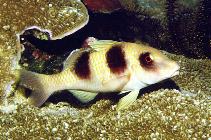 Parupeneus crassilabris
Fotografia de Patzner, R.
Fotografias | vídeos | Imagem do Google
Fotografia de Patzner, R.
Classificação / Nomes Nomes comuns | Sinónimos | Catalog of Fishes(Género, Espécies) | ITIS | CoL | WoRMS | Cloffa
> Mulliformes (Goatfishes) > Mullidae (Goatfishes)
Etymology: Parupeneus: Latin, parum, parvum = small + Peneus, the name of a river.
More on author: Valenciennes.
Etymology: Parupeneus: Latin, parum, parvum = small + Peneus, the name of a river.
More on author: Valenciennes.
Taxonomic Remarks
FishBase common name changed from Two-banded goatfish to Triplebar goatfish (Uiblein et al., 2024: Ref. 130857).
Ambiente: milieu / zona climática / intervalo de profundidade / gama de distribuição Ecologia
marinhas associadas(os) a recifes; intervalo de profundidade 1 - 80 m (Ref. 90102). Tropical; 32°N - 28°S, 95°E - 173°W
Distribuição Territórios | Áreas FAO | Ecossistemas | Ocorrências | Mapa dos pontos | Introduções | Faunafri
Indo-West Pacific: eastern Indian Ocean and the western Pacific east to Fiji, Tonga, and the Caroline Islands. This species is included in the Parupeneus trifasciatus complex where Parupeneus trifasciatus is restricted to the Indian Ocean and Parupeneus insularis from the Hawaiian Islands, French Polynesia, and Pitcairn Islands to the Marshalls, Mariana, Phoenix, and Samoa Islands.
Tamanho / Peso / Idade
Descrição breve Chaves de identificação | Morfologia | Morfometria
Espinhos dorsais (total) : 8; Raios dorsais moles (total) : 9; Espinhos anais: 1; Raios anais moles: 7. Diagnosis: Pectoral rays 15-16 (rarely 15). Gill rakers 7-10 + 27-31 (total 35-40). Body depth 2.653.1 in SL (deeper body with growth); head length (HL) 2.8-3.15 in SL; snout length 1.75-1.95 in HL; barbels short, 1.45-1.75 in HL; longest dorsal spine 1.4-1.6 in HL; penultimate dorsal ray 1.2-1.5 in length of last dorsal ray; pectoral-fin length 1.25-1.45 in HL; pelvic-fin length 1.2-1.4 in HL. Color white, the scale edges yellow or yellowish gray, the posterior edge often enlarged to a distinct yellow spot; upper two-thirds of body with two very large oval black spots, the first centered below anterior spines of first dorsal fin and the second below anterior half or more of second dorsal fin and extending into basal part of fin; a large black spot on head behind and enclosing part of eye, extending diffusely toward comer of mouth; broad outer part of second dorsal and anal fins blue with narrow oblique dark-edged yellow bands; caudal fin streaked with dull blue and yellow; inner rim of iris bright red (Ref. 54393).
Body shape (shape guide): fusiform / normal.
Body shape (shape guide): fusiform / normal.
Coastal to outer reef habitats. Juveniles usually in shallow surge channels on reef slopes adjacent to drop-offs. Adults usually seen resting on corals on reef crests (Ref. 48636).
Ciclo de vida e comportamento de acasalamento Maturidade | Reprodução | Desova | Ovos | Fecundidade | Larvas
Referência principal
Carregar as suas referências | Referências | Coordenador : Randall, John E. | Colaboradores
Randall, J.E., 2004. Revision of the goatfish genus Parupeneus (Perciformes: Mullidae), with descriptions of two new species. Indo-Pac. Fish. (36):64 p. (Ref. 54393)
Categoria na Lista Vermelha da IUCN (Ref. 130435: Version 2025-2 (Global))
Preocupação menor (LC) ; Date assessed: 04 February 2009
CITES
Not Evaluated
Ameaça para o homem
Harmless
Utilização humana
Pescarias: espécies comerciais
FAO - Publication: search | FishSource |
Mais informação
Ecologia Trófica
Produtos alimentares (presas)
Composição da dieta
Consumo alimentar
Rações alimentares
Predadores
Produtos alimentares (presas)
Composição da dieta
Consumo alimentar
Rações alimentares
Predadores
Dinâmica das populações
Parâmetros de crescimento
Idades / tamanhos máximos
Comprimento-peso rel.
Comprimento-comprimento rel.
Frequência de comprimento
Conversão de massa
Recrutamento
Abundância
Parâmetros de crescimento
Idades / tamanhos máximos
Comprimento-peso rel.
Comprimento-comprimento rel.
Frequência de comprimento
Conversão de massa
Recrutamento
Abundância
Ciclo de vida
Reprodução
Maturidade
Maturidade/Rel. das guelras
Fecundidade
Desova
Agregações de desova
Ovos
Desenvolvimento dos ovos
Larvas
Dinâmica larvar
Reprodução
Maturidade
Maturidade/Rel. das guelras
Fecundidade
Desova
Agregações de desova
Ovos
Desenvolvimento dos ovos
Larvas
Dinâmica larvar
Anatomia
Área branquial
Cérebro
Otólitos
Área branquial
Cérebro
Otólitos
Fisiologia
Composição corporal
Nutrientes
Consumo de oxigénio
Tipo de natação
Velocidade de natação
Pigmentos visuais
Som de peixe
Doenças e Parasitas
Toxicidade (LC50s)
Composição corporal
Nutrientes
Consumo de oxigénio
Tipo de natação
Velocidade de natação
Pigmentos visuais
Som de peixe
Doenças e Parasitas
Toxicidade (LC50s)
Genética
genoma
Genética
Heterozigotia
Hereditariedade
Diversidade genética
genoma
Genética
Heterozigotia
Hereditariedade
Diversidade genética
Relacionado com o ser humano
Sistemas de aquacultura
Perfis para aquacultura
Estirpes
Casos de Ciguatera
Selos, moedas, diversos.
Sistemas de aquacultura
Perfis para aquacultura
Estirpes
Casos de Ciguatera
Selos, moedas, diversos.
Ferramentas
E-book | Guia de campo | Ferramenta auxiliar de frequências de comprimento | Ferramenta sobre a história de vida | Mapa dos pontos |
Captura-MSY |
Relatórios especiais
Descarregue XML
Fontes da internet
AFORO (otoliths) | Aquatic Commons | BHL | Cloffa | Websites from users | Consultar FishWatcher | CISTI | Catalog of Fishes: Género, Espécies | DiscoverLife | ECOTOX | FAO - Publication: search | Faunafri | Fishipedia | Fishtrace | GloBI | Google Books | Google Scholar | Google | IGFA World Record | Bases de dados nacionais | OneZoom | Open Tree of Life | Otolith Atlas of Taiwan Fishes | PubMed | Reef Life Survey | Socotra Atlas | TreeBase | Árvore da vida | Wikipedia: ir para, procurar | World Records Freshwater Fishing | Registo zoológico
Estimativas baseadas em modelos
Temperatura preferida (Ref. 123201): 25.3 - 28.9, mean 27.7 °C (based on 350 cells).
Índice de diversidade filogenética (Ref. 82804): PD50 = 0.5000 [Uniqueness, from 0.5 = low to 2.0 = high].
Bayesian length-weight: a=0.01175 (0.00543 - 0.02542), b=3.09 (2.92 - 3.26), in cm total length, based on LWR estimates for this Genus-body shape (Ref. 93245).
Nível Trófico (Ref. 69278): 3.6 ±0.3 se; based on diet studies.
Resiliência (Ref. 120179): Médio, tempo mínimo de duplicação da população 1,4 - 4,4 anos (Preliminary K or Fecundity.).
Nutrientes (Ref. 124155): Calcium = 30.9 [15.6, 68.7] mg/100g; Iron = 0.297 [0.150, 0.656] mg/100g; Protein = 17.9 [14.6, 20.9] %; Omega3 = 0.127 [0.073, 0.229] g/100g; Selenium = 56.3 [27.5, 127.7] μg/100g; VitaminA = 195 [40, 801] μg/100g; Zinc = 0.512 [0.307, 0.976] mg/100g (wet weight);