



Cheilobarbus capensis (Smith, 1841)
Cape whitefish
Envoyez vos Photos et vidéos
Images Google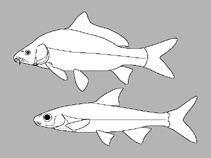 No image available for this species;
drawing shows typical species in Cyprinidae.
Images Google
drawing shows typical species in Cyprinidae.
Classification / Noms Noms communs | Synonymes | Catalog of Fishes(Genre, Espèce) | ITIS | CoL | WoRMS | Cloffa
> Cypriniformes (Carps) > Cyprinidae (Minnows or carps) > Smiliogastrinae
Etymology: Cheilobarbus: The name Cheilobarbus is derived from the Greek ‘cheilos’ meaning a margin, lip or brim, and the Latin ‘barba’ meaning a beard and referring to the oral barbels. Smith (1841) mentioned the “lips” of these species as being “full and firm”.
Etymology: Cheilobarbus: The name Cheilobarbus is derived from the Greek ‘cheilos’ meaning a margin, lip or brim, and the Latin ‘barba’ meaning a beard and referring to the oral barbels. Smith (1841) mentioned the “lips” of these species as being “full and firm”.
Taxonomic Remarks
Re-examination of the holotype of Barbus capensis revealed it to be a senior synonym of Pseudobarbus andrewi; the correct name for previous identifications of Barbus capensis should be Labeobarbus seeberi, the southern African clanwilliam yellowfish, while Pseudobarbus capensis is the correct name for previous identifications as Barbus andrewi (Ref. 108777).
Environnement : milieu / zone climatique / profondeur / gamme de distribution Écologie
; eau douce benthopélagique. Subtropical; 31°S - 34°S
Distribution Territoires | Zones FAO | Écosystèmes | Occurrences | Carte par point | Introductions | Faunafri
Africa: Berg and Breede River systems, south-western Cape Province in South Africa (Ref. 7248, 119402); also Clanwilliam Olifants River in South Africa (Ref. 111087).
Taille / Poids / Âge
Maturité: Lm ? range ? - ? cm
Max length : 60.0 cm SL mâle / non sexé; (Ref. 7248); poids max. publié: 3.4 kg (Ref. 7248)
Max length : 60.0 cm SL mâle / non sexé; (Ref. 7248); poids max. publié: 3.4 kg (Ref. 7248)
Prefers deep, rocky pools of larger tributaries and mainstreams and does well in dams such as Voëlvlei and Brandvlei. Feeds on bottom-dwelling invertebrates and algae. Breeds in summer, congregating at the head of large, stony pools or at the base of rapids. Eggs are laid in gravel in flowing water and hatch after about 5 days. Has been artificially bred and restocked by conservation authorities (Ref. 7248).
Cycle de vie et comportement reproducteur Maturité | Reproduction | Frai | Œufs | Fécondité | Larves
Référence principale
Téléchargez vos références | Références | Coordinateur | Collaborateurs
Skelton, P.H., E.R. Swartz and E.J. Vreven, 2018. The identity of Barbus capensis Smith, 1841 and the generic status of southern African tetraploid cyprinids (Teleostei, Cyprinidae). European Journal of Taxonomy 410:1-29. (Ref. 119402)
Statut dans la liste rouge de l'IUCN (Ref. 130435: Version 2025-2 (Global))
Menacé (EN) (B1ab(iii,iv,v)+2ab(iii,iv,v)); Date assessed: 30 November 2016
CITES
Not Evaluated
Menace pour l'homme
Harmless
Utilisations par l'homme
Aquaculture: expérimental; pêche sportive: oui
FAO - Publication: search | FishSource |
Plus d'informations
Écologie trophique
Aliments (proies)
Composition du régime alimentaire
Consommation alimentaire
Rations alimentaires
Prédateurs
Aliments (proies)
Composition du régime alimentaire
Consommation alimentaire
Rations alimentaires
Prédateurs
Dynamique des populations
Paramètres de croissance
Âges / tailles maximales
Longueur-poids rel.
Rel. longueur-longueur.
Fréquences de longueurs
Conversion de masse
Recrutement
Abondance
Paramètres de croissance
Âges / tailles maximales
Longueur-poids rel.
Rel. longueur-longueur.
Fréquences de longueurs
Conversion de masse
Recrutement
Abondance
Cycle de vie
Reproduction
Maturité
Maturité/épines rel.
Fécondité
Frai
Agrégats de frai
Œufs
Développement de l'œuf
Larves
Dynamique des populations larvaires
Reproduction
Maturité
Maturité/épines rel.
Fécondité
Frai
Agrégats de frai
Œufs
Développement de l'œuf
Larves
Dynamique des populations larvaires
Anatomie
Surface branchiale
Cerveau
Otolithe
Surface branchiale
Cerveau
Otolithe
Physiologie
Composition corporelle
Nutriments
Consommation d'oxygène
Type de natation
Vitesse de nage
Pigments visuels
Son de poisson
Maladies et parasites
Toxicité (CL50)
Composition corporelle
Nutriments
Consommation d'oxygène
Type de natation
Vitesse de nage
Pigments visuels
Son de poisson
Maladies et parasites
Toxicité (CL50)
Liées à l'homme
Systèmes d'aquaculture
Profils d'aquaculture
Souches
Cas de ciguatera
Timbres, pièces de monnaie, divers
Systèmes d'aquaculture
Profils d'aquaculture
Souches
Cas de ciguatera
Timbres, pièces de monnaie, divers
Outils
E-book | Guide de terrain | Clés d'identification | Générateur de fréquences de longueur | Outil de dynamique de population | Carte par point |
Capture-MSY |
Articles particuliers
Télécharger en XML
Sources Internet
AFORO (otoliths) | Aquatic Commons | BHL | Cloffa | Websites from users | FishWatcher | CISTI | Catalog of Fishes: Genre, Espèce | DiscoverLife | ECOTOX | FAO - Publication: search | Faunafri | Fishipedia | Fishtrace | GloBI | Google Books | Google Scholar | Google | IGFA World Record | OneZoom | Open Tree of Life | Otolith Atlas of Taiwan Fishes | PubMed | Reef Life Survey | Socotra Atlas | TreeBase | Arbre de Vie | Wikipedia: aller à, chercher | World Records Freshwater Fishing | Zoological Record
Estimations basées sur des modèles
Indice de diversité phylogénétique (Réf. 82804): PD50 = 0.7500 [Uniqueness, from 0.5 = low to 2.0 = high].
Bayesian length-weight: a=0.00603 (0.00282 - 0.01286), b=3.06 (2.87 - 3.25), in cm total length, based on LWR estimates for this (Sub)family-body shape (Ref. 93245).
Niveau trophique (Réf. 69278): 2.8 ±0.26 se; based on food items.
Résilience (Réf. 120179): Faible, temps minimum de doublement de population : 4,5 à 14 années (Preliminary K or Fecundity.).