



分類 / 名前 共通名の | 類義語 | Catalog of Fishes(部類, 種) | ITIS | CoL | WoRMS | Cloffa
> Petromyzontiformes (Lampreys) > Mordaciidae (Southern topeyed lampreys)
Etymology: Mordacia: Etymology not explained, likely derived from mordax (L.), biting, referring to specific name of M. mordax (See ETYFish); praecox: Latin for premature, referring to its “precocious nature of sexual development,” wherein newly metamorphosed ammocoetes become sexually mature without first reaching their adult parasitic phase (See ETYFish).
Etymology: Mordacia: Etymology not explained, likely derived from mordax (L.), biting, referring to specific name of M. mordax (See ETYFish); praecox: Latin for premature, referring to its “precocious nature of sexual development,” wherein newly metamorphosed ammocoetes become sexually mature without first reaching their adult parasitic phase (See ETYFish).
Taxonomic Remarks
No study has specifically described ammocoetes of this species. Based on the
general statement in Potter (1968) and Potter et al. (1968) that ammocoetes of M. mordax are indistinguishable from those of M. praecox, the reader is advised to refer to the description of ammocoetes of M. mordax (Ref. 89241).
環境:環境 / 気候帯 / 深さの範囲 / 分布範囲 生態学
; 新鮮な水 底生の; potamodromous (Ref. 51243). Temperate
分布 領土 | 国連食糧農業機関の区域 | エコシステム | 事件 | 目的のマップ | 導入 | Faunafri
Oceania: known only from the Moruya and Tuross Rivers in southern New South Wales, Australia.
サイズ / 重さ / 年齢
成熟: Lm ? range ? - ? cm
Max length : 50.0 cm SL オス/雌雄の選別がない; (Ref. 44894); common length : 37.5 cm SL オス/雌雄の選別がない; (Ref. 44894)
Max length : 50.0 cm SL オス/雌雄の選別がない; (Ref. 44894); common length : 37.5 cm SL オス/雌雄の選別がない; (Ref. 44894)
簡単な記述 検索表 | 形態学 | 形態計測学
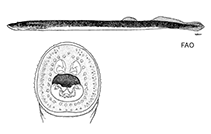
Adults: 10.2-172 mm TL; body proportions, as percentage of TL: 9.4-12.6 prebranchial length, 8.2-9.9 branchial length, 59.6-64.2 trunk length, 16.5-20.4 tail length, 1.3-1.5 eye length and 5.4-8.4 disc length; no gular pouch develops; urogenital papilla not prominent in mature adults; trunk myomeres, 85-93. Adult dentition: 2 triangular supraoral laminae each with 3 unicuspid teeth, 1 per apex (exceptionally, 4 unicuspid teeth per supraoral lamina); Infraoral lamina, 9-10 unicuspid teeth of various size (these teeth become greatly enlarged with sexual maturation); 5-6 endolaterals on each side; endolateral formula, typically 2-2-3-3-4-3 or 2-2-3-3-4-4 in immature individuals and 1-1-1-1-1 or 1-1-1-1-1-1 in mature individuals; 1 row of anterials; first row of anterials, 2 unicuspid teeth flanked on either side by one bicuspid tooth in immature individuals and 4 unicuspid teeth in mature individuals; 1-2 rows of exolaterals on each side; 1 row of posterials; first row of posterials, 16 posterial plates, the three lateralmost tricuspid and the internal ones bicuspid in immature individuals and 13 unicuspid teeth in mature individuals; transverse lingual lamina w-shaped with numerous unicuspid teeth of various size, the middle apex one being intermediate in size and the two bottom apex ones being largest, while the rest are small; longitudinal lingual laminae hook-shaped each with an undetermined number of unicuspid teeth. Body coloration (live) of mature adults with dark blue dorsal surface, occasionally with a green tinge, ventral surface of males mottled gray and ventral surface of females yellowish; extent of caudal fin pigmentation, 25% to <75%; caudal fin shape, spade-like; oral papillae, 33-48 (Ref. 89241).
Body shape (shape guide): eel-like.
Body shape (shape guide): eel-like.
Inhabits freshwater streams, a non-parasitic lamprey that spends its entire life cycle in freshwater. Ammocoetes burrow in soft substrates, phase lasts about 3 years; metamorphosis usually occurs between October and November. Presumed to migrate upstream around April, and spawns in late winter or spring (Ref. 44894). Fecundity, 326-675
eggs/female (Ref. 89241).
ライフサイクルと交尾行動 成熟 | 繁殖 | 放精 | 卵 | 生産力 | 幼生
主な参考文献
参考文献のアップロード | 参考文献 | コーディネーター | 協力者
Allen, G.R., 1989. Freshwater fishes of Australia. T.F.H. Publications, Inc., Neptune City, New Jersey. (Ref. 5259)
IUCNのレッドリストの状況は (Ref. 130435: Version 2025-2 (Global))
絶滅危惧 (EN) (A2b; B2ab(v)); Date assessed: 04 February 2019
CITES
Not Evaluated
人間に対する脅威
Harmless
人間の用途
水産業: 興味がない
FAO - Publication: search | FishSource |
より多くの情報
養殖生態
食料品(獲物)
餌の構成
摂食量
食料配給
捕食動物
食料品(獲物)
餌の構成
摂食量
食料配給
捕食動物
生態学
生態学
生態学
人口動態
成長のパラメーター
最大年齢/サイズ
長さ-重量比。
長短関係。
体長組成
質量変換
補充
豊度
成長のパラメーター
最大年齢/サイズ
長さ-重量比。
長短関係。
体長組成
質量変換
補充
豊度
生理学
体組成
栄養素
酸素消費
水泳タイプ
泳ぐ速さ
視覚色素
フィッシュ・サウンド
病気と寄生虫
毒性(LC50)
体組成
栄養素
酸素消費
水泳タイプ
泳ぐ速さ
視覚色素
フィッシュ・サウンド
病気と寄生虫
毒性(LC50)
用具
特記事項
XMLをダウンロードして下さい
インターネットの情報源
AFORO (otoliths) | Aquatic Commons | BHL | Cloffa | Websites from users | Check FishWatcher | CISTI | Catalog of Fishes: 部類, 種 | DiscoverLife | ECOTOX | FAO - Publication: search | Faunafri | Fishipedia | Fishtrace | GloBI | Google Books | Google Scholar | Google | IGFA World Record | OneZoom | Open Tree of Life | Otolith Atlas of Taiwan Fishes | PubMed | Reef Life Survey | Socotra Atlas | TreeBase | 生命の木 | Wikipedia: 行く, 検索する | World Records Freshwater Fishing | Zoobank | 動物に関する記録
モデルに基づく推定値
系統多様性指数 (参照 82804): PD50 = 0.7500 [Uniqueness, from 0.5 = low to 2.0 = high].
Bayesian length-weight: a=0.00102 (0.00046 - 0.00225), b=3.06 (2.88 - 3.24), in cm total length, based on all LWR estimates for this body shape (Ref. 93245).
栄養段階 (参照 69278): 4.4 ±0.8 se; based on size and trophs of closest relatives
回復力 (参照 120179): 低い, 4.5年~14年の倍増期間の最小個体群 (Semelparous species, assuming tm (= tmax) > 4).