Environment: milieu / climate zone / distribuzione batimetrica / distribution range
Ecologia
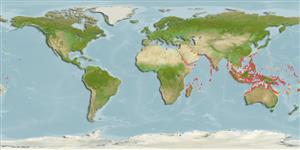
marino associati a barriera corallina; distribuzione batimetrica 1 - 20 m (Ref. 9710). Tropical; 31°N - 25°S, 32°E - 169°W (Ref. 5222)
Indo-Pacific: Red Sea to the Phoenix Islands and Samoa, north to Ryukyu Islands, south to Australia.
Length at first maturity / Size / Peso / Age
Maturità: Lm 36.6, range 30 - ? cm
Max length : 80.0 cm TL maschio/sesso non determinato; (Ref. 90102)
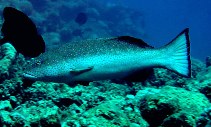
Spine dorsali (totale) : 7 - 8; Raggi dorsali molli (totale) : 10 - 12; Spine anali: 3; Raggi anali molli: 8. This species is distinguished by the following characters: body elongate and robust, depth 2.9-3.9 in SL; preopercle broadly rounded, with 3 large, ventrally-directed spines along lower half; opercle with 3 flat spines, the upper and lower spines covered by skin; nostrils subequal, set in a shallow groove running forward from eye; large canine teeth at front of jaws; 1-4 large canines on side of lower jaw; gill rakers of first gill arch 0-2 + 2-7; caudal fin truncate to slightly emarginate, the caudal concavity more than 13 times in HL; pectoral-fin rays 15-16, 2.0-2.3 in HL; lateral-line scales 83-97. Colour whitish to pale grey color, with numerous round to oval dark-edged blue spots (the largest about equal to pupil); most spots within a spot diameter of adjacent spots; head, body, and median fins frequently with 4-5 dark blotches forming saddles on back (greenish grey); pelvic fins with dark brown to blackish membranes; rear margin of caudal fin with a white edge and often with a blackish submarginal band (Ref. 39231, 89707, 90102).
Body shape (shape guide): fusiform / normal; Cross section: oval.
Adults inhabit lagoon and seaward reefs, in areas with rich coral growth. Most frequently encountered in channels along the reef front (Ref. 9710, 48635). Often a shy fish (Ref. 48635). Feed exclusively on fishes (Ref. 37816). Misidentified as P. leopardus in Ref. 2928 (Johannes, pers. comm.). This study reports of a declining stock in Palau due to fishing. Before actual spawning around full moon, the species aggregates along channels and are responsive to baited hooks, making them vulnerable to fishermen; upward movements of some to take baited hooks presumably mistaken for courtship or spawning behavior. Large individuals may be ciguatoxic in certain areas (Ref. 37816). In the Hong Kong live fish markets (Ref. 27253). Of interest to artisanal fisheries and caught with hook-and-line (Ref. 39231).
Life cycle and mating behavior
Maturità | Riproduzione | Deposizione | Uova | Fecundity | Larve
Heemstra, P.C. and J.E. Randall, 1993. FAO Species Catalogue. Vol. 16. Groupers of the world (family Serranidae, subfamily Epinephelinae). An annotated and illustrated catalogue of the grouper, rockcod, hind, coral grouper and lyretail species known to date. Rome: FAO. FAO Fish. Synop. 125(16):382 p. (Ref. 5222)
IUCN Red List Status (Ref. 130435: Version 2025-1)
Threat to humans
Reports of ciguatera poisoning (Ref. 4690)
Human uses
Pesca: scarso interesse commerciale
Strumenti
Special reports
Download XML
Fonti Internet
Estimates based on models
Preferred temperature (Fonte Biblio.
123201): 26.4 - 29.3, mean 28.5 °C (based on 1868 cells).
Phylogenetic diversity index (Fonte Biblio.
82804): PD
50 = 0.5039 [Uniqueness, from 0.5 = low to 2.0 = high].
Bayesian length-weight: a=0.01148 (0.00553 - 0.02385), b=3.04 (2.88 - 3.20), in cm total length, based on LWR estimates for this (Sub)family-body shape (Ref.
93245).
Trophic level (Fonte Biblio.
69278): 4.5 ±0.80 se; based on food items.
Resilienza (Fonte Biblio.
120179): Medio, tempo minimo di raddoppiamento della popolazione 1.4 - 4.4 anni (tm=2.5; Tmax=14;).
Fishing Vulnerability (Ref.
59153): Moderate vulnerability (36 of 100).
🛈
Climate Vulnerability (Ref.
125649): Very high vulnerability (88 of 100).
🛈
Nutrients (Ref.
124155): Calcium = 35.7 [20.3, 68.5] mg/100g; Iron = 0.617 [0.317, 1.074] mg/100g; Protein = 19.1 [17.2, 20.8] %; Omega3 = 0.135 [0.085, 0.221] g/100g; Selenium = 33.9 [18.5, 66.7] μg/100g; VitaminA = 73.1 [25.6, 238.9] μg/100g; Zinc = 0.729 [0.483, 1.107] mg/100g (wet weight);