Environment: milieu / climate zone / profondeur / distribution range
Écologie
marin démersal; profondeur 6 - 30 m (Ref. 9002). Tropical
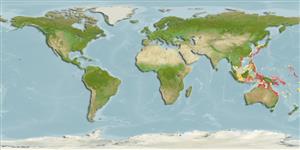
Southwest Pacific: eastern Australia.
Taille / Poids / Âge
Maturité: Lm ? range ? - ? cm
Max length : 9.0 cm TL mâle / non sexé; (Ref. 9002)
Description synthétique
Clés d'identification | Morphologie | Morphométrie
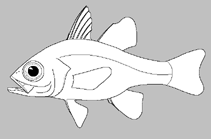
Épines dorsales (Total) : 8; Rayons mous dorsaux (Total) : 9; Épines anales: 2; Rayons mous anaux: 8. Short caudal peduncle. Posterior margin of preopercle coarsely serrated. Caudal fin slightly rounded with rounded corners. Pelvic fins larger than dorsal fin. Greyish-brown to black; ocellus above pectoral; caudal and pectorals clear, other fins black (Ref. 9002).
Cross section: compressed.
Inhabits protected coastal bays and estuaries in sponge and soft-coral areas (Ref. 9002).
Life cycle and mating behavior
Maturité | Reproduction | Frai | Œufs | Fécondité | Larves
Kuiter, R.H., 1993. Coastal fishes of south-eastern Australia. University of Hawaii Press. Honolulu, Hawaii. 437 p. (Ref. 9002)
Statut dans la liste rouge de l'IUCN (Ref. 130435: Version 2025-1)
Menace pour l'homme
Harmless
Utilisations par l'homme
Outils
Articles particuliers
Télécharger en XML
Sources Internet
Estimates based on models
Preferred temperature (Réf.
123201): 23.3 - 28, mean 26.4 °C (based on 393 cells).
Phylogenetic diversity index (Réf.
82804): PD
50 = 0.5000 [Uniqueness, from 0.5 = low to 2.0 = high].
Bayesian length-weight: a=0.01445 (0.00680 - 0.03071), b=3.07 (2.89 - 3.25), in cm total length, based on LWR estimates for this (Sub)family-body shape (Ref.
93245).
Niveau trophique (Réf.
69278): 3.4 ±0.5 se; based on size and trophs of closest relatives
Résilience (Réf.
120179): Haut, temps minimum de doublement de population inférieur à 15 mois (Preliminary K or Fecundity.).
Fishing Vulnerability (Ref.
59153): Low vulnerability (10 of 100).
🛈