



Divandu albimarginatus Lamboj & Snoeks, 2000
Envoyez vos Photos et vidéos
Images | Images Google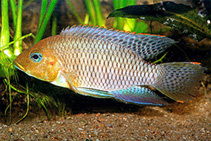 Divandu albimarginatus
Photo de AquaNet
Images | Images Google
Photo de AquaNet
Classification / Noms Noms communs | Synonymes | Catalog of Fishes(Genre, Espèce) | ITIS | CoL | WoRMS | Cloffa
> Cichliformes (Cichlids, convict blennies) > Cichlidae (Cichlids) > Incertae sedis
Etymology: Divandu: Vernacular name used in Mayombe, Congo; albimarginatus: From the white margin on the lower edge of the caudal fin in preserved specimens; an adjective.
Etymology: Divandu: Vernacular name used in Mayombe, Congo; albimarginatus: From the white margin on the lower edge of the caudal fin in preserved specimens; an adjective.
Environnement : milieu / zone climatique / profondeur / gamme de distribution Écologie
; eau douce pélagique. Tropical
Distribution Territoires | Zones FAO | Écosystèmes | Occurrences | Carte par point | Introductions | Faunafri
Africa: Kouilou-Niari and Loeme-Loukene basins(Republic of Congo), Nyanga and upper Ngounie basins and the Ogowe River (Gabon) (Ref. 81260).
Taille / Poids / Âge
Description synthétique Clés d'identification | Morphologie | Morphométrie
Épines dorsales (Total) : 13 - 16; Rayons mous dorsaux (Total) : 9 - 12; Épines anales: 3; Rayons mous anaux: 7 - 8; Vertèbres: 24 - 25. Diagnosis: relatively deep-bodied (Ref. 52307, 81260), particularly so in large specimens (depth 27.8-40.2% SL)(Ref. 8160). Head short (HL 31.9-37.2% SL); snout generally shorter than postorbital length; ascending process of premaxilla about one third longer than dentigerous arm; outer and inner row teeth in oral jaws unicuspid (Ref. 81260). Laterosensory system in the lachrymal bone with 5 openings (Ref. 45129, 52307, 81260). Infraorbital series complete (lachrymal bone and 4 other)(Ref. 45129, 81260). First pelvic fin ray longest in adults of both sexes (Ref. 45129), usually reaching anus or beyond (Ref. 81260). Pectoral fin somewhat shorter than pelvic; some dorsal and anal rays produced (branched dorsal rays 4-6, branched anal rays 4-5 longest), upper and lower caudal rays also produced in both sexes; caudal peduncle somewhat deeper than long (Ref. 81260). 2.3-3 scales between highest point of upper lateral line (about the 8-9th pored scale) and dorsal fin base; between the last 2-4 pored scale and the dorsal fin base 1 or 1 large and 1 very small scale (Ref. 45129). 12 circumpeduncular scales (Ref. 45129, 81260). Chest scales markedly smaller than flank scales (Ref. 81260). No sexual dimorphism in morphology or coloration (Ref. 45129).
Coloration: base body colour pale brown, cheeks and ventrum somewhat paler; usually 6-7 vertical bars on flanks; opercular spot well marked; reddish black maculae on caudal, soft dorsal and anal fins, often forming distinct bands proximally on the fins (Ref. 81260). Dorsal, anal and pelvic fins (Ref. 81260), and upper (Ref. 52307, 81260) and lower (Ref. 52307) edge of caudal fin, with narrow red margin (Ref. 52307, 81260), caudal fin also with thin white submargin (Ref. 52307). Lower edge of caudal with white margin; metallic (silvery) flush below red margin on soft dorsal fin (Ref. 81260).
Body shape (shape guide): short and / or deep; Cross section: compressed.
Body shape (shape guide): short and / or deep; Cross section: compressed.
Inhabits the middle and lower parts of the river basins; collection sites are in regions with primary or secondary forests. The water is clear with transparency of more than 100 cm, acidity approximately neutral (pH 7-7.5) with low conductivity (50 µS) and temperatures 21-22°C. The species lives syntopically with Chromidotilapia mamonekenei, which is more abundant than D. albimarginatus (Ref. 45129). Feeds on small particles (both animal- and plantbased), detritus and aufwuchs (Ref. 52307). Polygamous, ovophilic, female mouthbrooder (Ref. 81260). Possibly larvophilic (Ref. 52307).
Cycle de vie et comportement reproducteur Maturité | Reproduction | Frai | Œufs | Fécondité | Larves
Référence principale
Téléchargez vos références | Références | Coordinateur : Kullander, Sven O. | Collaborateurs
Lamboj, A. and J. Snoeks, 2000. Divandu albimarginatus, a new genus and species of cichlid (Teleostei: Cichlidae) from Congo and Gabon, Central Africa. Ichthyol. Explor. Freshwat. 11(4):355-360. (Ref. 45129)
Statut dans la liste rouge de l'IUCN (Ref. 130435: Version 2025-2 (Global))
Préoccupation mineure (LC) ; Date assessed: 16 February 2009
CITES
Not Evaluated
Menace pour l'homme
Harmless
Utilisations par l'homme
FAO - Publication: search | FishSource |
Plus d'informations
Écologie trophique
Aliments (proies)
Composition du régime alimentaire
Consommation alimentaire
Rations alimentaires
Prédateurs
Aliments (proies)
Composition du régime alimentaire
Consommation alimentaire
Rations alimentaires
Prédateurs
Écologie
Écologie
Écologie
Dynamique des populations
Paramètres de croissance
Âges / tailles maximales
Longueur-poids rel.
Rel. longueur-longueur.
Fréquences de longueurs
Conversion de masse
Recrutement
Abondance
Paramètres de croissance
Âges / tailles maximales
Longueur-poids rel.
Rel. longueur-longueur.
Fréquences de longueurs
Conversion de masse
Recrutement
Abondance
Cycle de vie
Reproduction
Maturité
Maturité/épines rel.
Fécondité
Frai
Agrégats de frai
Œufs
Développement de l'œuf
Larves
Dynamique des populations larvaires
Reproduction
Maturité
Maturité/épines rel.
Fécondité
Frai
Agrégats de frai
Œufs
Développement de l'œuf
Larves
Dynamique des populations larvaires
Anatomie
Surface branchiale
Cerveau
Otolithe
Surface branchiale
Cerveau
Otolithe
Physiologie
Composition corporelle
Nutriments
Consommation d'oxygène
Type de natation
Vitesse de nage
Pigments visuels
Son de poisson
Maladies et parasites
Toxicité (CL50)
Composition corporelle
Nutriments
Consommation d'oxygène
Type de natation
Vitesse de nage
Pigments visuels
Son de poisson
Maladies et parasites
Toxicité (CL50)
Génétique
génôme
Génétique
Hétérozygotie
Héritabilité
Diversité génétique
génôme
Génétique
Hétérozygotie
Héritabilité
Diversité génétique
Liées à l'homme
Systèmes d'aquaculture
Profils d'aquaculture
Souches
Cas de ciguatera
Timbres, pièces de monnaie, divers
Systèmes d'aquaculture
Profils d'aquaculture
Souches
Cas de ciguatera
Timbres, pièces de monnaie, divers
Outils
E-book | Guide de terrain | Générateur de fréquences de longueur | Outil de dynamique de population | Carte par point |
Capture-MSY |
Articles particuliers
Télécharger en XML
Sources Internet
AFORO (otoliths) | Aquatic Commons | BHL | Cloffa | Websites from users | FishWatcher | CISTI | Catalog of Fishes: Genre, Espèce | DiscoverLife | ECOTOX | FAO - Publication: search | Faunafri | Fishipedia | Fishtrace | GloBI | Google Books | Google Scholar | Google | IGFA World Record | OneZoom | Open Tree of Life | Otolith Atlas of Taiwan Fishes | PubMed | Reef Life Survey | Socotra Atlas | TreeBase | Arbre de Vie | Wikipedia: aller à, chercher | World Records Freshwater Fishing | Zoobank | Zoological Record
Estimations basées sur des modèles
Indice de diversité phylogénétique (Réf. 82804): PD50 = 1.0000 [Uniqueness, from 0.5 = low to 2.0 = high].
Bayesian length-weight: a=0.01995 (0.00906 - 0.04395), b=3.01 (2.83 - 3.19), in cm total length, based on all LWR estimates for this body shape (Ref. 93245).
Niveau trophique (Réf. 69278): 3.3 ±0.3 se; based on size and trophs of closest relatives
Résilience (Réf. 120179): Haut, temps minimum de doublement de population inférieur à 15 mois (Preliminary K or Fecundity.).