Environment: milieu / Klimaatzone / Diepte / distribution range
Ecologie
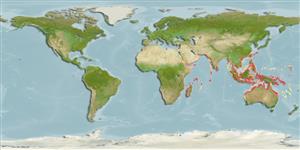
marien; brak water pelagic-neritic; diepte 1 - 20 m (Ref. 6898). Tropical; 28°N - 40°S, 21°E - 170°E (Ref. 189)
Indo-Pacific: India Ocean from Gulf of Oman south to Port Alfred, but no records from the Red Sea and Madagascar; coasts of Pakistan, India and probably Burma; Thailand, Indonesia, Philippines to Taiwan (Ref. 189), including Arafura Sea (Ref. 9819); also northern Australia, Papua New Guinea, Solomon Islands and New Hebrides (Ref. 189).
Lengte bij maturiteit / Grootte / Gewicht / Leeftijd
Maturiteit: Lm 16.0 range ? - ? cm
Max length : 18.0 cm SL mannelijk / geslacht onbekend; (Ref. 9822); common length : 15.0 cm SL mannelijk / geslacht onbekend; (Ref. 9822)
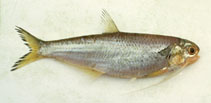
Dorsale stekels (totaal) : 0; Dorsale zachte stralen (totaal) : 14 - 16; Anale stekels: 0; Anale zachte stralen: 32 - 39. Diagnosis: Body fairly compressed, belly with 16-18 plus 9-10, with a total of 25-28 keeled scutes; lower gill rakers 10-12; head with gold tints; anal and caudal fins deep yellow; a black area behind upper part of gill opening (Ref. 189). It is distinguished from all other Thryssa species and in fact all other anchovies by the very long maxilla, reaching at least to tip of pectoral fin, usually to pelvic fin base or even to anal fin origin; also unique is the high coronoid process of the lower jaw, the jaw rising steeply in the mouth (Ref. 189).
Body shape (shape guide): fusiform / normal; Cross section: compressed.
Marine, pelagic, presumably schooling, occurring mostly close inshore, entering bays and estuaries (Ref. 189, 30573). Recorded at a temperature range of 26.0-29.0 °C in the Trinity Inlet system, Australia (Ref. 4959). It feeds mainly on crustaceans, like amphipods, zoea larvae, Acetes (Ref. 189, 30573). May be caught using ringnets (Ref. 5213). Used as bait in the tuna fishery in the South Pacific.
Levenscyclus en paargedrag
Maturiteit | Voortplanting | Paaien | Eieren | Fecunditeit | Larven
Wongratana, T., T.A. Munroe and M. Nizinski, 1999. Order Clupeiformes. Engraulidae. Anchovies. p. 1698-1753. In K.E. Carpenter and V.H. Niem (eds.) FAO species identification guide for fishery purposes. The living marine resources of the WCP. Vol. 3. Batoid fishes, chimaeras and bony fishes part 1 (Elopidae to Linophrynidae). FAO, Rome. (Ref. 9822)
Status op de Rode Lijst van het IUCN (Ref. 130435: Version 2025-1)
Gevaar voor de mens
Harmless
Gebruik door de mens
Visserij: van minder commercieel belang; aas: usually
Tools
Speciale rapporten
Download XML
Internetbronnen
Estimates based on models
Preferred temperature (Ref.
123201): 24.9 - 29.3, mean 28.5 °C (based on 3124 cells).
Fylogenetische diversiteitsindex (Ref.
82804): PD
50 = 0.5000 [Uniqueness, from 0.5 = low to 2.0 = high].
Bayesian length-weight: a=0.00776 (0.00481 - 0.01252), b=3.09 (2.96 - 3.22), in cm total length, based on LWR estimates for this species & (Sub)family-body (Ref.
93245).
Trofisch niveau (Ref.
69278): 3.3 ±0.48 se; based on food items.
Generation time: 2.7 ( na - na) years. Estimated as median ln(3)/K based on 2
growth studies.
Weerstandsvermogen (Ref.
120179): Hoog, minimale populatieverdubbelingstijd minder dan 15 maanden (Preliminary K or Fecundity.).
Fishing Vulnerability (Ref.
59153): Low vulnerability (11 of 100).
🛈
Nutrients (Ref.
124155): Calcium = 204 [124, 477] mg/100g; Iron = 1.55 [0.84, 2.70] mg/100g; Protein = 19 [18, 20] %; Omega3 = 0.449 [0.226, 0.957] g/100g; Selenium = 27.8 [13.5, 59.9] μg/100g; VitaminA = 24.7 [6.9, 69.6] μg/100g; Zinc = 1.99 [1.37, 2.86] mg/100g (wet weight);