>
Gobiiformes (Gobies) >
Gobiidae (Gobies) > Gobionellinae
Etymology: Gnatholepis: Greek, gnathos = jaw + Greek,lepis = scale (Ref. 45335); gymnocara: Named for the absence of scales on the cheek and opercle ('gymnocara' = naked head).
More on authors: Randall & Greenfield.
Environment: milieu / Zona climática / intervalo de profundidade / distribution range
Ecologia
marinhas demersal; intervalo de profundidade 0 - 1 m (Ref. 41653). Subtropical
Western Pacific: Australia.
Tamanho / Peso / Idade
Maturidade: Lm ? range ? - ? cm
Max length : 3.7 cm SL macho/indeterminado; (Ref. 41653)
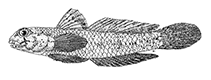
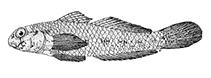
Espinhos dorsais (total) : 7; Raios dorsais (total) : 11; Espinhos anais: 1; Raios anais : 11 - 12. Distinguished by the following characteristics: small Gnatholepis (up to 35.4 mm SL) lacking scales on side of cheek, opercle and predorsal midline, few cycloid scales present on pectoral fin base and on breast; no distinct flap on end of lower lip (low fold may be present); no distinct canine or enlarged teeth; second dorsal fin rays I,11; anal fin rays I,11-12 (usually I,12); pectoral rays 15-19 (usually 17); lateral scales 26-28, ctenoid; predorsal scales absent from nape midline, scales on side of head reaching to nearly behind eyes; body pale with dusky speckling and mid-lateral row of six dusky blotches and horizontal row of darker spots and short streaks, an irregular cross-shaped dark mark on cheek extending down from eye, pupil-sized brown spot just above mid-point of caudal fin base, males with small black spot on rear part of first dorsal fin (Ref. 92171).
Body shape (shape guide): fusiform / normal; Cross section: oval.
Occurs in shallow water, generally in less than 0.5 m; at least one lot was collected from a brackish habitat (Ref. 41653).
Ciclo de vida ou comportamento de acasalamento
Maturidade | Reprodução | Desova | Ovos | Fecundidade | Larvas
Randall, J.E. and D.W. Greenfield, 2001. A preliminary review of the Indo-Pacific gobiid fishes of the genus Gnatholepis. Ichthyological Bulletin of the J.L.B. Smith Institute of Ichthyology, 69:1-17. (Ref. 41653)
Status na Lista Vermelha da UICN (Ref. 130435: Version 2025-1)
Ameaça para os humanos
Harmless
Uso pelos humanos
Ferramentas
Relatórios especiais
Baixar XML
Fontes da internet
Estimates based on models
Preferred temperature (Ref.
123201): 24.5 - 27.5, mean 26.3 °C (based on 166 cells).
Índice de diversidade filogenética (Ref.
82804): PD
50 = 0.5010 [Uniqueness, from 0.5 = low to 2.0 = high].
Bayesian length-weight: a=0.00977 (0.00444 - 0.02153), b=3.04 (2.85 - 3.23), in cm total length, based on LWR estimates for this (Sub)family-body shape (Ref.
93245).
Nível Trófico (Ref.
69278): 3.2 ±0.5 se; based on size and trophs of closest relatives
Resiliência (Ref.
120179): Elevada, tempo mínimo de duplicação da população menor que 15 meses (Preliminary K or Fecundity.).
Fishing Vulnerability (Ref.
59153): Low vulnerability (10 of 100).
🛈