



Lethenteron alaskense Vladykov & Kott, 1978
Alaskan brook lamprey
Загрузить свой Фото и Видео
изображения | Изображение на Google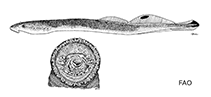 Lethenteron alaskense
Male Изображение сделано FAO
изображения | Изображение на Google
Male Изображение сделано FAO
Классификация / Имена народные названия | синонимы | Catalog of Fishes(род, виды) | ITIS | CoL | WoRMS | Cloffa
> Petromyzontiformes (Lampreys) > Petromyzontidae (Northern lampreys) > Lampetrinae
Etymology: Lethenteron: Etymology not explained, perhaps lethalis (L.), lethal, or lethe (Gr.), forgetting or forgetfulness; enteron (Gr.) intestine, presumably referring to “degenerate and non-functional” intestine of adult L. appendix (See ETYFish); alaskense: -ensis, Latin suffix denoting place: Alaska (USA), where type locality (West Creek, a tributary of Brooks Lake) is situated (See ETYFish).
Etymology: Lethenteron: Etymology not explained, perhaps lethalis (L.), lethal, or lethe (Gr.), forgetting or forgetfulness; enteron (Gr.) intestine, presumably referring to “degenerate and non-functional” intestine of adult L. appendix (See ETYFish); alaskense: -ensis, Latin suffix denoting place: Alaska (USA), where type locality (West Creek, a tributary of Brooks Lake) is situated (See ETYFish).
Taxonomic Remarks
Provisionally considered to be a junior synonym of Lethenteron kessleri (Anikin, 1905) (in Ref. 125650).
Окружающая среда: среда / климатическая зона / пределы глубины / диапазон распространения экология
; пресноводный демерсальный; мигрирует в реке (Ref. 43939). Temperate
распространение Территории | регионы FAO | Экосистемы | места находок | карта точек | интродукции | Faunafri
North America: Alaska and Kenai peninsulas to Chatanika and Chena rivers near Fairbanks; Martin River, Mackenzie River basin, Northwest Territories.
Размер / Вес / Возраст
Краткое описание определительные ключи | морфология | морфометрия
Adult preserved specimens gray-brown dorsally, white ventrally, with a dark blotch on 2nd dorsal fin; tail dark. Teeth on disk blunt and weakly cornified. Tongue teeth poorly developed and blunt. Typical length 12-17 cm TL (Ref. 43939). Trunk myomeres 66-72 (Ref. 43938, 89241). Other adult diagnostic features: 12.2-18.8 cm TL. Body proportions, as percentage of TL (based on 68 specimens measuring 12.2-18.8 cm TL): prebranchial length, 9.3-14.9; branchial length, 8.7?11.6; trunk length, 45.4-53.5; tail length, 25.7-33.5; eye length, 1.7-3.2; disc length, 3.8-7.3. Urogenital papilla length, as a percentage of branchial length, in a 14.1 cm TL spawning male, 26.9. The shape of the second dorsal fin in spawning males is arch-like and in females triangular. Dentition: supraoral lamina, 2 unicuspid teeth (1 of 34 specimens had 2 additional small unicuspid teeth on the bridge); infraoral lamina, 6-11 teeth, the lateralmost one on each side unicuspid or bicuspid and the internal ones unicuspid; 3 endolaterals on each side; endolateral formula, 2-2-2; 3 rows of anterials; first row of anterials, 3-5 unicuspid teeth; total number of anterials, 23-38 unicuspid teeth; exolaterals absent or one or two unicuspid exolaterals present in each lateral field, exceptionally, one complete row of exolaterals on each side; single row of posterials, 17-24 unicuspid teeth; transverse lingual lamina, 9-15 unicuspid teeth, the median one greatly enlarged; longitudinal lingual laminae each with 6-13 unicuspid teeth. Velar tentacles, 5-7, with tubercles and with the single median tentacle shorter than the lateral tentacles immediately next to it. Body coloration (preserved) in mature adults is gray brown on the upper surface and flanks and whitish on the lower surface. Lateral line neuromasts unpigmented. Gular region unpigmented (2 of 64 specimens had weak pigmentation). Second dorsal fin with a dark blotch near the apex (4 of 64 specimens did not have a blotch). Extent of caudal fin pigmentation, 1% to <25% (17% of specimens), 25% to <75% (36%) or, 75% or more (46%). Caudal fin shape, spade-like. Oral papillae, 18 (Ref. 89241).
Body shape (shape guide): eel-like.
Body shape (shape guide): eel-like.
Freshwater, in creeks and rivers (Ref. 89241). A non-parasitic lamprey. At about 4 years of age transforms from ammocoete in fall, moves downstream into lakes over winter; spawns the following spring and summer in shallow of lakes and rivers (Ref. 43939). Spawning period between 11 June and 25 September in Naknek River Basin, Alaska. Fecundity, 2,188-3,477 eggs/female. Egg length, 0.9 mm (Ref. 89241).
Жизненный цикл и брачное поведение половая зрелость | размножение | нерест | икра | Плодовитость | личинки
Основная ссылка
Загрузите свои рекомендации | ссылки | координатор | соавторы
Mecklenburg, C.W., T.A. Mecklenburg and L.K. Thorsteinson, 2002. Fishes of Alaska. American Fisheries Society, Bethesda, Maryland. xxxvii +1037 p. (Ref. 43939)
Статус Красного Списка МСОП (Ref. 130435: Version 2025-2 (Global))
Нехватка данных (DD) ; Date assessed: 21 February 2012
CITES
Not Evaluated
Угроза для людей
Harmless
Использование человеком
FAO - Publication: search | FishSource |
дополнительная информация
Трофическая экология
Пищевые предметы (добыча)
состав пищи
потребление пищи
Продовольственные пайки
хищники
Пищевые предметы (добыча)
состав пищи
потребление пищи
Продовольственные пайки
хищники
Динамика численности населения
Параметры роста
Макс. возраст / размер
Отношение длины к весу.
Отношение длины к длине.
Размерный состав
Преобразование массы
пополнение
численность
Параметры роста
Макс. возраст / размер
Отношение длины к весу.
Отношение длины к длине.
Размерный состав
Преобразование массы
пополнение
численность
Жизненный цикл
размножение
половая зрелость
Зрелость/Жиры относительно.
Плодовитость
нерест
Нерестовые скопления
икра
Развитие икры
личинки
динамика численности личинок
размножение
половая зрелость
Зрелость/Жиры относительно.
Плодовитость
нерест
Нерестовые скопления
икра
Развитие икры
личинки
динамика численности личинок
Анатомия
жаберная область
Мозг
Отолит
жаберная область
Мозг
Отолит
Физиология
Состав тела
Питательные вещества
Потребление кислорода
Тип плавания
Скорость плавания
Зрительные пигменты
Звук рыбы
Болезни и паразиты
Токсичность (LC50s)
Состав тела
Питательные вещества
Потребление кислорода
Тип плавания
Скорость плавания
Зрительные пигменты
Звук рыбы
Болезни и паразиты
Токсичность (LC50s)
генетика
Геном
генетика
Гетерозиготность
наследуемость
Генетическое разнообразие
Геном
генетика
Гетерозиготность
наследуемость
Генетическое разнообразие
Связанные с человеком
Системы аквакультуры
особенности рыбоводства
степень растяжения
Случаи заболевания сигуатерой
Марки, монеты и прочее.
Системы аквакультуры
особенности рыбоводства
степень растяжения
Случаи заболевания сигуатерой
Марки, монеты и прочее.
инструменты
Электронная книга | полевой определитель | определительные ключи | Длина-Частота | онтогенез | карта точек |
Catch-MSY |
Специальные отчеты
Проверить содержание в аквариумах | Проверить опубликованные видовые данные | Проверить опубликованные данные по аквакультуре
Скачать в формате XML
ресурсы в Интернет
AFORO (otoliths) | Aquatic Commons | BHL | Cloffa | Websites from users | Проверить FishWatcher | CISTI | Catalog of Fishes: род, виды | DiscoverLife | ECOTOX | FAO - Publication: search | Faunafri | Fishipedia | Fishtrace | GloBI | Google Books | Google Scholar | Google | IGFA World Record | OneZoom | Open Tree of Life | Otolith Atlas of Taiwan Fishes | PubMed | Reef Life Survey | Socotra Atlas | TreeBase | Tree of Life | Wikipedia: Вперёд, поиск | World Records Freshwater Fishing | Zoobank | Зоологическая летопись
Оценки, основанные на моделях
Индекс филогенетического разнообразия (ссылка 82804): PD50 = 0.5020 [Uniqueness, from 0.5 = low to 2.0 = high].
Bayesian length-weight: a=0.00132 (0.00060 - 0.00290), b=2.99 (2.80 - 3.18), in cm total length, based on LWR estimates for this (Sub)family-body shape (Ref. 93245).
Трофический уровень (ссылка 69278): 3.1 ±0.4 se; based on size and trophs of closest relatives
устойчивость к внешним воздействиям (ссылка 120179): низкий, минимальное время удвоения популяции 4.5-14 лет (tm=tmax=5).